


1. Court’s decision
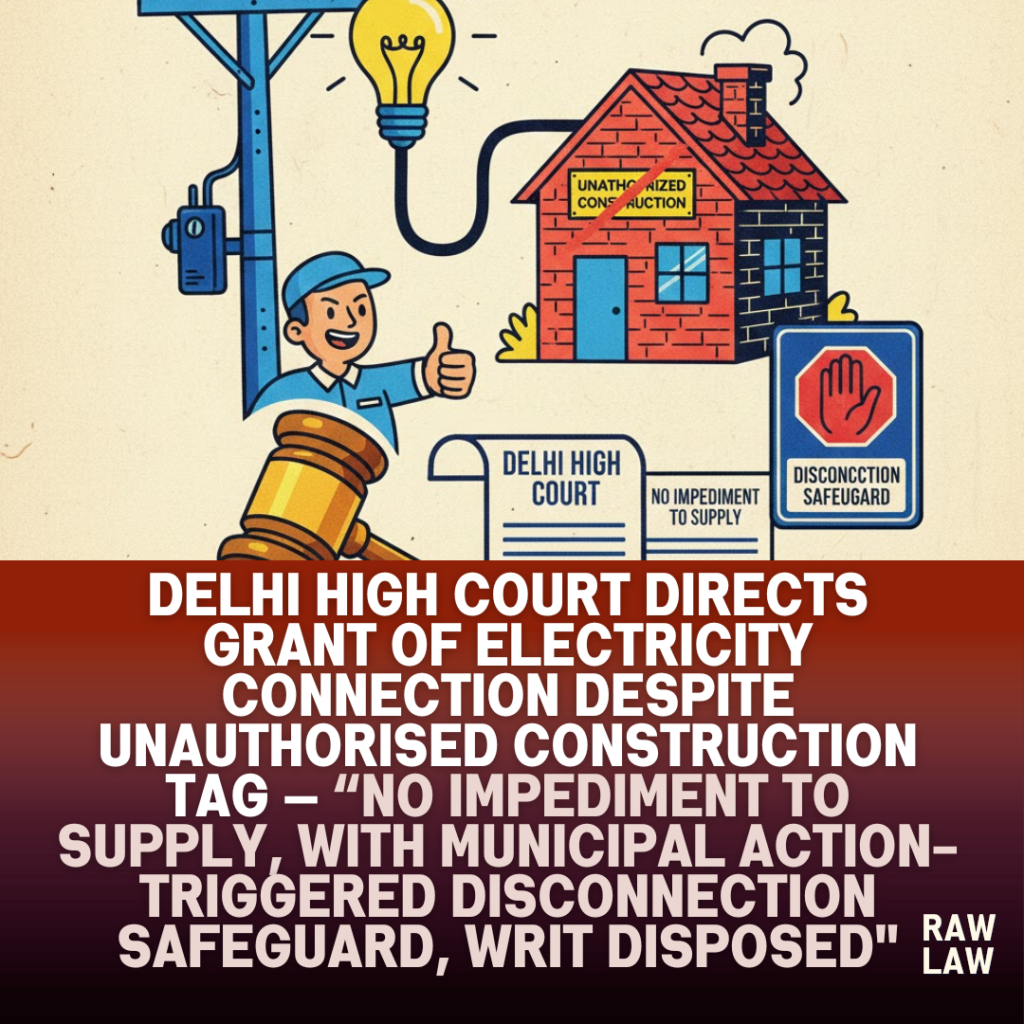
The Delhi High Court disposed of a writ petition seeking an electricity connection for a residential property in Central Delhi by directing the petitioner to submit a fresh application within one week and requiring the distribution company to grant the connection expeditiously—preferably within four weeks of receiving the application—once codal and commercial formalities are completed. The Court relied on its recent “practice directions” clarifying that a municipal corporation’s booking of a property for unauthorised construction does not, by itself, bar grant or continuance of electricity supply; the distribution company may disconnect only when municipal sealing/demolition action is actually undertaken and the municipal corporation intimates the electricity company accordingly.
2. Facts
The petitioner approached the High Court seeking directions to the concerned distribution company to provide an electricity connection at a specified third-floor premises in Baljeet Nagar, Central Delhi. The petitioner’s counsel drew attention to an earlier High Court judgment dated 13 November 2025, contending that a “no objection certificate” from the Municipal Corporation of Delhi is not required even if the premises involves unauthorised construction. On notice, the distribution company stated it had no objection to granting a fresh connection, provided the petitioner applies afresh and fulfils codal and commercial requirements. The distribution company also indicated the petitioner’s previous application stood cancelled due to lapse of time.
3. Issues
Two practical legal issues framed the dispute. First, whether a distribution company can insist on a municipal “no objection certificate” as a pre-condition to provide an electricity connection where the property is alleged to be unauthorised or booked for unauthorised construction. Second, what operational mechanism should apply to balance electricity access for an occupied premises with the municipal corporation’s statutory power to act against unauthorised construction—so that electricity supply does not become an incentive for illegality, yet denial does not drive unsafe, illegal electricity usage. The Court addressed these questions through its prior practice directions and a case-specific timeline for compliance.
4. Petitioner’s arguments
The petitioner argued that she was entitled to an electricity connection and that the distribution company could not refuse supply merely because there may be unauthorised construction. Emphasising the High Court’s judgment dated 13 November 2025 in connected writ matters, the petitioner submitted that there is no requirement of obtaining a municipal no objection certificate from the Municipal Corporation of Delhi in such situations. On that foundation, the petitioner sought a direction compelling the distribution company to provide the electricity connection without being stalled by municipal objections tied to the property’s construction status.
5. Respondent’s arguments
The distribution company indicated that it had no objection to supplying electricity, but insisted that the petitioner must submit a fresh application and comply with all codal and commercial formalities. It also pointed out that the earlier application had already been cancelled on account of lapse of time, implying that the administrative process had to restart. Other respondents, including municipal and regulatory authorities, were represented; however, the operative position reflected in the order is that the matter could be resolved by applying the earlier practice directions and ensuring procedural compliance for a fresh connection, coupled with safeguards for disconnection when municipal coercive action is taken.
6. Analysis of the law
Electricity supply disputes often sit at the intersection of essential services and municipal regulation of building norms. Courts have repeatedly treated electricity as a basic requirement for safe habitation, while also recognising that granting utilities should not dilute municipal enforcement against unauthorised construction. The legal tension typically arises when distribution companies adopt policies requiring municipal clearances or no objection certificates, and residents contend such requirements are extra-statutory or disproportionate. In this decision, the High Court’s legal approach is anchored in a structured “practice direction” model: allow electricity connection to occupied premises even if booked for unauthorised construction, but ensure that disconnection is coordinated with municipal action—sealing or demolition—so that enforcement remains effective.
7. Precedent analysis
The Court expressly relied on its own judgment dated 13 November 2025 passed in earlier connected writ proceedings, extracting key paragraphs that operate as “practice directions” for future cases. Those directions recognise two realities: (i) denial of electricity to occupied premises can encourage unauthorised use of electricity and electricity theft; and (ii) illegal hooking and unsafe wiring can create serious safety risks. The precedent therefore held there is “no impediment” to granting or continuing electricity in premises booked for unauthorised construction, but required the municipal corporation to intimate the electricity company at the time of coercive action, permitting disconnection then. The present case applied that framework to resolve the petitioner’s request by directing a fresh application and time-bound supply.
8. Court’s reasoning
The High Court recorded that the distribution company did not oppose grant of a fresh electricity connection, subject to a fresh application and completion of codal and commercial formalities, because the previous application had lapsed. The Court then expressly “took note” of the 13 November 2025 practice directions, underlining that lack of electricity in occupied premises can lead to theft and unsafe conditions and that electricity supply should not be blocked solely because a property is booked for unauthorised construction. Using this framework, the Court crafted a practical order: the petitioner must apply within a week; comply with formalities; and on compliance, the distribution company must grant connection expeditiously, preferably within four weeks. The Court further protected the distribution company by permitting action if dues are not paid.
9. Conclusion
The writ petition was disposed of with targeted directions that operationalise the High Court’s broader practice directions on electricity supply in allegedly unauthorised constructions. The petitioner was required to file a fresh application promptly, while the distribution company was required to process and provide the connection within a defined timeline after completion of formalities. The order reaffirmed that municipal “booking” of unauthorised construction is not, by itself, a ground to deny electricity, and that the appropriate enforcement point for disconnection is when the municipal corporation undertakes sealing or demolition, supported by intimation to the distribution company.
10. Implications
This decision is important for residents and landlords in Delhi facing denial of electricity connection due to “unauthorised construction” objections. It strengthens the principle that electricity connection cannot be withheld merely because the premises is booked for building violations and that insisting on a municipal no objection certificate may not be justified in such cases. For distribution companies, it offers a workable compliance model—grant the connection after codal and commercial checks, but retain the ability to disconnect when the municipal corporation undertakes sealing or demolition and communicates the action. For municipal authorities, it reinforces a coordination duty: if coercive action is initiated, timely intimation enables lawful disconnection aligned with enforcement.
Case law references
Delhi High Court judgment dated 13 November 2025 (practice directions in connected writ matters)
- What it held: Electricity connections may be granted or continued even where properties are booked for unauthorised construction; denial can fuel electricity theft and safety hazards. Disconnection should occur when municipal sealing/demolition action is undertaken and the municipal corporation intimates the electricity company.
- How applied here: The Court used these directions to conclude there was no impediment to grant of supply, and therefore directed the petitioner to apply afresh and mandated time-bound grant of connection upon compliance with formalities.
FAQs
1) Can an electricity connection be denied in Delhi because a property is booked for unauthorised construction?
This order reiterates that mere booking for unauthorised construction is not, by itself, an impediment to grant or continuation of electricity supply, subject to completion of codal and commercial formalities.
2) Is a Municipal Corporation of Delhi no objection certificate required for a new electricity connection in such cases?
The petitioner relied on the High Court’s practice directions indicating that a no objection certificate is not required solely on the ground of unauthorised construction booking, and the Court proceeded on that basis while directing processing of a fresh application.
3) When can the distribution company disconnect electricity in an unauthorised construction scenario?
The practice directions indicate disconnection can be undertaken when the municipal corporation takes sealing/demolition action and intimates the electricity company, enabling coordinated enforcement.