


1. Court’s decision
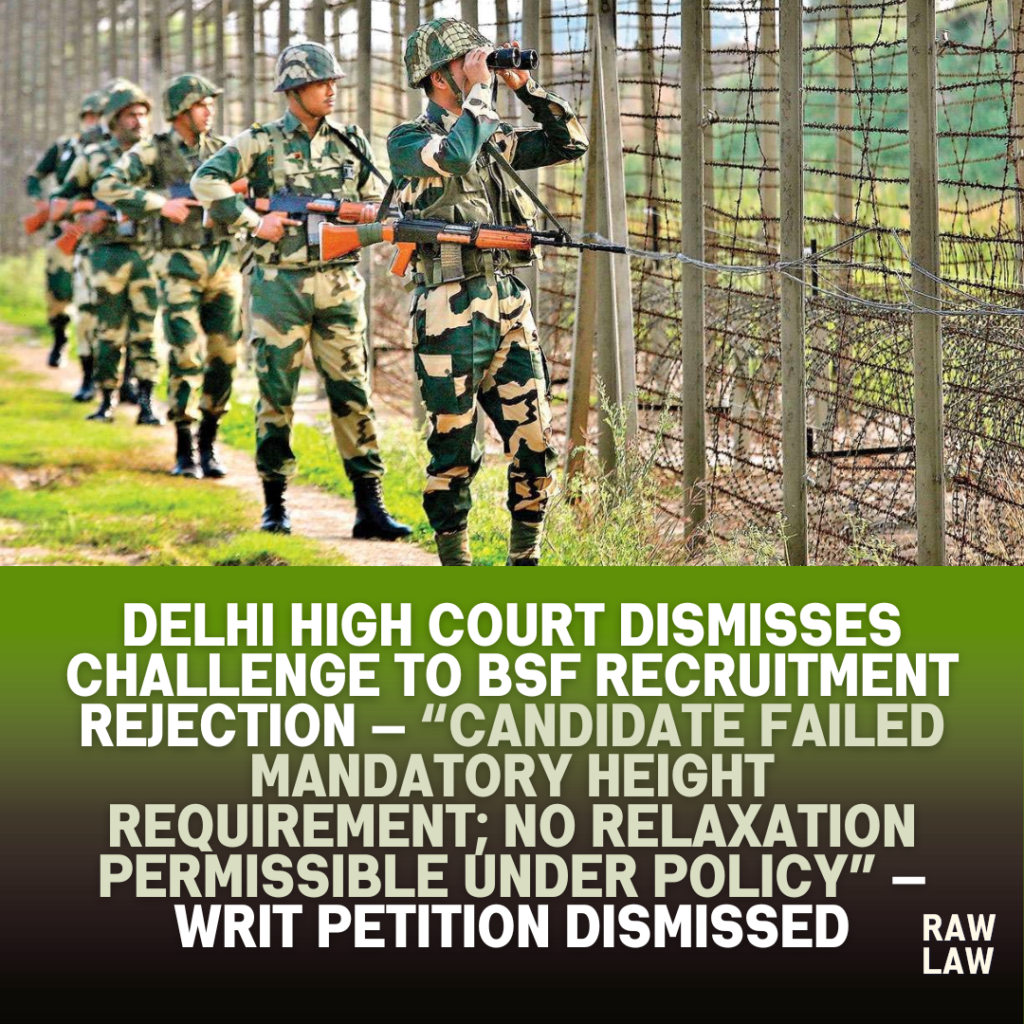
The Delhi High Court dismissed a writ petition filed by a candidate who had challenged his rejection from recruitment to the Border Security Force after failing to meet the minimum height requirement of 165 cm prescribed for the post of Constable (GD) under the CAPF recruitment rules. The Court held that height standards are rigid, non-negotiable criteria directly tied to operational readiness and cannot be relaxed unless expressly provided by statute or recruitment policy. Because the petitioner measured 163.5 cm, the rejection was held lawful. The Court found no procedural irregularity and ruled that no vested right to appointment arises unless the candidate satisfies all eligibility norms.
2. Facts
The petitioner participated in the 2021–22 CAPF recruitment cycle for the post of Constable (GD). He cleared the written examination and appeared for the Physical Standard Test (PST). During height measurement, recruitment officials recorded his height as 163.5 cm, falling short of the mandatory 165 cm standard prescribed for the General category.
The petitioner requested re-measurement, claiming that the initial measurement was erroneous and that his actual height was 165 cm. The authorities declined, citing adherence to PST/screening protocols. The results were subsequently published, reflecting his rejection on the basis of height. He approached the High Court seeking quashing of the rejection, direction for re-measurement, and permission to continue in the recruitment process. The respondents defended the measurement and the PST procedure.
3. Issues
- Whether the rejection on the ground of insufficient height complied with the CAPF recruitment rules.
- Whether the petitioner’s request for a second height measurement warranted mandatory consideration.
- Whether recruitment authorities acted arbitrarily or failed to follow prescribed PST procedures.
- Whether the Court could direct relaxation of mandatory physical standards in exercise of writ jurisdiction.
- Whether any enforceable right to appointment existed despite failure to meet a qualifying physical standard.
4. Petitioner’s arguments
The petitioner argued that his rejection was arbitrary because the measurement process was flawed. He asserted that his height was, in reality, 165 cm, and that he was entitled to a re-measurement under principles of fair recruitment. He contended that minor variations in measurement could occur due to human error or faulty equipment, and therefore denying re-measurement violated fairness.
He further submitted that height standards must be applied with reasonable flexibility, particularly when the deviation is minimal. According to him, disqualification for being 1.5 cm short unfairly deprived him of employment despite clearing other stages. He sought a direction permitting reevaluation of his height under Court supervision.
5. Respondents’ arguments
The BSF and Union of India contended that recruitment standards are fixed and publicly notified. The minimum height requirement of 165 cm is prescribed under the CAPF rules, leaving no scope for relaxation in the petitioner’s category.
They argued that PSTs are conducted by trained personnel using certified equipment, and that height measurements are taken with precision. Once recorded, PST results cannot be reopened on individual request, as doing so would jeopardise uniformity and fairness. The respondents emphasised that the petitioner was given the same opportunity as all candidates, and because he fell short of the mandated measurement, the rejection was valid. No right to appointment accrued to him.
6. Analysis of the law
The Court reiterated that in recruitment to uniformed forces, physical standards are integral to the selection process, not mere guidelines. The Supreme Court has consistently held that height, chest measurement, vision, and other PST parameters are essential eligibility conditions directly linked to operational performance, discipline, and force uniformity.
The Court explained that writ jurisdiction cannot be invoked to override express statutory or policy-based recruitment norms. Mandating re-measurement for one candidate would encourage similar claims, undermining the integrity of PST procedures. Moreover, courts avoid interfering in technical assessments unless clear mala fides or procedural violations are shown. In this case, the petitioner produced no evidence demonstrating irregularity or deviation from PST protocols.
Further, recruitment jurisprudence recognises that no vested right exists until the candidate clears all qualifying stages. Failure to satisfy even one mandatory standard—however marginal—bars continuation in the selection process.
7. Precedent analysis
Although the judgment does not cite individual authorities, it implicitly applies long-standing principles from apex court precedents:
1. Physical standards as eligibility criteria
Courts uphold strict compliance with prescribed standards for forces such as CAPF, BSF, CISF, and police organisations.
2. Limited judicial interference
Recruitment processes involving measurement-based and fitness-based assessments are technical in nature. Courts do not substitute their assessment for that of specialised recruitment bodies.
3. Equality in competitive selection
Relaxation of criteria for one candidate would create inequality and violate Articles 14 and 16, unless such relaxation is authorised by law or policy.
4. No right to appointment
Clearing earlier stages creates only a legitimate expectation—not an enforceable right—especially when the candidate fails a mandatory qualifying test.
These principles directly informed the High Court’s conclusion.
8. Court’s reasoning
The Court held that the petitioner’s height of 163.5 cm was a factual finding recorded by the PST board. Without evidence of mala fides or procedural irregularities, the Court could not reopen or override that finding.
The minimum requirement of 165 cm is non-negotiable. The Court emphasised that even a shortfall of 1 mm would legally justify disqualification because eligibility standards must be uniformly applied.
The argument for re-measurement was rejected because the recruitment rules did not authorise such a procedure upon individual request, and the Court declined to create exceptions judicially.
Accordingly, the Court found that the rejection was lawful, non-arbitrary, and fully consistent with recruitment rules. As the petitioner lacked the basic physical qualification, the writ petition was held meritless and dismissed.
9. Conclusion
The High Court upheld the BSF’s decision to reject the petitioner’s candidature for failing to meet the height requirement. The Court refused to order re-measurement or grant relaxation, reiterating that recruitment criteria for uniformed services must be applied with precision and uniformity. The writ petition and all pending applications were dismissed.
10. Implications
This judgment strengthens the legal position that:
• Physical standards in CAPF/BSF recruitment are absolute and cannot be diluted through litigation.
• Courts will not order re-tests unless clear malice or procedural breach is shown.
• Candidates cannot rely on marginal shortfalls to claim relaxation absent express statutory provision.
• Uniformity of standards outweighs individual hardship in defence and paramilitary recruitment.
Recruitment authorities may cite this ruling to resist re-measurement or relaxation requests based on minimal deviations from PST norms.
CASE LAW REFERENCES
1. Strict interpretation of recruitment norms
Physical standards are mandatory eligibility conditions.
2. Non-interference in technical assessments
Courts avoid re-evaluating measurements or fitness assessments.
3. No vested right to appointment
Failure in a qualifying stage extinguishes any claim to further process.
FAQs
1. Can courts relax height requirements in BSF/CAPF recruitment?
No. Physical standards are rigid eligibility conditions and cannot be relaxed unless expressly authorised by statute or policy.
2. Can a candidate demand re-measurement of height during PST?
Not ordinarily. Re-measurement is only allowed if the recruitment policy permits it or procedural irregularity is shown.
3. Does clearing written exams give a right to appointment?
No. A candidate acquires no enforceable right unless all mandatory stages, including physical standards, are satisfied.