


Court’s decision
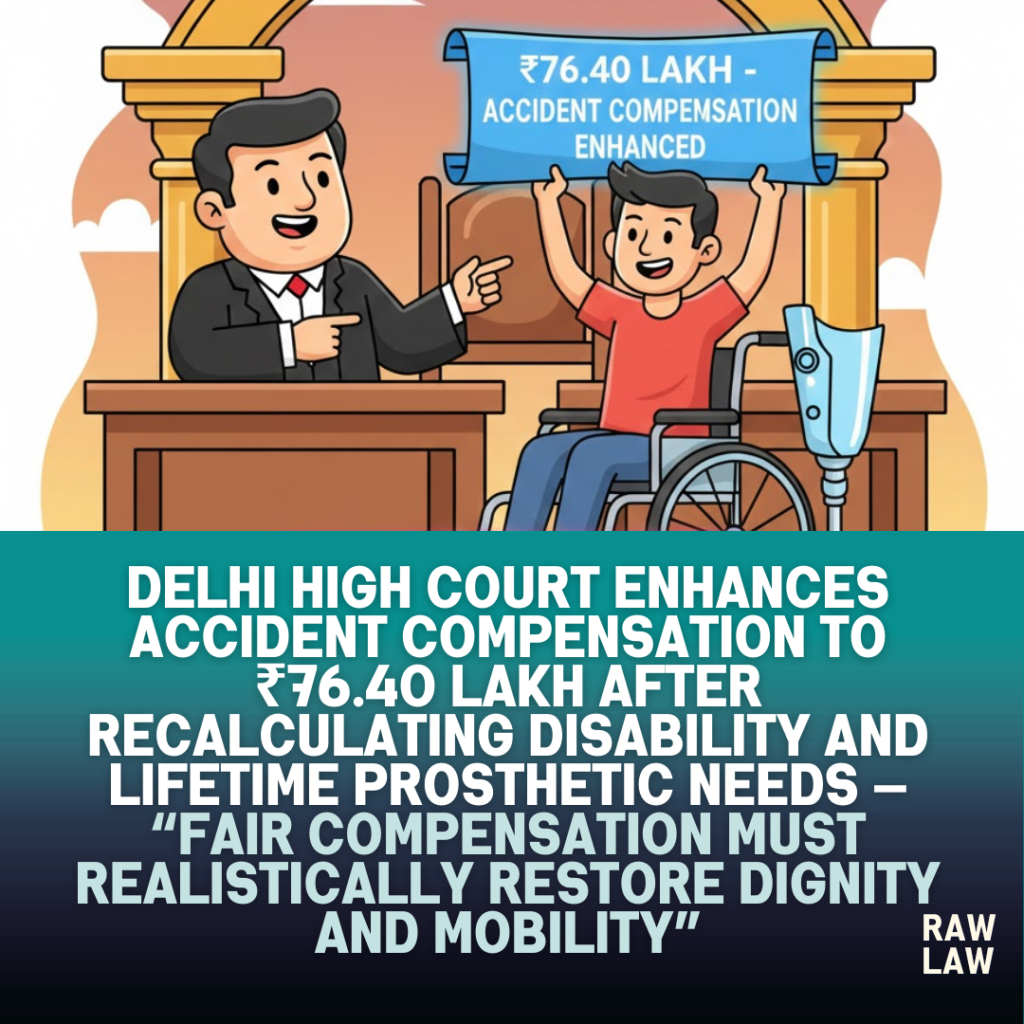
The Delhi High Court partly allowed cross-appeals filed by an insurance company and an injured claimant, modifying a Motor Accident Claims Tribunal award and enhancing the total compensation from ₹69.03 lakh to ₹76.40 lakh. While correcting errors in income assessment, functional disability, and future prospects, the Court substantially increased compensation by factoring in the cost of multiple prosthetic limb replacements and their maintenance over the claimant’s lifetime. The Court held that compensation under the Motor Vehicles Act must be realistic and restorative, not merely arithmetical.
Facts
The proceedings arose out of a road traffic accident that occurred on 20 December 2008 near Gupta Market Bus Stand, Lajpat Nagar, Delhi. The claimant was riding a motorcycle with a pillion rider when a truck struck them due to rash and negligent driving. Both riders suffered grievous injuries, and the claimant’s right leg was crushed under the truck’s wheel.
An FIR was registered against the truck driver under Sections 279 and 338 of the Indian Penal Code, and a charge sheet followed. The claimant underwent prolonged treatment between December 2008 and July 2011 at multiple hospitals, including AIIMS Trauma Centre, Vimhans Hospital, Metro Hospital, and Apollo Hospital. Despite several surgeries, the claimant’s condition deteriorated, ultimately resulting in amputation of the right leg above the knee.
The Motor Accident Claims Tribunal awarded ₹69,03,713 with interest at 9% per annum under various heads, including medical expenses, pain and suffering, loss of future income, and attendant charges. Both the insurer and the claimant challenged the award—one alleging over-compensation and the other seeking enhancement.
Issues
The High Court was required to determine whether the Tribunal had correctly assessed the claimant’s income, loss of income during treatment, functional disability, and future prospects. A critical issue was whether compensation for an artificial limb should account only for a single prosthesis or for multiple replacements over the claimant’s lifetime. The Court also examined whether mathematical and legal errors in the Tribunal’s computation warranted modification of the award.
Insurance company’s arguments
The insurer argued that the Tribunal had relied on an income tax return that was not formally exhibited and should have assessed income on the basis of minimum wages. It was further contended that physical disability of 80% in one limb could not automatically translate into 80% functional disability or loss of earning capacity, particularly as the claimant was self-employed as an electrical contractor and not engaged in manual labour.
The insurer also challenged the addition of 50% future prospects, submitting that under settled law, self-employed persons were entitled only to a 40% addition. It was urged that the Tribunal’s computation of loss of future income was excessive and contrary to binding precedent.
Claimant’s arguments
The claimant contended that the Tribunal had under-compensated him. He argued that although the Tribunal acknowledged the cost of an artificial limb, it failed to include that amount in the final computation. More importantly, the claimant emphasized that a prosthetic limb has a limited lifespan of around five years and requires periodic replacement and maintenance.
It was submitted that compensation must cover the cost of multiple prosthetic limbs over the claimant’s lifetime, along with maintenance expenses, to truly restore mobility and dignity. The claimant also sought enhancement of compensation for loss of income during the extended treatment period, which spanned nearly 31 months.
Analysis of the law
The Court reiterated that proceedings under the Motor Vehicles Act are governed by principles of summary justice and preponderance of probabilities, not strict rules of evidence. Income tax returns, even if marked for identification, could be relied upon where their authenticity was not seriously disputed.
On disability, the Court applied the three-step test laid down by the Supreme Court for assessing functional disability, distinguishing between physical impairment and actual loss of earning capacity. The Court also reaffirmed that future prospects for self-employed persons must be assessed in accordance with Constitution Bench jurisprudence.
Precedent analysis
The Court relied on Raj Kumar v. Ajay Kumar to reassess functional disability, emphasizing that physical disability percentages cannot be mechanically equated with loss of earning capacity. It applied National Insurance Co. Ltd. v. Pranay Sethi to correct the Tribunal’s error in adding 50% future prospects instead of 40%.
On prosthetic limb compensation, the Court followed Mohd. Sabeer v. Regional Manager, UPSRTC and Oriental Insurance Co. Ltd. v. Master Anshu Kumar, holding that compensation must include the cost of multiple prosthetic limbs and maintenance up to the age of 70.
Court’s reasoning
The Court recalculated the claimant’s net annual income after accounting for tax liability and enhanced compensation for loss of income during treatment from ₹1 lakh to over ₹6 lakh, noting the prolonged period of hospitalisation and surgeries.
Functional disability was reduced from 80% to 60%, as the claimant, though amputated, retained some capacity to manage his electrical contracting business. Future prospects were corrected from 50% to 40% in line with binding precedent.
The most significant enhancement related to prosthetic limbs. Based on medical evidence that a prosthetic limb lasts about five years, the Court awarded compensation for seven prosthetic limbs over the claimant’s lifetime, along with ₹5 lakh towards maintenance. The Court noted that although future costs may rise, lump-sum payment upfront balances such uncertainties.
Conclusion
The Delhi High Court modified the Tribunal’s award and enhanced total compensation to ₹76,40,402 with interest at 9% per annum. The insurer was directed to deposit the enhanced amount within eight weeks. While correcting over-assessments under certain heads, the Court ensured that long-term rehabilitation needs—especially prosthetic limb replacement—were fully addressed.
Implications
This judgment reinforces a victim-centric approach to motor accident compensation. It clarifies that courts must adopt a life-cycle perspective in cases of permanent disability, particularly where assistive devices like prosthetic limbs are required. The ruling will guide tribunals to factor in future replacement and maintenance costs, ensuring that compensation genuinely restores dignity, mobility, and economic security to accident victims.
Case law references
- Raj Kumar v. Ajay Kumar
Held: Functional disability must reflect actual loss of earning capacity.
Applied: Used to reassess disability at 60%. - National Insurance Co. Ltd. v. Pranay Sethi
Held: Future prospects for self-employed persons capped at 40%.
Applied: Corrected Tribunal’s computation. - Mohd. Sabeer v. Regional Manager, UPSRTC
Held: Compensation must include cost of multiple prosthetic limbs over lifetime.
Applied: Basis for major enhancement.
FAQs
Q1. Can courts award compensation for multiple prosthetic limbs in accident cases?
Yes. Courts now recognise that prosthetic limbs have a limited lifespan and award compensation for multiple replacements and maintenance.
Q2. Is physical disability the same as functional disability?
No. Functional disability depends on the claimant’s profession and actual loss of earning capacity.
Q3. What future prospects apply to self-employed accident victims?
As per Supreme Court law, a 40% addition applies where the claimant is below 40 years of age.