


Court’s decision
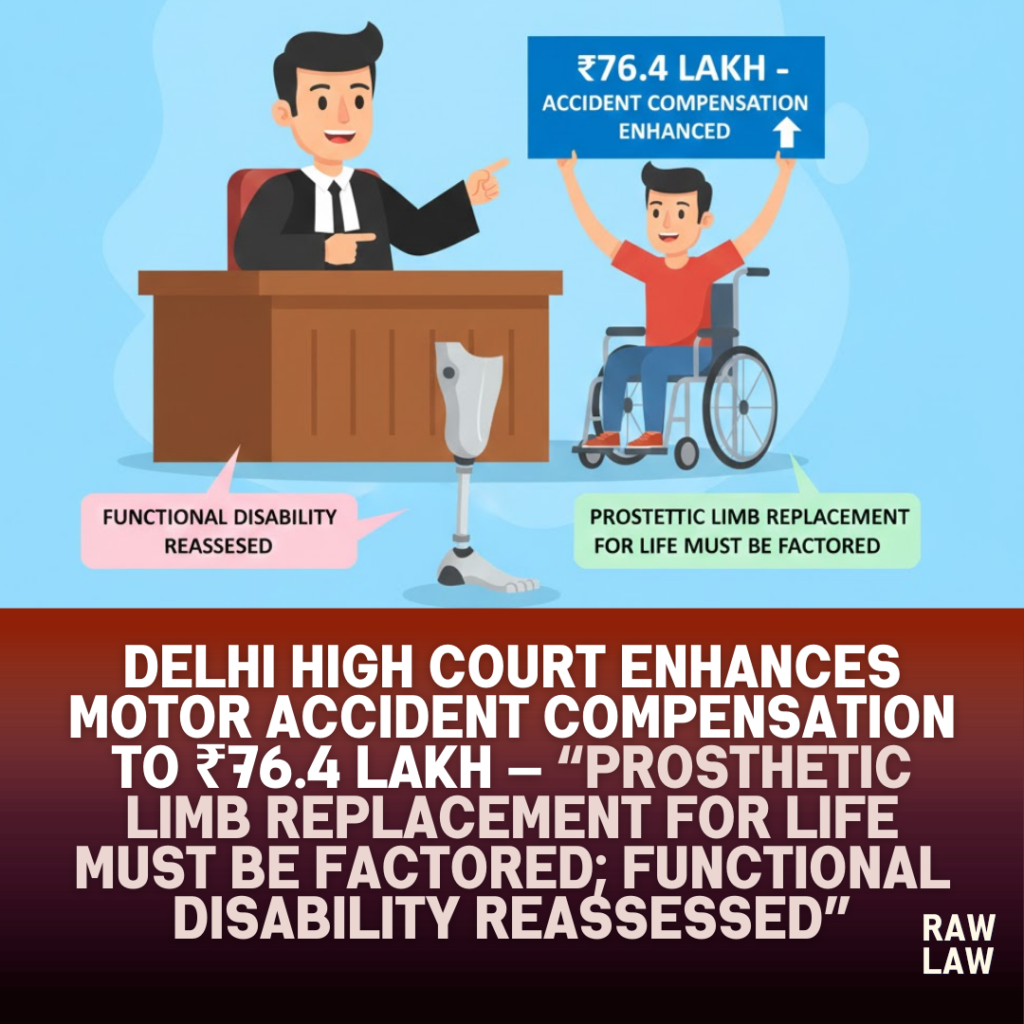
The Delhi High Court partly allowed cross-appeals filed by an insurance company and an injured claimant, enhancing compensation awarded in a motor accident case from ₹69.03 lakh to ₹76.40 lakh. While correcting errors in computation of income, future prospects, and functional disability, the Court significantly increased compensation by awarding costs for multiple prosthetic limb replacements and their maintenance over the claimant’s lifetime. The Court held that fair compensation under the Motor Vehicles Act must realistically restore the injured person, as far as money can, to the position he would have occupied but for the accident.
Facts
The case arose from a road traffic accident that occurred in December 2008 near Lajpat Nagar, Delhi. The claimant was riding a motorcycle when it was hit by a truck being driven rashly and negligently. As a result of the collision, the claimant sustained grievous injuries, including crushing injuries to the right leg, which ultimately led to amputation of the right lower limb above the knee.
An FIR was registered against the truck driver, and a charge-sheet followed. The claimant underwent prolonged medical treatment over nearly three years across multiple hospitals, including trauma care, repeated surgeries, and eventual amputation. Disability certificates issued by government hospitals assessed permanent physical disability of the right lower limb at 80% to 87%.
The Motor Accident Claims Tribunal awarded compensation of ₹69,03,713 with interest, under various heads including medical expenses, pain and suffering, loss of future income, loss of amenities, and attendant charges. Both the insurance company and the claimant challenged the award—one alleging excess compensation and the other seeking enhancement.
Issues
The High Court was called upon to determine whether the Tribunal had correctly assessed:
(i) the claimant’s income at the time of the accident;
(ii) loss of income during treatment;
(iii) functional disability and loss of future earning capacity;
(iv) future prospects for a self-employed claimant; and
(v) compensation for prosthetic limb, including future replacements and maintenance.
The Court also examined whether the Tribunal had committed mathematical or legal errors warranting modification of the award.
Insurance company’s arguments
The insurer contended that the Tribunal had grossly overestimated the claimant’s income and loss of earning capacity. It argued that the income tax return relied upon by the Tribunal was not formally proved and should not have been acted upon. According to the insurer, income should have been assessed on the basis of minimum wages.
The insurer further submitted that disability of 80% in one limb could not automatically translate into 80% functional disability. Relying on Supreme Court jurisprudence, it argued that the claimant, being a self-employed contractor and not a manual labourer, retained some earning capacity. The insurer also challenged the application of 50% future prospects, contending that the correct figure for a self-employed person was 40%.
Claimant’s arguments
The claimant argued that the Tribunal had, in fact, under-compensated him. He submitted that the award failed to account for the long duration of treatment during which he was unable to earn, despite clear evidence of hospitalisation and multiple surgeries.
Most importantly, the claimant highlighted that although the Tribunal acknowledged the cost of an artificial limb, it failed to include that amount in the final computation. He further contended that a prosthetic limb has a limited lifespan and requires periodic replacement and maintenance, and therefore compensation should cover multiple prosthetic limbs over his lifetime, not merely one.
Analysis of the law
The Court reiterated that proceedings before the Motor Accident Claims Tribunal are governed by principles of summary justice and preponderance of probabilities, not strict rules of evidence. It held that income tax returns, even if marked for identification and not formally exhibited, could be relied upon where their authenticity was not disputed in cross-examination.
On disability assessment, the Court applied the three-step test laid down by the Supreme Court for determining functional disability, distinguishing between physical disability and actual loss of earning capacity. The Court also reaffirmed that future prospects for self-employed persons must be assessed in line with Constitution Bench jurisprudence, which prescribes a 40% addition where the injured is below 40 years of age.
Precedent analysis
The Court relied extensively on Raj Kumar v. Ajay Kumar, which laid down the methodology for assessing functional disability and loss of future earnings. It also applied the principles from National Insurance Co. Ltd. v. Pranay Sethi to correct the Tribunal’s error in applying 50% future prospects.
On prosthetic limbs, the Court followed Mohd. Sabeer v. Regional Manager, UPSRTC and Oriental Insurance Co. Ltd. v. Master Anshu Kumar, holding that compensation must account for repeated replacement of artificial limbs over the injured person’s lifetime, ordinarily up to the age of 70 years.
Court’s reasoning
The Court held that the claimant’s net annual income should be assessed after deducting tax liability, and accordingly recalculated income. It enhanced loss of income during treatment from ₹1 lakh to over ₹6 lakh, noting that the claimant remained under treatment for nearly 31 months.
On functional disability, the Court reduced the Tribunal’s assessment from 80% to 60%, holding that while the claimant suffered permanent amputation, he retained some capacity to manage his electrical contracting business. Future prospects were corrected from 50% to 40%.
The most substantial enhancement came from prosthetic limb compensation. Based on medical evidence that a prosthetic limb lasts about five years, the Court awarded costs for seven prosthetic limbs over the claimant’s lifetime, along with maintenance expenses. This resulted in a major upward revision of the award.
Conclusion
The Delhi High Court modified the Tribunal’s award, enhancing total compensation to ₹76,40,402 with interest at 9% per annum. While correcting over-assessments under certain heads, the Court ensured that long-term rehabilitation needs—particularly prosthetic limb replacement—were fully addressed. The insurer was directed to deposit the enhanced amount within eight weeks.
Implications
This judgment is a significant reaffirmation of victim-centric compensation in motor accident cases. It underscores that courts must adopt a realistic, life-cycle approach while awarding damages, especially in cases involving permanent disability and assistive devices. The ruling will guide tribunals across India to factor in future replacement and maintenance of prosthetics, ensuring that compensation truly serves its restorative purpose.
Case law references
- Raj Kumar v. Ajay Kumar
Held: Functional disability must be assessed based on actual loss of earning capacity.
Applied: Used to reassess disability at 60%. - National Insurance Co. Ltd. v. Pranay Sethi
Held: Future prospects for self-employed persons capped at 40%.
Applied: Corrected Tribunal’s error of 50%. - Mohd. Sabeer v. Regional Manager, UPSRTC
Held: Cost of prosthetic limb replacement over lifetime must be compensated.
Applied: Basis for awarding multiple prosthetic limbs.
FAQs
Q1. Can compensation include future replacement of prosthetic limbs?
Yes. Courts now recognise that prosthetic limbs have a limited lifespan and award compensation for multiple replacements over the victim’s lifetime.
Q2. Is disability percentage the same as loss of earning capacity?
No. Courts assess functional disability based on the claimant’s profession and actual impact on earning capacity.
Q3. What future prospects apply to self-employed accident victims?
As per Supreme Court law, a 40% addition applies where the claimant is below 40 years of age.