


Court’s decision
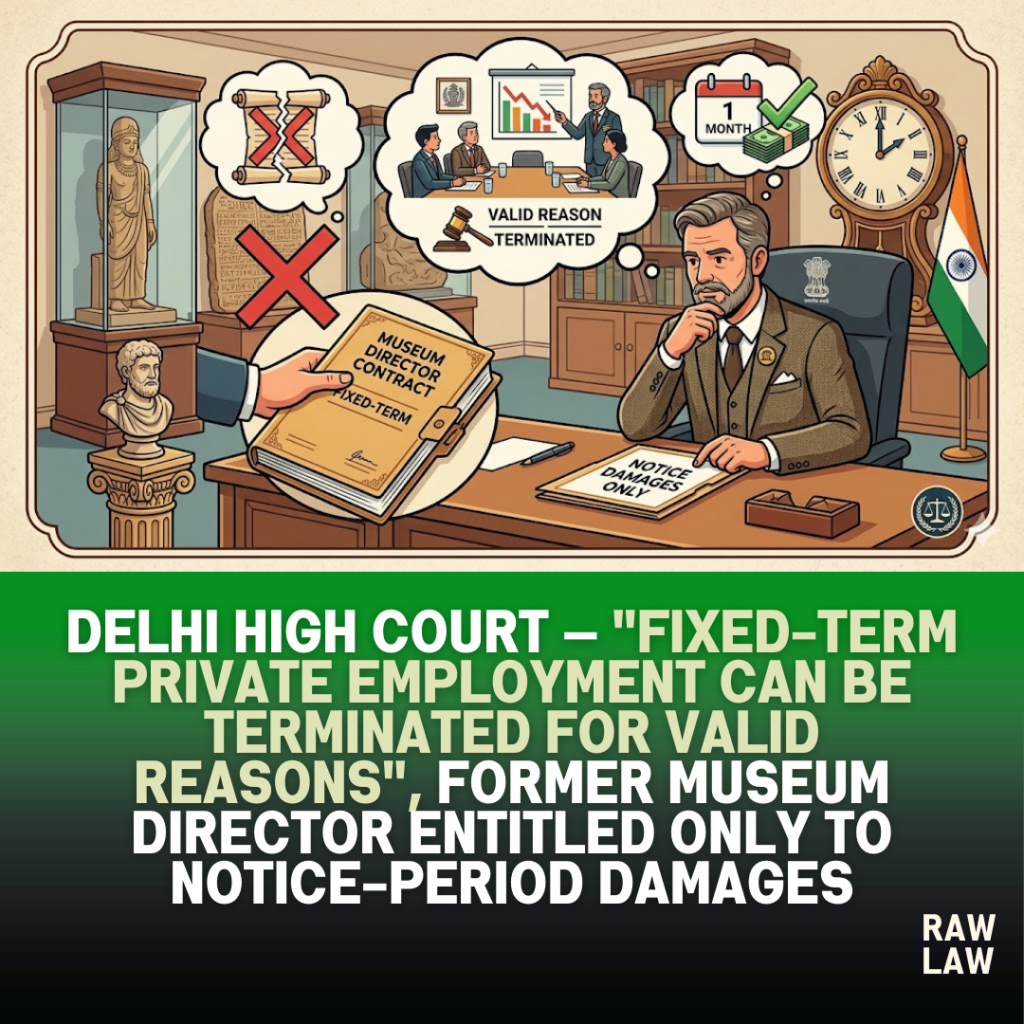
The Delhi High Court affirmed the judgment of the Additional District Judge which had partly decreed the appellant’s suit for damages but rejected her claim that the termination of her employment was illegal.
The Court concluded that the engagement between the parties was private contractual employment, governed by the rules of the registered society that operated the National Gandhi Museum.
Since those rules permitted termination by giving three months’ notice, the trial court correctly limited compensation to the salary equivalent of the notice period. The High Court therefore dismissed the appeal and upheld the decree of ₹90,000 with interest.
Facts
The appellant was appointed in September 2010 as Director of the National Gandhi Museum and ex-officio Member Secretary of the Gandhi Smarak Sangrahalaya Samiti.
The appointment was for a fixed term of five years with an honorarium of ₹30,000 per month.
The appellant served in the role from September 2010 until January 2013. In January 2013, she was diagnosed with a brain tumour and underwent emergency surgery.
Due to medical complications following surgery, she applied for three months’ medical leave from February to April 2013, which was approved with payment of 50% honorarium.
Later, she requested additional medical leave from May to July 2013, which was granted without honorarium.
Subsequently, the appellant sought further extension of leave from August to October 2013. However, the governing body of the museum declined the request and decided to relieve her from her position.
Accordingly, the Chairman issued a termination letter on 1 August 2013.
The appellant then filed a civil suit seeking:
- Declaration that the termination was illegal
- Compensation and damages of ₹12,50,000
Issues
The Delhi High Court examined the following questions:
- Whether the termination of a fixed-term employment contract before completion of the term was illegal.
- Whether the appellant was entitled to compensation for the remaining period of the five-year contract.
- Whether the trial court correctly limited damages to the notice-period salary.
- Whether prolonged medical leave justified termination of the contract.
Petitioner’s arguments
The appellant argued that her appointment as Director was for a fixed period of five years, and there was no clause allowing premature termination.
Therefore, the termination of her services in August 2013 was unlawful.
She contended that because her contract had not expired, she was entitled to damages for the entire remaining duration of the appointment.
The appellant also argued that her medical leave had already been extended by the Chairman until September 2013 and therefore the termination during this period was arbitrary.
Additionally, it was argued that her employment was a post-retirement engagement, meaning the usual principle of mitigation of loss should not apply when calculating damages.
Respondent’s arguments
The respondents argued that the museum is a registered society under the Societies Registration Act, not a statutory body, and therefore the appellant’s employment was governed strictly by contractual rules.
They submitted that under the applicable Service Rules, an employee could be terminated by giving three months’ notice.
The respondents also argued that the appellant had remained absent from duty for extended periods due to medical issues.
Since she held a senior administrative position, her prolonged absence adversely affected the functioning of the institution.
Therefore, the governing body had valid reasons to terminate the engagement.
Analysis of the law
The Court analysed the legal framework governing private contractual employment.
Since the museum was a registered society rather than a statutory authority, constitutional protections such as Article 311 did not apply.
Instead, the relationship between the parties was governed by:
- The appointment terms
- The society’s rules and regulations
- Applicable service rules
The Court noted that under Rule X(2) of the Service Rules, employment could be terminated by giving three months’ notice.
Therefore, even if the termination was wrongful, the remedy would ordinarily be damages equivalent to the notice period, rather than reinstatement or compensation for the entire contractual period.
Precedent analysis
The Court relied on the Delhi High Court decision in Shriram Pistons and Rings Ltd. v. T.S. Mokha, which held that even if an employer wrongfully repudiates a contract of employment, damages are generally limited to the salary payable during the notice period.
The Court also examined India International Centre v. S.N. Pandit, which clarified that fixed-term employment contracts may be terminated earlier if sufficient cause exists.
These precedents reinforced the principle that private employment disputes are governed by contractual remedies rather than public law protections.
Court’s reasoning
The Court noted that the appellant had remained on medical leave for several months and sought further extension beyond July 2013.
The governing body considered the issue and concluded that allowing indefinite leave was not feasible because the appellant was holding the position of Director, which required active administrative functioning.
The Court also observed that under the service rules, employees suffering from serious illness could receive a maximum of 90 days’ medical leave.
The appellant had already exceeded that limit.
Therefore, the respondents were justified in refusing further extension and terminating the engagement.
Even assuming that the termination was wrongful, the Court held that the appellant could claim only notice-period compensation, which had already been granted by the trial court.
Conclusion
The Delhi High Court concluded that the termination of the appellant’s employment did not warrant any further compensation beyond the notice-period damages already awarded.
Accordingly, the Court dismissed the appeal and upheld the trial court’s decree granting ₹90,000 with interest.
Implications
This judgment reiterates important principles governing private employment law.
The ruling clarifies that even fixed-term employment contracts may be terminated before expiry if valid reasons exist.
It also reinforces the well-established rule that in cases of wrongful termination in private employment, courts generally award notice-period damages rather than compensation for the entire contractual term.
For employers and employees alike, the decision highlights the importance of carefully drafted service rules and contractual termination clauses.
Case Law References
- Shriram Pistons and Rings Ltd. v. T.S. Mokha
Held that damages for wrongful termination of private employment are generally limited to notice-period salary. - India International Centre v. S.N. Pandit
Recognised that fixed-term employment contracts can be terminated early for sufficient cause.
FAQs
1. Can a fixed-term employment contract be terminated before its expiry?
Yes. Courts have held that fixed-term employment contracts may be terminated earlier if sufficient justification exists.
2. What damages are awarded for wrongful termination in private employment?
Generally, courts award compensation equivalent to the notice period rather than the salary for the entire remaining term of the contract.
3. Do constitutional protections apply to employees of private societies?
No. Employees of private bodies such as registered societies are governed primarily by contractual terms and service rules.