


Court’s decision
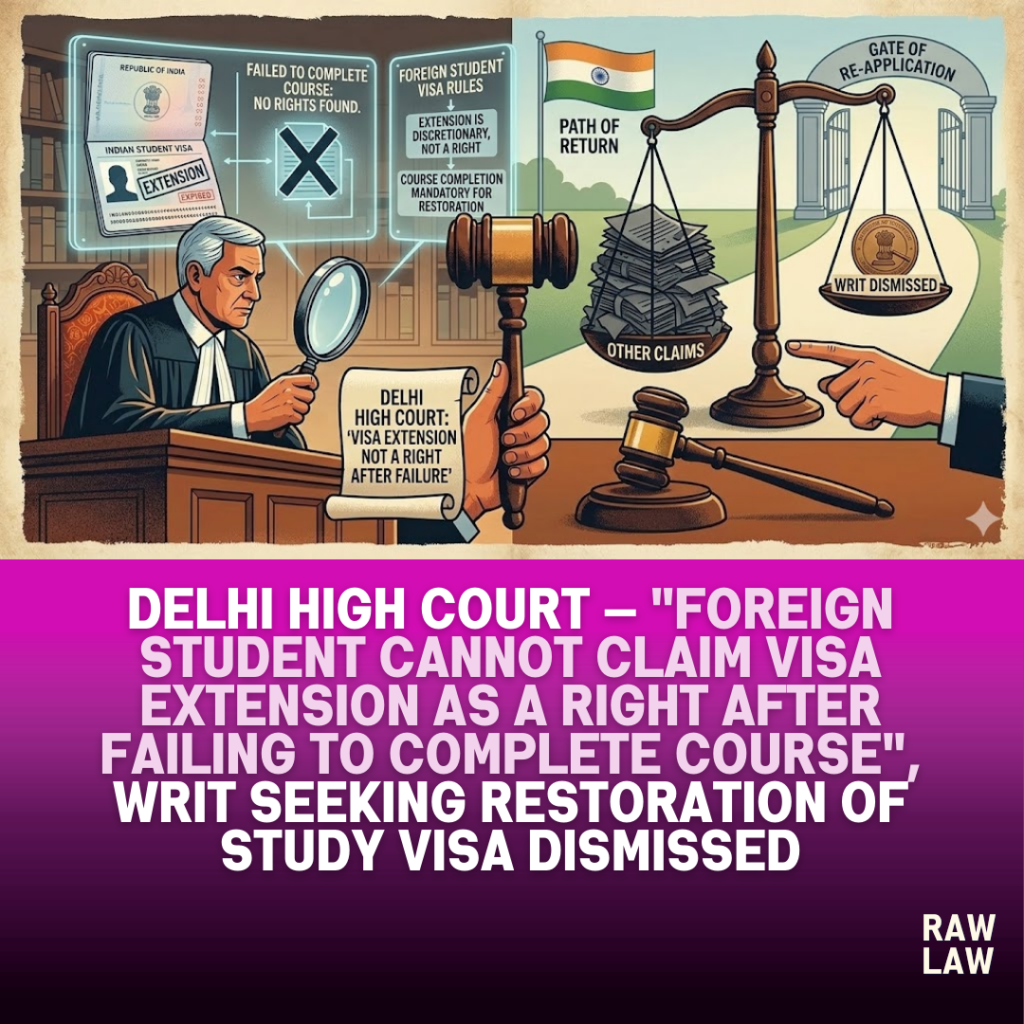
The Delhi High Court dismissed both the writ petition and the connected contempt petition filed by the foreign student. The Court concluded that the petitioner had failed to complete his degree programme despite being given multiple opportunities by the university.
The Court further noted that the petitioner’s student visa expired on 31 July 2022, after which he remained in India without a valid visa. Since extension of visa lies within the sovereign domain of the Central Government, the Court declined to issue any direction compelling authorities to grant a visa extension.
Consequently, the Court dismissed the petition and clarified that the authorities were free to proceed in accordance with law regarding deportation.
Facts
The petitioner, a Nigerian national, initially came to India in 2015 after securing admission to a B.Tech Computer Science programme at Apeejay Stya University under a scholarship.
However, after the death of his father—who financed his education—the petitioner was unable to continue his studies and obtained a no-objection certificate from the university allowing him to transfer to another institution.
Subsequently, the petitioner obtained provisional admission to a B.Sc. Information Technology programme at GD Goenka University. The admission required him to obtain a student visa in the name of the university.
When the Foreigners Regional Registration Office declined registration of the visa, the petitioner travelled back to Nigeria in 2017, obtained a fresh student visa, and returned to India in 2018.
According to the petitioner, the university later refused to provide necessary academic resources, delayed examination processes, and ultimately denied him the ability to complete his degree despite receiving substantial tuition fees.
The petitioner also claimed that the university refused to provide the bonafide student certificate required for visa extension, resulting in rejection of his visa extension applications by immigration authorities.
On this basis, the petitioner approached the Delhi High Court seeking restoration of his student visa, permission to resume studies, and compensation for financial losses.
Issues
The Court examined the following legal issues:
- Whether the writ petition was maintainable against a private university.
- Whether the petitioner was entitled to a student visa extension to complete his degree programme.
- Whether the Court could grant financial compensation and other reliefs under Article 226.
- Whether the petitioner’s continued stay in India after visa expiry was lawful.
Petitioner’s arguments
The petitioner argued that the university had caused irreparable harm to his academic career and finances by refusing to allow him to complete his studies despite collecting the majority of the tuition fees.
He claimed that the university initially misled him regarding admission procedures and later demanded additional fees, delayed academic processes, and denied him necessary resources for coursework and examinations.
The petitioner also alleged that university officials assaulted him when he refused to leave the campus.
According to the petitioner, these actions prevented him from completing his academic programme and obtaining the bonafide certificate required to extend his student visa.
He therefore sought directions restoring his study rights, extending his visa, and awarding financial compensation for expenses incurred since 2016.
Respondent’s arguments
The immigration authorities argued that visa regulation falls within the sovereign domain of the Central Government under the Foreigners Act, 1946.
They submitted that the petitioner’s student visa was issued in December 2017 and expired in July 2022 after periodic extensions.
Since the petitioner failed to provide the required bonafide certificate from the university, further extensions could not be granted under the Visa Manual.
The university argued that it is a private, non-aided institution, and therefore disputes regarding admission, fees, and academic performance are contractual in nature.
It further submitted that the petitioner failed to meet academic requirements, including minimum attendance and credit requirements.
According to the university’s records, the petitioner earned only 20 credits out of the required 138 credits during the entire programme, making him ineligible to obtain the degree.
Analysis of the law
The Court analysed the scope of writ jurisdiction under Article 226 of the Constitution.
Relying on established jurisprudence, the Court held that writs may be issued against private bodies when they perform public functions.
However, disputes involving purely private contractual matters fall outside the scope of writ jurisdiction.
The Court also examined the legal framework governing student visas in India.
Under the Visa Manual issued by the Ministry of Home Affairs, a student visa is typically valid for up to five years or the duration of the course.
Extensions beyond this period are permitted only in rare and exceptional circumstances and require certification from the concerned educational institution.
Precedent analysis
The Court relied on the Supreme Court decision in Andi Mukta Sadguru Trust v. V.R. Rudani, which clarified that writ jurisdiction can extend to private bodies performing public duties.
It also referred to St. Mary’s Education Society v. Rajendra Prasad Bhargava, where the Supreme Court held that disputes arising from purely contractual relationships with private educational institutions may not be amenable to writ jurisdiction.
For immigration law principles, the Court relied on Hans Muller of Nurenburg v. State of West Bengal, which recognised the absolute power of the Central Government to expel foreigners from India.
Court’s reasoning
The Court held that although private educational institutions may fall within writ jurisdiction when performing public functions, the relief sought by the petitioner primarily related to contractual disputes concerning admission and fees.
Such claims, according to the Court, are better suited for adjudication by civil courts rather than through writ proceedings.
The Court further noted that the petitioner failed to meet the academic requirements of the programme.
University records indicated that he had earned only 20 credits out of the required 138 credits and had failed to maintain the mandatory 75% attendance requirement for examinations.
Consequently, the university’s refusal to issue a bonafide certificate for visa extension was justified.
The Court also emphasised that once the visa expired, the petitioner had no legal right to remain in India.
Conclusion
The Delhi High Court concluded that the petitioner was not entitled to restoration of his student visa or continuation of his academic programme.
Since the visa had expired and the petitioner failed to demonstrate exceptional circumstances warranting extension, the Court refused to intervene.
The writ petition and the contempt petition were both dismissed, and authorities were permitted to proceed with deportation in accordance with law.
Implications
This judgment reinforces the principle that foreign nationals cannot claim visa extension as a legal right.
The ruling also clarifies the limited scope of writ jurisdiction in disputes involving private educational institutions.
By emphasising the sovereign authority of the Central Government over immigration matters, the decision strengthens the legal framework governing visa regulation and deportation.
For foreign students studying in India, the judgment highlights the importance of maintaining academic compliance and valid immigration status.
Case Law References
- Andi Mukta Sadguru Trust v. V.R. Rudani (1989)
Held that writ jurisdiction may extend to private bodies performing public duties. - St. Mary’s Education Society v. Rajendra Prasad Bhargava (2023)
Clarified limits of writ jurisdiction in disputes involving private educational institutions. - Hans Muller of Nurenburg v. State of West Bengal (1955)
Recognised the absolute power of the Central Government to expel foreign nationals.
FAQs
1. Can a foreign student claim visa extension in India as a legal right?
No. Visa extension is discretionary and depends on compliance with immigration regulations and institutional certification.
2. Can courts order universities to issue bonafide certificates for visa extensions?
Courts generally avoid issuing such directions when academic requirements or institutional rules have not been fulfilled.
3. Can private universities be challenged through writ petitions in India?
Yes, but only when their actions involve public duties. Disputes involving private contractual matters are usually not maintainable under writ jurisdiction.