


HEADNOTE
Monika & Ors. v. Municipal Corporation of Delhi & Ors.
Court: Delhi High Court
Jurisdiction: Writ Jurisdiction (Article 226 of the Constitution of India)
Bench: Justices Navin Chawla & Madhu Jain
Date of Judgment: December 12, 2025
Citation: W.P.(C) 15818/2025 (Delhi High Court)
Laws / Provisions Involved:
Right of Children to Free and Compulsory Education Act, 2009;
Service jurisprudence relating to contractual employment;
Samagra Shiksha Scheme (Government of India)
Keywords: Contract teachers MCD, Samagra Shiksha deployment, preferential appointment, contractual employment expiry, limitation, pupil–teacher ratio
Summary
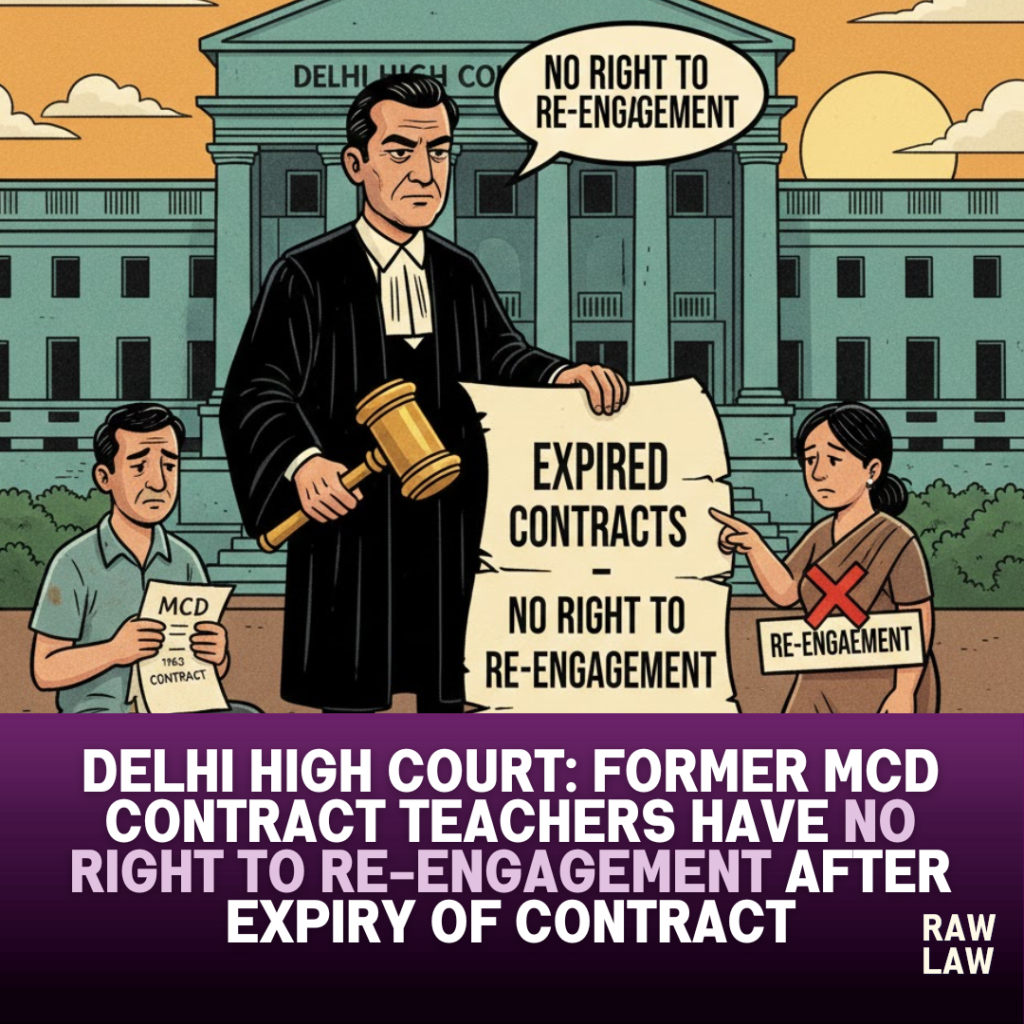
The Delhi High Court dismissed a writ petition filed by former Contract Primary Teachers of the Municipal Corporation of Delhi (MCD), holding that contractual engagement which ended in 2016 does not confer any vested or preferential right to re-engagement years later. Upholding the Central Administrative Tribunal’s order, the Court ruled that the petitioners could not challenge administrative arrangements made in 2023 whereby teachers already working under the Department of Education, GNCTD, were temporarily allocated to MCD schools under the Samagra Shiksha scheme to meet pupil–teacher ratio requirements. The Court clarified that such stop-gap deployment did not amount to fresh contractual recruitment or replacement of the petitioners. Reiterating settled service law principles, the Bench held that contractual employment creates no indefeasible right to continuation or future appointment, and the Supreme Court’s decision in Devesh Sharma on qualifications for primary teachers did not revive expired contracts.
Court’s decision
The Delhi High Court dismissed the writ petition and upheld the order of the Central Administrative Tribunal dated 29 July 2025. The Court held that the petitioners, whose contractual engagement ended in 2016, had no enforceable or preferential right to be considered for contractual appointment in subsequent years. No costs were imposed.
Facts
The petitioners were engaged as Contract Primary Teachers with the MCD and served for over five years before their contracts ended in 2016 following recruitment of regular teachers through DSSSB. In 2023, facing a shortage of teachers and inability to maintain the prescribed pupil–teacher ratio under the RTE Act, the MCD sought deployment of teachers under the Samagra Shiksha scheme. Teachers already working under the Department of Education, GNCTD, were temporarily allocated to MCD schools. The petitioners sought preference in engagement and challenged the deployment orders dated 13 July 2023 and 3 October 2023, which the Tribunal rejected.
Issues
Whether former contract teachers of the MCD, whose engagement ended years earlier, could claim a vested or preferential right to re-engagement, and whether the temporary allocation of teachers under Samagra Shiksha violated any legal or constitutional rights of the petitioners.
Petitioners’ arguments
The petitioners argued that a fresh cause of action arose in 2023 when the MCD sought teachers from Samagra Shiksha and that they deserved preference over Guest Teachers from the GNCTD. They contended that Samagra Shiksha was only a funding agency and could not dictate recruitment, and that deployment of B.Ed.-qualified teachers for primary classes violated the Supreme Court’s ruling in Devesh Sharma. They also relied on the principle that existing contractual employees cannot be replaced by another set of contractual appointees.
Respondents’ arguments
The respondents submitted that Samagra Shiksha does not recruit teachers but merely provides financial assistance, and that due to budgetary constraints no fresh contractual appointments were made. It was argued that teachers already working under the DoE, GNCTD were temporarily allocated as a stop-gap arrangement to meet PTR norms, and that no new contractual recruitment was undertaken to replace the petitioners. The respondents also pointed out that teachers allocated contrary to Devesh Sharma were subsequently reverted.
Analysis of the law
The Court reiterated settled principles of service law that contractual employment is governed strictly by the terms of the contract, and once the contract expires, no right to continuation or future engagement survives. The Court held that administrative decisions taken years later regarding deployment of manpower cannot be challenged by former contractual employees whose relationship with the employer had long ceased.
Precedent analysis
The Bench relied on the Supreme Court’s ruling in Shankarsan Dash v. Union of India to reiterate that public employment is not an indefeasible right. It distinguished Devesh Sharma v. Union of India, holding that while it concerns qualifications for primary teachers, it does not create any right of re-appointment for former contractual employees.
Court’s reasoning
The Court found that the petitioners’ engagement had validly ended in 2016 and that no fresh contractual recruitment was undertaken in 2023. The temporary allocation of existing teachers under Samagra Shiksha was an administrative and fiscal decision aimed at maintaining the pupil–teacher ratio. The Court held that such arrangements do not revive lapsed contractual relationships or create preferential rights.
Conclusion
The High Court concluded that the petitioners had no subsisting legal right to seek re-engagement or preferential consideration and that the Tribunal’s dismissal of the O.A. suffered from no infirmity. The writ petition was accordingly dismissed.
Implications
This judgment reinforces that expired contractual engagements cannot be resurrected through subsequent administrative developments. It provides clarity for public authorities that stop-gap deployments under schemes like Samagra Shiksha do not create enforceable claims for former contractual staff and affirms fiscal and administrative discretion in managing teacher shortages.
Case law references
• Shankarsan Dash v. Union of India (AIR 1991 SC 1612)
Holding: Public employment is not an indefeasible right.
Application: Relied upon to reject claims of vested right to re-engagement.
• Devesh Sharma v. Union of India (2023 INSC 704)
Holding: D.El.Ed. is the requisite qualification for primary teachers, not B.Ed.
Application: Distinguished; held not to revive expired contracts.
FAQs
Q1. Do former contract teachers have a right to re-engagement after expiry of contract?
No. Once a contractual engagement ends, no vested or preferential right survives.
Q2. Did deployment under Samagra Shiksha amount to fresh recruitment?
No. The Court held it was only a temporary allocation of existing teachers.
Q3. Did the Court find violation of the Devesh Sharma judgment?
No. Teachers allocated contrary to it were later reverted, and it did not aid the petitioners’ claim.
Also Read: Bombay High Court restores eviction decree for permanent structural changes in hospital tenancy