


HEADNOTE
Case Title: Lokesh @ Manish v. State (Govt. of NCT of Delhi) & Anr.
Court: Delhi High Court
Bench: Hon’ble Mr. Justice Saurabh Banerjee
Date of Judgment: 21 January 2026
Case Number: Bail Application No. 3562/2025
Laws/Sections Involved:
Sections 392, 394, 397, 451, 411, 120-B, 34, Indian Penal Code, 1860;
Sections 483 and 528, Bharatiya Nagarik Suraksha Sanhita, 2023;
Articles 21 and 22(1), Constitution of India
Keywords: grounds of arrest, Article 22(1), illegal arrest, robbery with knife, constitutional safeguards, bail on technical grounds, Delhi High Court
Summary
The Delhi High Court granted regular bail to Lokesh @ Manish, accused in a daylight house robbery involving use of a knife and recovery of ₹2.5 lakh, holding that his arrest and subsequent remand were unconstitutional due to non-supply of written grounds of arrest as mandated under Article 22(1) of the Constitution and Section 47 of the Bharatiya Nagarik Suraksha Sanhita, 2023. Justice Saurabh Banerjee held that failure to communicate the “grounds of arrest”, distinct from routine “reasons for arrest”, vitiates the entire arrest process irrespective of the gravity of allegations or recovery of stolen property. Relying extensively on recent Supreme Court precedents including Prabir Purkayastha and Pankaj Bansal, the Court ruled that such a constitutional infraction alone was sufficient to grant bail, without examining other merits. The judgment reinforces the primacy of personal liberty and strict compliance with arrest safeguards.
Court’s decision
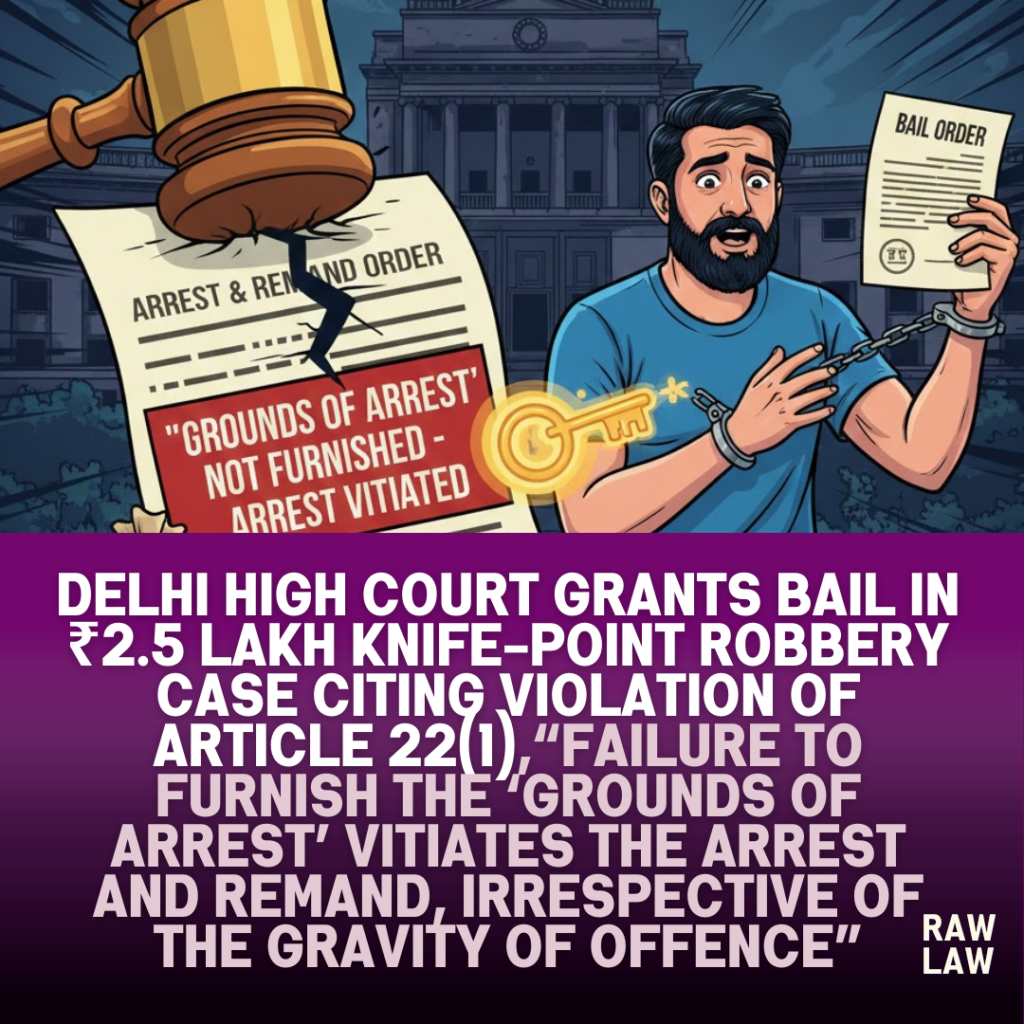
In a constitutionally significant ruling, the Delhi High Court granted regular bail to Lokesh @ Manish, accused of participating in a violent house robbery involving a deadly weapon, on the sole ground that the police failed to supply him the written grounds of arrest at the time of his apprehension. Justice Saurabh Banerjee held that such non-compliance strikes at the root of Articles 21 and 22(1) of the Constitution and renders the arrest and subsequent remand illegal in law. The Court categorically ruled that once a constitutional infraction of this nature is established, the accused is entitled to bail without the Court being required to examine the gravity of the offence, the recovery of robbed property, or other conventional bail considerations.
Factual background of the robbery case
The case arose from FIR No. 376/2024 registered at Police Station Nangloi, Delhi. According to the prosecution, on 26 April 2024 at around 1:30 PM, three accused persons unlawfully entered the complainant’s residence. One of them allegedly wielded a knife and threatened the complainant, while the present applicant searched the house, located the cupboard keys, and removed ₹2.5 lakh in cash.
When the complainant raised an alarm and attempted to resist, she was allegedly assaulted and fell to the ground. While the accused attempted to flee, one of them—carrying the knife and the stolen cash—was apprehended by family members and members of the public. The police recovered the robbed cash and the weapon from the apprehended accused, who disclosed his identity as Lokesh @ Manish. He was arrested the same day and remanded to custody.
Procedural history and prolonged incarceration
Following his arrest on 26 April 2024, Lokesh @ Manish remained in judicial custody for over fifteen months. His earlier bail applications were rejected, prompting him to approach the Delhi High Court under Sections 483 and 528 of the BNSS seeking regular bail.
While the allegations against him involved serious offences under Sections 392, 394 and 397 IPC—robbery with use of a deadly weapon—the applicant’s primary challenge before the High Court was not based on factual innocence, but on the legality of the arrest itself.
Core issue before the High Court
The central issue before the Court was whether the admitted failure of the arresting officers to furnish the “grounds of arrest” to the accused at the time of arrest rendered the arrest unconstitutional, thereby entitling him to bail regardless of the seriousness of the alleged offence.
The Court was also required to examine whether such illegality could be cured by subsequent remand orders or filing of the charge-sheet.
Applicant’s submissions
Counsel for the applicant argued that the arrest memo dated 26 April 2024 clearly demonstrated that the applicant was not informed of the grounds of arrest, either orally or in writing, as mandated by Article 22(1) of the Constitution and Section 47 of the BNSS. It was further submitted that Section 48 of the BNSS, which requires communication of arrest grounds to relatives or nominated persons, was also not complied with.
Relying on a series of recent Supreme Court judgments—including Pankaj Bansal, Prabir Purkayastha, Vihaan Kumar, and Mihir Rajesh Shah—the defence contended that non-supply of written grounds of arrest vitiates the arrest itself, and once such violation is shown, bail must follow as a matter of constitutional consequence.
The applicant also invoked parity, pointing out that a co-accused had already been granted bail by the Sessions Court.
State’s opposition
Opposing the bail plea, the State argued that the offence was grave and involved a violent robbery at knife-point, with prompt recovery of stolen cash and weapon from the accused. The prosecution submitted that mere non-supply of written grounds of arrest should not automatically invalidate the arrest unless demonstrable prejudice was caused.
The State further contended that the Supreme Court’s ruling in Mihir Rajesh Shah applied prospectively and therefore could not benefit the applicant.
Constitutional analysis by the Court
Justice Saurabh Banerjee undertook an extensive analysis of Articles 21 and 22(1) of the Constitution, emphasising that personal liberty occupies the highest pedestal in India’s constitutional framework. The Court reiterated that Article 22(1) imposes a mandatory obligation on arresting authorities to inform the arrestee of the grounds of arrest “as soon as may be”.
Drawing heavily from Prabir Purkayastha, the Court underscored the crucial distinction between “reasons for arrest” and “grounds of arrest”. While reasons are generic justifications for arrest, grounds must contain specific factual allegations personal to the accused, enabling him to effectively challenge remand, consult counsel, and seek bail.
Failure of the State to discharge burden
The Court noted that once an accused alleges non-supply of grounds of arrest, the burden shifts to the State to prove compliance. In the present case, the State did not dispute that no written grounds of arrest were furnished to the applicant at the time of arrest or during remand proceedings.
This failure, the Court held, rendered the entire process of arrest and remand unconstitutional and unsustainable in law.
Gravity of offence held irrelevant
A key aspect of the judgment is its categorical rejection of gravity-based justification. The Court held that constitutional safeguards cannot be diluted on the basis of the seriousness of allegations. Even in cases involving violent robbery and recovery of stolen property, arrest procedures must strictly comply with constitutional mandates.
Justice Banerjee observed that permitting such violations to stand would amount to judicial endorsement of unconstitutional policing practices.
Grant of bail
Having found a clear violation of Article 22(1), the Court granted regular bail to the applicant without examining other bail parameters such as likelihood of absconding or influencing witnesses. The applicant was directed to furnish a personal bond of ₹50,000 with one surety and comply with strict conditions relating to appearance, travel restrictions, cooperation with investigation, and non-interference with witnesses.
Conclusion
The judgment marks another strong reaffirmation of constitutional supremacy in criminal procedure. It sends an unambiguous message that compliance with arrest safeguards is non-negotiable and that liberty cannot be sacrificed at the altar of investigative convenience.
Implications
This ruling will have far-reaching implications for policing and bail jurisprudence across India. It reinforces that failure to supply written grounds of arrest is not a curable irregularity but a fatal constitutional defect. The decision is likely to be relied upon extensively in bail proceedings involving procedural violations, even in serious criminal cases.
Also Read: Bombay High Court restores deemed membership to flat purchasers despite pending civil suit