


Court’s decision
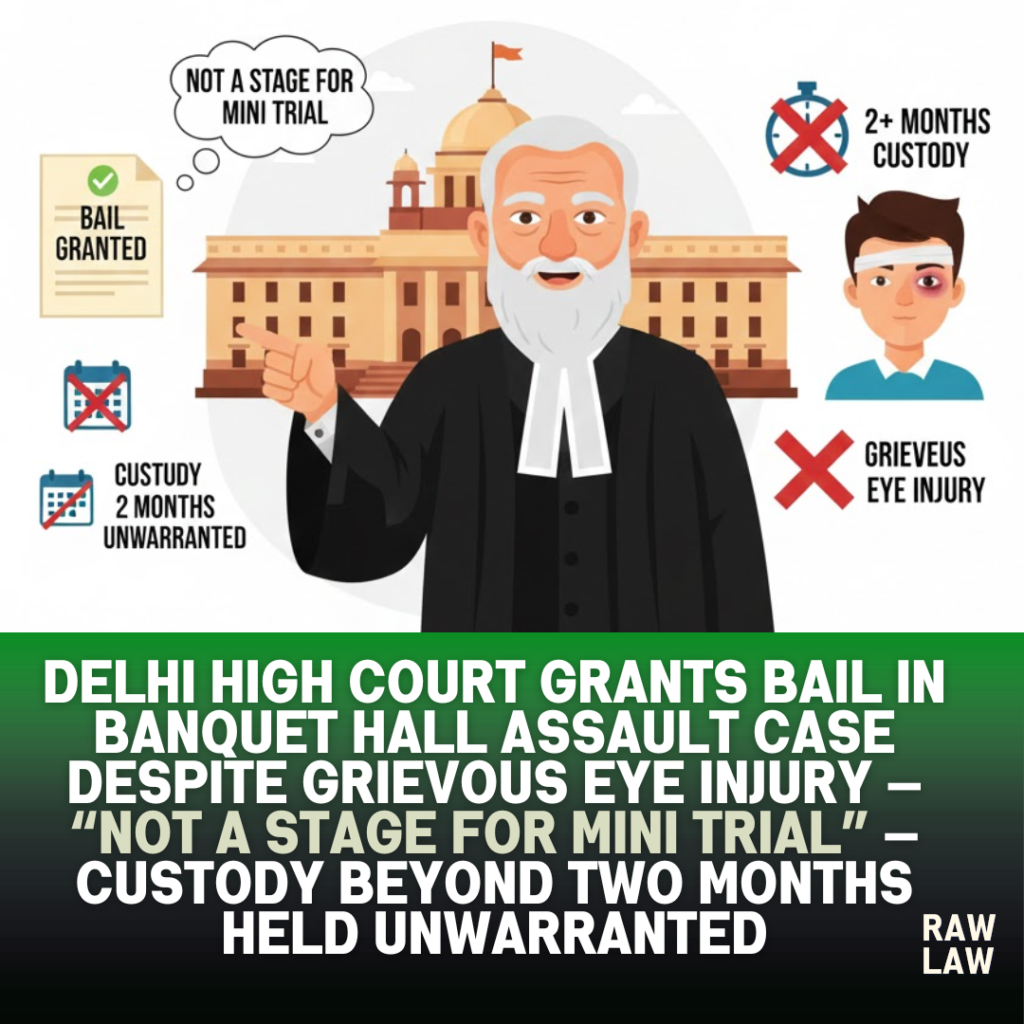
The Delhi High Court granted regular bail to four accused in a violent altercation case arising out of a wedding function at a farmhouse, holding that continued incarceration was not justified at the present stage of investigation. The Court observed that adjudication of bail is not an occasion for a “mini trial” and that the precise applicability of attempt to murder provisions under Section 109(1) of the Bharatiya Nyaya Sanhita must be assessed at the appropriate stage.
While acknowledging the grievous injuries suffered by the victim, including permanent loss of vision in one eye, the Court found that the primary role of direct assault with glass tubes was attributed to another co-accused. The petitioners were released subject to strict conditions.
Facts
The case arose from an incident dated 17/18 December 2025 at a wedding reception held at “Divine Farms,” where the complainant’s family operates a banquet venue. A dispute reportedly broke out when guests allegedly attempted to carry food to parked vehicles. The complainant’s brother objected, leading to a verbal altercation that escalated into physical violence.
According to the FIR, a group of 8–10 persons attacked the complainant’s brother using decorative glass tubes, allegedly used like knives, targeting his head, face and neck. The attackers were said to have exhorted each other to kill him. He was rushed to AIIMS Trauma Centre and later operated upon at Dr. Rajendra Prasad Eye Centre, suffering permanent loss of vision in one eye.
Other employees and family members also sustained injuries. The FIR was registered under Sections 109(1), 115(2) and 3(5) of the Bharatiya Nyaya Sanhita.
Issues
The principal issue before the Court was whether the petitioners, who had been in custody for approximately two months, should be granted regular bail in light of the nature of allegations and injuries.
The Court was required to consider whether the material on record justified continued incarceration, especially when investigation was ongoing and charges were yet to be crystallised.
A related issue concerned whether common intention under Section 3(5) BNS and the ingredients of Section 109(1) BNS (corresponding to attempt to murder) were prima facie established against each petitioner.
Petitioners’ arguments
The petitioners contended that the incident arose from a sudden and unpremeditated quarrel over a trivial issue. They argued that there was no forensic evidence directly linking them to the fatal blows. CCTV footage, according to them, covered only the entry gate and not the actual assault area in the parking lot.
They emphasized that the role attributed to them was limited: one allegedly used an iron pipe, another an iron chair, and another only punches and kicks. The direct attack using glass tubes, which caused the grievous eye injury, was attributed to a co-accused.
The petitioners also invoked parity with a co-accused who had been granted bail. They highlighted their young age, lack of criminal antecedents, and the substantial period already spent in custody.
Respondent’s arguments
The prosecution and complainant strongly opposed bail. It was argued that the petitioners were aggressors who reacted violently to a legitimate request regarding removal of food and unlawful consumption of alcohol.
The prosecution stressed the brutality of the attack and the permanent loss of vision suffered by the victim. It relied on Supreme Court precedents holding that common intention can arise suddenly and does not require premeditation.
It was further argued that investigation was ongoing, some accused were yet to be apprehended, and release at this stage could lead to witness intimidation or tampering with evidence.
Analysis of the law
The Court reiterated the settled principle that bail proceedings are not meant for conducting a detailed evaluation of evidence. Relying on Supreme Court jurisprudence, it observed that courts must avoid a “mini trial” at the stage of bail.
Although Section 109(1) BNS carries a maximum punishment of life imprisonment, the Court declined to conclusively determine its applicability at this stage. It noted that whether common intention under Section 3(5) BNS was established would be for the trial court to decide after full consideration of evidence.
The Court instead focused on the individual roles attributed to each petitioner in the status reports and whether their continued custody was necessary.
Precedent analysis
The prosecution relied on Ashish Yadav v. Yashpal and State of Karnataka v. Battegowda to argue that common intention may arise spontaneously. The Court did not dispute this principle but held that its application required detailed evaluation at trial.
The Court referred to Union of India v. K.A. Najeeb and State of U.P. v. Anurudh to reiterate that bail adjudication should not convert into a premature determination of guilt.
The decision reflects a calibrated application of bail jurisprudence: balancing gravity of offence with presumption of innocence and necessity of custody.
Court’s reasoning
The Court carefully examined the prosecution’s status reports. It noted that CCTV footage covered only the entrance and not the actual assault location. Bloodstains were found in the parking area, which lacked camera coverage.
The direct attack with glass tubes was primarily attributed to another co-accused. The present petitioners were alleged to have used an iron pipe, iron chair, or fists and kicks. While these allegations were serious, they were distinct from the act that caused permanent blindness.
The petitioners had already spent nearly two months in custody. The prosecution did not specify any pending investigative step requiring custodial interrogation. There were no prior criminal antecedents.
In these circumstances, continued incarceration was held unjustified.
Conclusion
The Delhi High Court granted bail to all four petitioners subject to strict conditions, including furnishing personal bonds of ₹50,000 each, joining investigation, maintaining operational mobile numbers, and refraining from influencing witnesses.
The Court clarified that its observations were confined to bail adjudication and would not prejudice trial proceedings or pending challenges to bail granted to co-accused.
Implications
This judgment reinforces the principle that seriousness of injury alone does not automatically justify indefinite pre-trial detention. Courts must assess individual roles, stage of investigation, and necessity of custody.
The ruling underscores judicial restraint in bail matters, especially where investigation is incomplete and charges yet to be framed. It also highlights the nuanced approach required when applying attempt to murder provisions in sudden group altercations.
The case will likely inform future bail decisions under the Bharatiya Nyaya Sanhita in violent group assault matters.
Case law references
- Union of India v. K.A. Najeeb (2021)
Held that bail proceedings should not involve a detailed examination of evidence akin to a trial. - State of U.P. v. Anurudh (2026)
Reaffirmed limits of judicial scrutiny at the bail stage. - Ashish Yadav v. Yashpal (2025)
Held that common intention can arise on the spur of the moment. - State of Karnataka v. Battegowda (2025)
Reiterated that premeditation is not essential to establish common intention.
FAQs
1. Can bail be granted in attempt to murder cases?
Yes. Courts assess individual roles, evidence, custody period, and necessity of detention before deciding bail.
2. Does permanent injury automatically prevent bail?
No. While gravity is relevant, courts also consider proportionality, stage of investigation, and prima facie material.
3. What conditions are typically imposed in serious assault cases?
Conditions often include personal bonds, joining investigation, travel restrictions, and prohibitions against influencing witnesses.