


Court’s decision
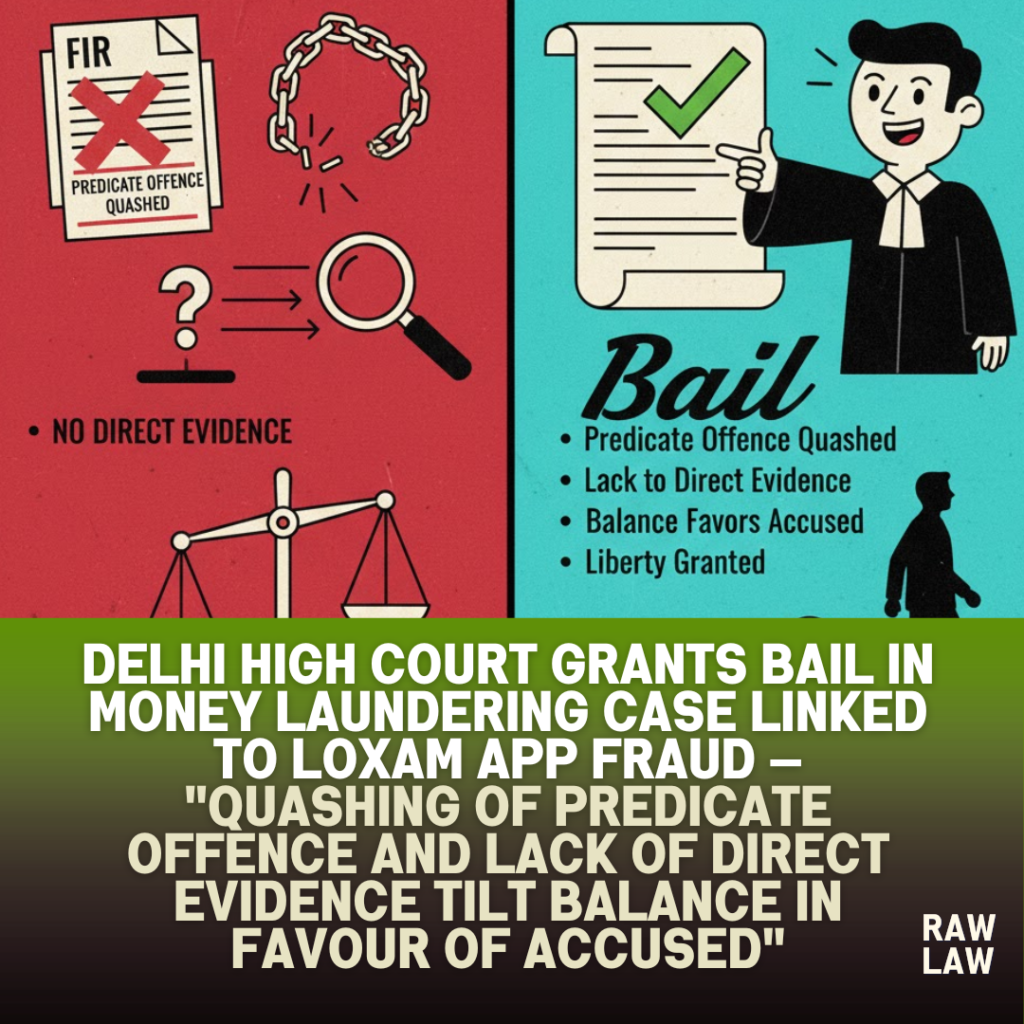
The Delhi High Court granted regular bail to an accused arrested under the Prevention of Money Laundering Act, 2002 in connection with the alleged LOXAM investment app fraud. The Court held that while the twin conditions under Section 45 of the PMLA are stringent and mandatory, the quashing of the predicate offence, absence of direct incriminating material, and lack of prosecution in the scheduled offence weighed in favour of the applicant. Observing that the court at the bail stage must assess broad probabilities and not conduct a mini-trial, the High Court concluded that continued incarceration was unwarranted.
Facts
The case originated from an FIR registered at Cyber Crime Police Station, Hyderabad, alleging that the complainant was duped of Rs. 1.16 lakh through an online investment application styled as “LOXAM,” which falsely promised high returns. The FIR invoked Sections 419 and 420 IPC and relevant provisions of the Information Technology Act.
During investigation, funds were traced to virtual accounts linked to Xindai Technologies Pvt. Ltd. The Enforcement Directorate subsequently registered an ECIR under Sections 3 and 4 of the PMLA, alleging that proceeds of crime were layered through multiple accounts, including Ranjan Moneycorp Pvt. Ltd. and KDS Forex Pvt. Ltd., and eventually siphoned off in cash and foreign exchange.
The applicant was arrested and remanded to judicial custody. The ED alleged that he was the mastermind behind a syndicate of shell companies used to launder proceeds of crime amounting to approximately Rs. 311 crores.
Issues
The principal issue before the Court was whether the applicant satisfied the twin conditions under Section 45 of the PMLA for grant of bail.
The Court also considered whether quashing of the predicate offence by the Telangana High Court diluted the foundation of the money laundering case.
Additionally, the Court examined whether the available material established reasonable grounds to believe that the applicant was guilty of money laundering, and whether he posed a flight risk or likelihood of tampering with evidence.
Petitioner’s arguments
The applicant argued that he was neither named in the FIR nor chargesheeted in the predicate offence and that no coercive action had been taken against him by the Hyderabad Police. He emphasized that the FIR forming the basis of the ECIR had been quashed by the Telangana High Court following a compromise. In the absence of a subsisting scheduled offence, the very foundation of proceedings under the PMLA stood eroded. He contended that the ED’s case relied heavily on statements of co-accused recorded under Section 50 PMLA, which were contradictory and unreliable. He denied any beneficial ownership or control of the alleged shell entities and submitted that all evidence was documentary, eliminating any risk of tampering. He further argued that prolonged incarceration would violate his right to personal liberty under Article 21.
Respondent’s arguments
The Enforcement Directorate opposed bail, asserting that money laundering is an independent offence and need not collapse merely because the predicate offence is quashed. It maintained that proceeds of crime were routed through multiple entities controlled by the applicant and that common IP addresses and bank transactions demonstrated beneficial ownership and layering. The ED contended that approximately Rs. 17 crores were routed through payment gateways into companies allegedly controlled by the applicant. It further argued that the applicant had earlier been declared a Fugitive Economic Offender and had entered India through informal routes, demonstrating flight risk. The ED submitted that the twin conditions under Section 45 PMLA had not been satisfied and that economic offences of such magnitude required strict scrutiny.
Analysis of the law
The High Court reiterated that Section 45 of the PMLA imposes stringent twin conditions: the Court must be satisfied that there are reasonable grounds to believe that the accused is not guilty and that he is unlikely to commit any offence while on bail. These conditions are mandatory.
However, the Court clarified that at the bail stage, it is not required to conclusively determine guilt but only to assess whether the material discloses reasonable grounds for continued detention. The Court acknowledged that money laundering is an independent offence but observed that the subsistence of a predicate offence provides foundational context.
The Court also examined jurisprudence emphasizing that bail jurisprudence under economic offences must balance societal interest with individual liberty, especially where investigation is complete and the evidence is primarily documentary.
Precedent analysis
The judgment discussed authoritative rulings including Vijay Madanlal Choudhary on the independence of the PMLA offence and the scope of Section 3. It also considered Union of India v. Kanhaiya Prasad, emphasizing the mandatory nature of Section 45 twin conditions.
The Court distinguished precedents where prolonged incarceration justified relaxation of twin conditions, noting that the duration of custody must be assessed contextually. While acknowledging the seriousness of economic offences, the Court reiterated that bail cannot be denied as a matter of course merely because allegations involve large sums.
Importantly, the Court held that the quashing of the predicate offence enured to the benefit of the applicant at the bail stage, though not conclusively terminating PMLA proceedings.
Court’s reasoning
The Court found it significant that the applicant was neither named in the original FIR nor chargesheeted in the predicate offence. No coercive action had been initiated against him by the Hyderabad Police.
The quashing of the predicate FIR was considered a relevant factor weighing in favour of the applicant. Although PMLA is an independent offence, the disappearance of the underlying complaint weakened the prosecution narrative at the stage of bail.
The Court also noted that much of the ED’s case rested on statements of co-accused and inferred beneficial ownership through common IP addresses and transactional overlaps. At the bail stage, such material did not conclusively establish guilt.
Given that the investigation was complete and the prosecution complaint filed, the Court held that continued custody was not justified.
Conclusion
The Delhi High Court granted regular bail to the applicant in the ECIR arising from the alleged LOXAM app fraud. The Court held that the applicant satisfied the twin conditions under Section 45 PMLA at the stage of bail, particularly in light of the quashing of the predicate offence and absence of direct incriminating material establishing his role as mastermind.
The decision underscores that while economic offences are grave and require strict scrutiny, bail jurisprudence under PMLA must still adhere to constitutional safeguards and principles of proportionality.
Implications
This ruling is significant in the evolving jurisprudence on bail under the PMLA. It clarifies that quashing of a predicate offence, though not automatically fatal to a money laundering prosecution, materially impacts bail considerations.
The judgment also signals judicial caution in relying solely on statements under Section 50 PMLA and inferred transactional links at the pre-trial stage.
For future PMLA cases, the decision reinforces that courts must evaluate the strength of the material connecting the accused to proceeds of crime and cannot treat arrest as a default consequence of registration of an ECIR.
Case Law References
- Vijay Madanlal Choudhary v. Union of India – Upheld the constitutional validity of core PMLA provisions and clarified the scope of Section 3 and independence of the offence.
- Union of India v. Kanhaiya Prasad – Reaffirmed the mandatory nature of twin conditions under Section 45 PMLA.
- Manish Sisodia v. CBI – Discussed prolonged incarceration and bail principles in economic offences.
- Satender Kumar Antil v. CBI – Emphasized proportionality and liberty in bail jurisprudence.
The Court applied these precedents to hold that the applicant met the statutory requirements for bail.
FAQs
1. Does quashing of a predicate offence automatically end PMLA proceedings?
No. The offence of money laundering is independent. However, quashing of the predicate offence can significantly impact bail considerations and weaken the prosecution’s case at the pre-trial stage.
2. What are the twin conditions under Section 45 of PMLA?
The Court must be satisfied that there are reasonable grounds to believe the accused is not guilty and that he is unlikely to commit any offence while on bail. Both conditions are mandatory.
3. Can statements under Section 50 PMLA alone justify denial of bail?
Courts may consider such statements, but at the bail stage they must assess whether the material collectively establishes reasonable grounds of guilt. Contradictory or uncorroborated statements may not suffice.