


Court’s decision
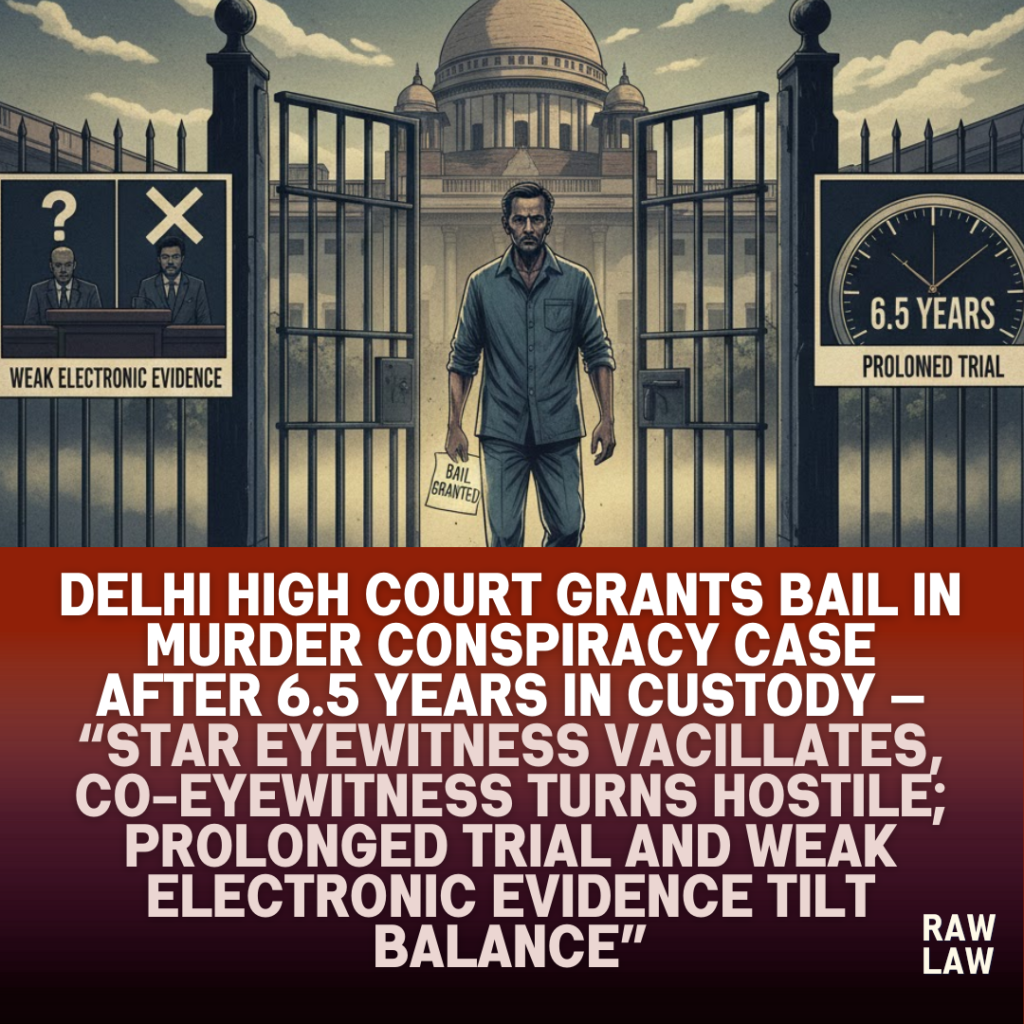
The Delhi High Court granted regular bail to an accused facing trial for murder and criminal conspiracy, holding that prolonged incarceration of over six years, wavering eyewitness identification, and failure of electronic evidence to support the prosecution version rendered continued custody unjustified. The Court ruled that at the bail stage, glaring inconsistencies in ocular testimony coupled with an uncertain trial timeline warrant release on strict conditions — “an accused cannot be kept in jail indefinitely to await the outcome of a protracted trial”; bail allowed under the Bharatiya Nagarik Suraksha Sanhita.
Court’s decision
Justice Vikas Mahajan allowed the bail application filed under Section 483 of the Bharatiya Nagarik Suraksha Sanhita in connection with a 2019 murder case registered at Police Station Narela Industrial Area. The Court directed the petitioner’s release on furnishing a personal bond of ₹50,000 with one surety and imposed multiple conditions to secure his presence during trial and prevent interference with evidence.
Facts
The prosecution case relates to a murder that occurred on 1 February 2019. A PCR call alerted the police to a shooting incident, where the deceased was found inside an Eeco van with fatal gunshot injuries to the head. The complainant, a relative of the deceased, claimed that moments before the incident he heard a gunshot near a public school and saw three armed men fleeing in a Honda City car in which two others were already seated.
The complainant alleged that the assailants were associates of a village rival who had earlier issued death threats to the deceased. During investigation, the police recovered firearms from the petitioner and a co-accused, claimed bloodstains were found in the alleged getaway car, and relied upon CCTV footage from a nearby school gate which showed vehicles following each other but did not capture the actual shooting. The petitioner was arrested on 15 February 2019 and remained in custody thereafter.
Issues
The primary issue before the High Court was whether the petitioner deserved regular bail in a case involving offences punishable under Sections 302, 120B and 34 of the Penal Code read with provisions of the Arms Act, given the seriousness of the allegations. Ancillary issues included the reliability of eyewitness testimony at the bail stage, the evidentiary value of CCTV footage and electronic material, and whether prolonged incarceration with a slow-moving trial violated the petitioner’s right to personal liberty.
Petitioner’s arguments
The petitioner argued that the prosecution case substantially rested on two alleged eyewitnesses. One witness, during examination-in-chief, identified the petitioner as a shooter but in cross-examination admitted that the assailants had covered their faces and that he could not see them properly. The second eyewitness completely failed to support the prosecution case and was declared hostile, even denying acquaintance with the accused persons when shown to him in court.
It was further contended that recovery of firearms was not substantive evidence, that the CCTV footage admittedly did not cover the crime scene, and that the mobile phone of the hostile witness could not be examined by forensic experts. Emphasis was placed on the petitioner’s custody of more than six years and nine months, satisfactory jail conduct, and the fact that only six out of forty-four prosecution witnesses had been examined, making early conclusion of trial unlikely.
Respondent’s arguments
The State opposed bail, asserting that the offence was grave and involved organised gang rivalry. It was argued that the petitioner was part of a criminal gang operating under a local leader and that firearms had been recovered from him pursuant to disclosure statements. The prosecution also relied on CCTV footage showing the accused vehicle following the deceased’s vehicle and stressed that seriousness of the offence and the petitioner’s alleged criminal antecedents justified continued detention.
Analysis of the law
The Court reiterated that while considering bail in serious offences, it must strike a balance between societal interests and the fundamental right to personal liberty. At the bail stage, courts are not expected to conduct a detailed appreciation of evidence or convert proceedings into a mini-trial, but they are entitled to take a prima facie view of the strength of the prosecution case, the likelihood of trial concluding within a reasonable time, and the possibility of the accused absconding or tampering with evidence.
Precedent analysis
Though no specific judgments were cited, the reasoning reflects settled constitutional jurisprudence that prolonged pre-trial incarceration offends Article 21 when trials are delayed for reasons not attributable to the accused. Courts have consistently held that hostile or contradictory eyewitness testimony at an advanced stage of trial can be a relevant factor while deciding bail, particularly where most public witnesses stand examined.
Court’s reasoning
The Court noted that one of the two alleged eyewitnesses had taken diametrically opposite stands regarding identification of the accused, while the other had not supported the prosecution at all. Although the credibility of witnesses would ultimately be assessed at trial, such inconsistencies significantly weakened the prosecution case for the limited purpose of bail.
The Court further observed that the CCTV footage relied upon by the prosecution did not capture the crime scene and, therefore, could not conclusively establish the petitioner’s involvement. The failure of forensic examination of the mobile phone of a key witness further diluted the electronic evidence.
Importantly, the Court placed substantial weight on the petitioner’s long custody of over six years and nine months, the examination of all material public witnesses, and the bleak prospect of early trial completion given the large number of remaining witnesses. In these circumstances, continued incarceration was held to be unjustified.
Conclusion
The Delhi High Court granted regular bail to the petitioner, subject to stringent conditions including restriction on travel outside the NCR, periodic reporting to the investigating officer, prohibition on contacting witnesses, and maintenance of an active mobile phone number. The Court clarified that its observations were confined to the bail stage and would not influence the merits of the trial.
Implications
This ruling underscores the judiciary’s increasing emphasis on preventing indefinite pre-trial detention, even in cases involving grave offences like murder. It reiterates that seriousness of the charge alone cannot justify prolonged incarceration where the prosecution evidence appears fragile and trials remain stagnant. The judgment reinforces the principle that bail, not jail, remains the norm when liberty is pitted against delay and evidentiary uncertainty.
Case law references
- Prolonged pre-trial custody: Long incarceration with no end of trial in sight weighs heavily in favour of bail. Applied to grant relief.
- Eyewitness inconsistency: Contradictory or hostile eyewitness testimony weakens prosecution case at bail stage. Relied upon.
- Electronic evidence limits: CCTV footage not covering crime scene lacks probative value. Applied to dilute prosecution reliance.
FAQs
1. Can bail be granted in a murder case after long custody?
Yes. Prolonged incarceration without early trial completion can justify bail even in serious offences.
2. Do contradictory eyewitness statements matter at the bail stage?
Yes. Courts may consider glaring inconsistencies to assess prima facie strength of the prosecution case.
3. Does weak CCTV evidence affect bail decisions?
Yes. If electronic evidence does not capture the crime scene, its probative value is limited at the bail stage.