


Court’s decision
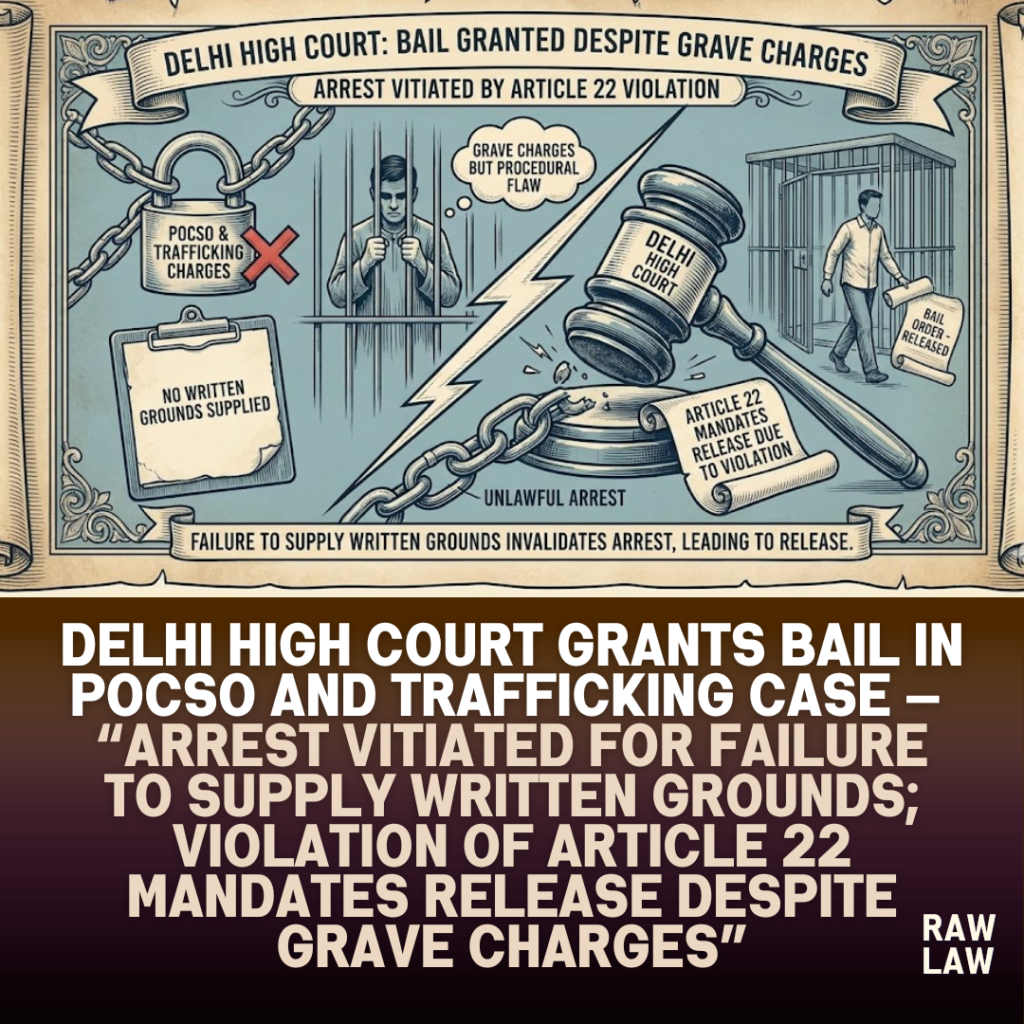
The Delhi High Court granted regular bail to an accused facing charges of kidnapping, trafficking, rape, aggravated penetrative sexual assault under the POCSO Act, and offences under the Immoral Traffic (Prevention) Act, holding that the arrest itself stood vitiated due to a clear violation of the constitutional mandate under Article 22(1). The Court ruled that non-supply of written grounds of arrest at the time of arrest or immediately thereafter rendered the arrest and subsequent remand illegal, entitling the accused to bail irrespective of the gravity of the allegations.
Court’s decision
Justice Saurabh Banerjee allowed the bail application under the Bharatiya Nagarik Suraksha Sanhita, 2023, and directed release of the applicant on regular bail, subject to stringent conditions. The Court held that once a violation of Articles 21 and 22(1) of the Constitution is established, the illegality strikes at the root of the arrest and cannot be cured by subsequent filing of a charge-sheet. The application was accordingly allowed.
Facts
An FIR was registered in May 2024 at Police Station Kapashera on the complaint of the mother of a minor girl alleging that her daughter had gone missing. During investigation, the minor was recovered from Surat, Gujarat, from the custody of co-accused persons who allegedly lured her and transported her across states.
The prosecution alleged that the present applicant had arranged accommodation for the co-accused in Surat and was complicit in the exploitation of the minor. He was arrested on 28 May 2024 in Gujarat and subsequently charge-sheeted for offences under the Indian Penal Code, the Protection of Children from Sexual Offences Act, and the Immoral Traffic (Prevention) Act. The applicant remained in custody when he approached the High Court seeking bail.
Issues
The principal issue before the High Court was whether failure to inform the accused of the grounds of arrest in writing, as required under Article 22(1) of the Constitution and statutory provisions, rendered the arrest and subsequent remand illegal, thereby entitling the accused to bail. A connected issue was whether such constitutional infirmity could be overlooked in view of the seriousness and gravity of the offences alleged.
Petitioner’s arguments
The applicant contended that he was arrested without being informed of the grounds of arrest either orally or in writing, in violation of Article 22(1) of the Constitution and the statutory mandate under the criminal procedure law. It was argued that this right is a substantive constitutional safeguard and not a mere procedural formality.
Relying on recent Supreme Court judgments, the applicant submitted that any arrest made without furnishing written grounds stands vitiated and the illegality cannot be cured by later compliance or by filing of the charge-sheet. It was further argued that the prosecutrix’s statement did not consistently attribute sexual exploitation to the applicant and that his role was at best peripheral.
Respondent’s arguments
The State opposed bail, contending that the allegations involved grave offences against a minor, including trafficking and aggravated sexual assault, which had serious societal impact. It was argued that the prosecutrix had, during cross-examination, identified the applicant and attributed sexual exploitation to him.
On the issue of arrest, the State submitted that while the law requires communication of grounds of arrest, the mode and manner of such communication is not rigidly prescribed and absence of written grounds does not automatically invalidate the arrest unless prejudice is shown. The State further argued that recent Supreme Court decisions on written grounds of arrest should apply prospectively.
Analysis of the law
The Court undertook an extensive analysis of Articles 21 and 22(1) of the Constitution, reiterating that the right to life and personal liberty is sacrosanct and any deprivation must strictly conform to constitutional safeguards. It noted that Article 22(1) mandates that an arrestee be informed, as soon as may be, of the grounds of arrest to enable effective exercise of the right to legal representation, opposition to remand, and seeking bail.
Relying on binding Supreme Court precedent, the Court held that the requirement of supplying written grounds of arrest applies across statutes and that violation of this mandate vitiates both the arrest and the remand, regardless of the nature of the offence.
Precedent analysis
The Court relied heavily on recent Supreme Court judgments which have consistently held that failure to furnish written grounds of arrest infringes Article 22(1) and invalidates the arrest. These decisions clarified that the right is not diluted by seriousness of allegations and that subsequent procedural steps cannot legitimise an unconstitutional arrest. The Court rejected the State’s argument of prospective application, noting that the law as declared was operative on the date of the applicant’s arrest.
Court’s reasoning
Applying these principles, the Court noted that the State had fairly admitted that written grounds of arrest were not supplied to the applicant at the time of arrest or immediately thereafter. Once such violation was established, the burden on the investigating agency to show compliance remained undischarged.
The Court held that this constitutional infirmity alone was sufficient to grant bail without entering into other considerations such as merits, gravity, or likelihood of tampering. It emphasised that constitutional guarantees cannot be sacrificed at the altar of seriousness of allegations and must be enforced with equal rigour in all cases.
Conclusion
The Delhi High Court allowed the bail application and directed the release of the applicant on regular bail, subject to strict conditions including surrender of passport, restriction on travel, monthly reporting to the investigating officer, and non-interference with witnesses. The Court clarified that its observations were confined to the bail stage and would not prejudice the trial.
Implications
This judgment significantly strengthens constitutional bail jurisprudence by reaffirming that compliance with Article 22(1) is mandatory and non-negotiable, even in cases involving grave offences such as POCSO and human trafficking. It sends a clear message to investigating agencies that failure to supply written grounds of arrest will result in release on bail, regardless of the seriousness of allegations. The ruling is likely to have far-reaching impact on arrest practices and reinforces strict judicial scrutiny of procedural compliance.
Case law references
- Written grounds of arrest under Article 22(1): Non-supply vitiates arrest and remand irrespective of the offence. Applied as the sole ground for grant of bail.
- Illegality not cured by charge-sheet: Subsequent filing of charge-sheet does not validate an unconstitutional arrest. Applied to reject State’s defence.
- Gravity of offence not decisive: Seriousness of allegations cannot override violation of fundamental rights. Applied to grant bail despite POCSO charges.
FAQs
1. Can bail be granted in serious POCSO cases on procedural grounds?
Yes. Courts have held that violation of Article 22(1), such as failure to supply written grounds of arrest, vitiates the arrest and entitles the accused to bail.
2. Is supplying written grounds of arrest mandatory?
Yes. The Supreme Court has clarified that written grounds of arrest must be furnished as a matter of course in all cases.
3. Does filing of a charge-sheet cure an illegal arrest?
No. An unconstitutional arrest remains invalid despite subsequent filing of a charge-sheet.