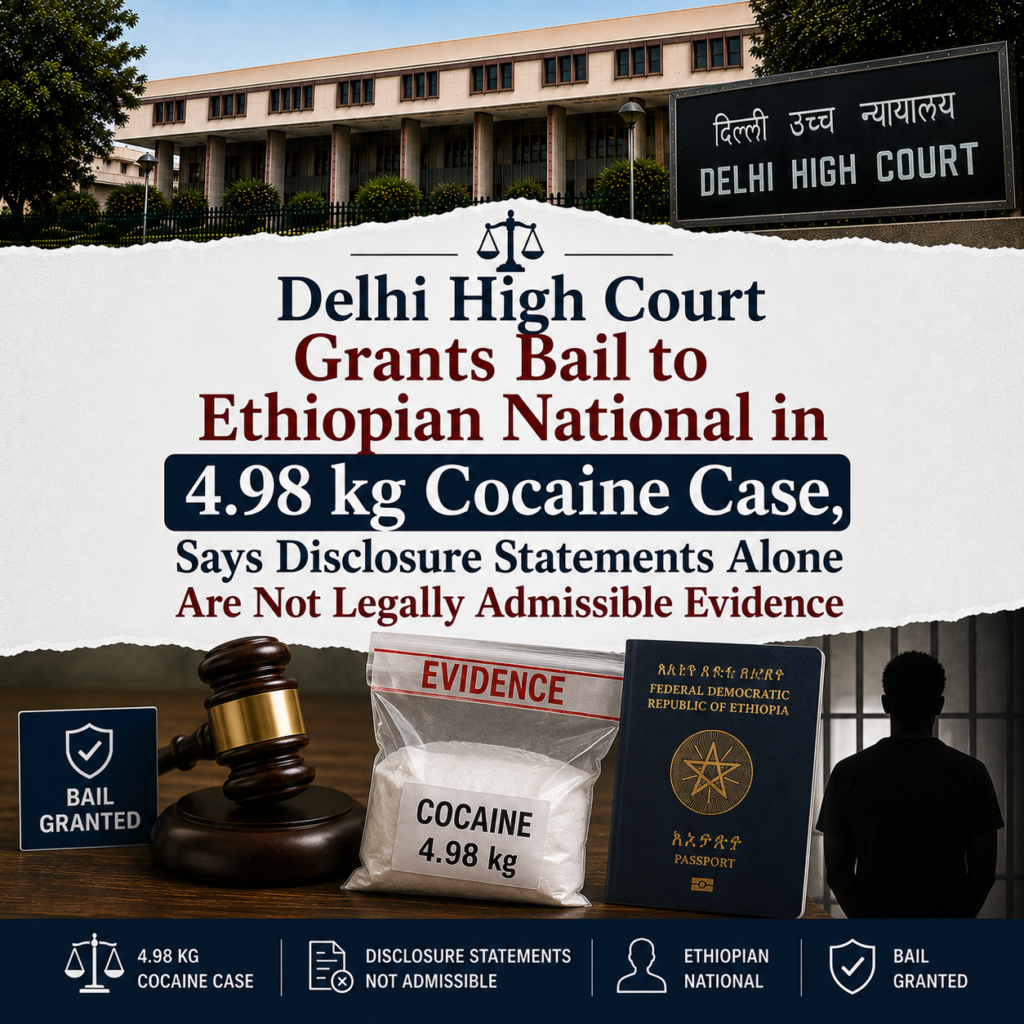
Delhi High Court Grants Bail to Ethiopian National in Cocaine Seizure Case, Says No Legally Admissible Evidence Apart From Disclosure Statement and Parity Applies
Facts
The petitioner, Dawit Hayelom Berhe, sought regular bail in Crime No. VIII/74/DZU/2022 registered by NCB, DZU, R.K. Puram, for offences under Sections 8, 21, 23 and 29 of the NDPS Act.
According to the prosecution, 4.98 kg cocaine was seized from co-accused Dipali during a raid in Tilak Nagar, New Delhi. In her alleged confessional statement, Dipali stated that she had received the contraband from the petitioner and another person, Desalegn, at Hotel Apex Regency, Mumbai, on the instructions of her husband Peter.
NCB further alleged that the petitioner and Desalegn disclosed that they had been sent to India from Ethiopia by one Aklilu, who had provided them trolley bags containing cocaine. Based on further disclosures, NCB also conducted searches at hotels in Mumbai, leading to recovery of 2.055 kg cocaine from another Ethiopian national, Kelemuwa.
Issues
- Whether the petitioner was entitled to regular bail in an NDPS case involving commercial quantity of cocaine.
- Whether the petitioner could be kept in custody when the material against him was primarily disclosure statements and alleged recovery of USD 3,500.
- Whether parity applied when two co-accused with similar roles had already been granted bail.
Petitioner’s Arguments
The petitioner argued that apart from the alleged disclosure statement and recovery of USD 3,500 from him, there was no evidence justifying his continued custody.
It was also argued that two co-accused persons having a similar role had already been released on bail, and therefore the petitioner was entitled to bail on the ground of parity.
Respondent’s Arguments
NCB did not dispute that two co-accused persons with roles similar to the petitioner had already been granted bail.
However, NCB opposed the bail application on the ground that granting bail in such cases would hamper its efforts to curb the drug menace in the country.
Analysis of the Law
The Court considered the nature of evidence available against the petitioner and the fact that similarly placed co-accused had already been granted bail.
Although the case involved serious NDPS allegations and commercial quantity cocaine recoveries, the Court noted that the prosecution case against the petitioner was presently based on material that was not legally admissible. The Court also gave importance to the principle of parity, since two co-accused with similar roles had already been enlarged on bail.
The Court further took note of the fact that the petitioner’s visa had expired, and therefore issued a specific direction for his custody to be handed over to FRRO after acceptance of bail bonds.
Precedent Analysis
No specific precedent was discussed in the order. The Court applied settled bail principles relating to legally admissible evidence, parity with co-accused, and the need to impose appropriate conditions where the accused is a foreign national whose visa has expired.
Court’s Reasoning
The Court held that there was presently no legally admissible evidence against the petitioner. It also recorded that two co-accused with similar roles had already been granted bail.
Since NCB fairly did not dispute the parity aspect, the Court found that the petitioner could not be denied bail merely on the general objection that release in such cases may affect efforts to curb drug trafficking.
At the same time, because the petitioner’s visa had expired, the Court directed that after bail bonds are accepted, the Jail Superintendent must hand over the petitioner’s custody to FRRO.
Conclusion
The Delhi High Court allowed the bail application and directed the petitioner to be released on regular bail on furnishing a personal bond of ₹50,000 with one surety of the like amount.
The Court clarified that after acceptance of bail bonds, the petitioner’s custody must be handed over to FRRO since his visa had expired. The Court also stated that nothing in the order should prejudice either side during trial.
Case Details
Case: Dawit Hayelom Berhe v. Narcotics Control Bureau
Court: Delhi High Court
Case Number: BAIL APPLN. 1637/2026
Judge: Justice Girish Kathpalia
Date: 8 July 2026
Result: Bail granted; petitioner to be handed over to FRRO after acceptance of bail bonds.