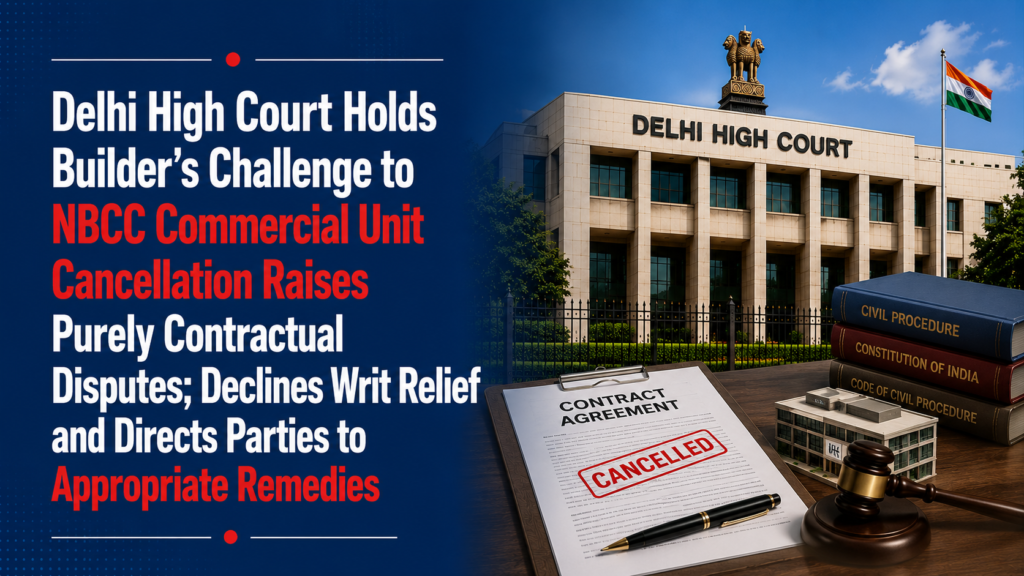
Delhi High Court Refuses Relief Against Termination of Bulk Commercial Unit Sale; Holds Disputed Contractual Claims Must Be Tried Elsewhere
Facts
The petitioner, M/s Mansan Builders Private Limited, participated in an NBCC-conducted e-auction for bulk sale of commercial units in the “Down Town, Sarojini Nagar, New Delhi” redevelopment project and emerged as the successful bidder. An allotment letter was issued for 598 retail and office units, followed by an Agreement for Sale executed on 6 March 2025. The petitioner claimed to have paid approximately ₹568.73 crore, but alleged that the respondents failed to execute conveyance deeds in favour of purchasers, adversely affecting its ability to sell units and generate funds for subsequent instalments.
Respondent No.2 (NBCC) alleged repeated payment defaults, issued demand notices and ultimately terminated the allotment on 8 April 2026. Thereafter, NBCC issued a fresh Notice Inviting Offer on 7 May 2026 proposing re-auction of the commercial units. The petitioner challenged both the termination and the proposed re-auction through the present writ petition under Article 226 of the Constitution.
Issues
- Whether the writ petition challenging termination of the commercial allotment and consequential re-auction deserved to be entertained under Article 226.
- Whether the surviving dispute was essentially contractual and therefore outside the scope of writ jurisdiction.
- Whether the Court should interfere with the termination notice and restore the petitioner’s contractual rights.
Petitioner’s Arguments
The petitioner contended that NBCC lacked authority to terminate the allotment because the Agreement for Sale had been executed only between the petitioner and the Union of India, and the contractual power of cancellation vested solely in the promoter.
It further argued that termination violated the contractual procedure, as mandatory notice requirements were not properly followed and accounts were never reconciled before determining alleged defaults. The petitioner maintained that it had deposited substantial sums, while the respondents’ failure to execute conveyance deeds prevented further sales and disrupted cash flow required for subsequent payments.
The petitioner also challenged the fresh auction, alleging that it was initiated while interim protection granted by the Delhi RERA remained operative, thereby demonstrating arbitrariness and mala fides.
Respondents’ Arguments
The respondents submitted that NBCC, as the implementing agency, was fully authorised to act on behalf of the promoter throughout the project, including issuing the termination notice.
They argued that the petitioner had repeatedly defaulted despite several reminders, notices and even a written undertaking acknowledging its payment obligations. The respondents further contended that the present writ petition merely re-agitated issues already raised in an earlier writ petition which had been withdrawn without liberty.
It was also argued that the dispute was entirely contractual, involving disputed questions relating to payments, reconciliation of accounts, performance of reciprocal obligations and validity of termination, all of which required adjudication before the competent civil forum rather than under Article 226.
Analysis of the Law
The High Court emphasised that Article 226 primarily provides a public law remedy intended to ensure legality and fairness in exercise of statutory powers. Merely because one contracting party is a government authority does not convert every contractual dispute into a public law dispute.
The Court noted that the challenge to the fresh auction had substantially become academic because the auction had already been conducted and third-party rights had intervened. Consequently, the real dispute concerned termination of contractual rights under the Agreement for Sale.
The Court found that deciding the controversy would necessarily require examination of disputed facts relating to payment defaults, reconciliation of accounts, execution of conveyance deeds, adjustment of payments and performance of reciprocal obligations. Such disputes are unsuitable for adjudication in writ proceedings and must ordinarily be resolved before the competent civil forum.
Precedent Analysis
The respondents relied upon:
- State of Gujarat v. Meghji Pethraj Shah Charitable Trust (1994) 3 SCC 552, to contend that contractual disputes involving disputed questions of fact should ordinarily not be entertained under Article 226.
The High Court applied the settled principle emerging from this precedent that judicial review under Article 226 is not intended for adjudicating private commercial disputes involving extensive factual controversies and contractual rights.
Court’s Reasoning
The Court held that the petitioner’s challenge essentially sought restoration of contractual rights under a commercial sale agreement. Resolution of the dispute required detailed examination of evidence regarding payment obligations, account reconciliation, execution of conveyance deeds and alleged contractual breaches by both sides.
The Court also noted that third-party purchasers had already acquired rights pursuant to the subsequent auction and had not been impleaded. Moreover, the petitioner had earlier filed and withdrawn a writ petition challenging substantially the same termination and auction notices before instituting the present proceedings shortly thereafter.
Given the contractual nature of the dispute, existence of disputed questions of fact and repeated invocation of writ jurisdiction, the Court declined to exercise its discretionary powers under Article 226 and deliberately refrained from expressing any opinion on the merits of the contractual claims.
Conclusion
The Delhi High Court dismissed the writ petition, holding that the surviving controversy arose purely from contractual rights and obligations under the Agreement for Sale and therefore did not warrant interference under Article 226. The Court left all contractual claims, defences and disputes open for adjudication before the appropriate forum and expressly preserved the parties’ liberty to pursue remedies available under law.
Case Details
Case: M/s Mansan Builders Private Limited v. Union of India & Anr.
Court: High Court of Delhi
Case Number: W.P.(C) 8118/2026
Judges: Hon’ble Mr. Justice Anil Kshetrapal and Hon’ble Mr. Justice Amit Mahajan
Date: 31 July 2026
Result: Writ Petition Dismissed; the Court held that the dispute was essentially contractual, declined to exercise writ jurisdiction under Article 226, and left the petitioner to pursue appropriate remedies available in law.