


Court’s decision
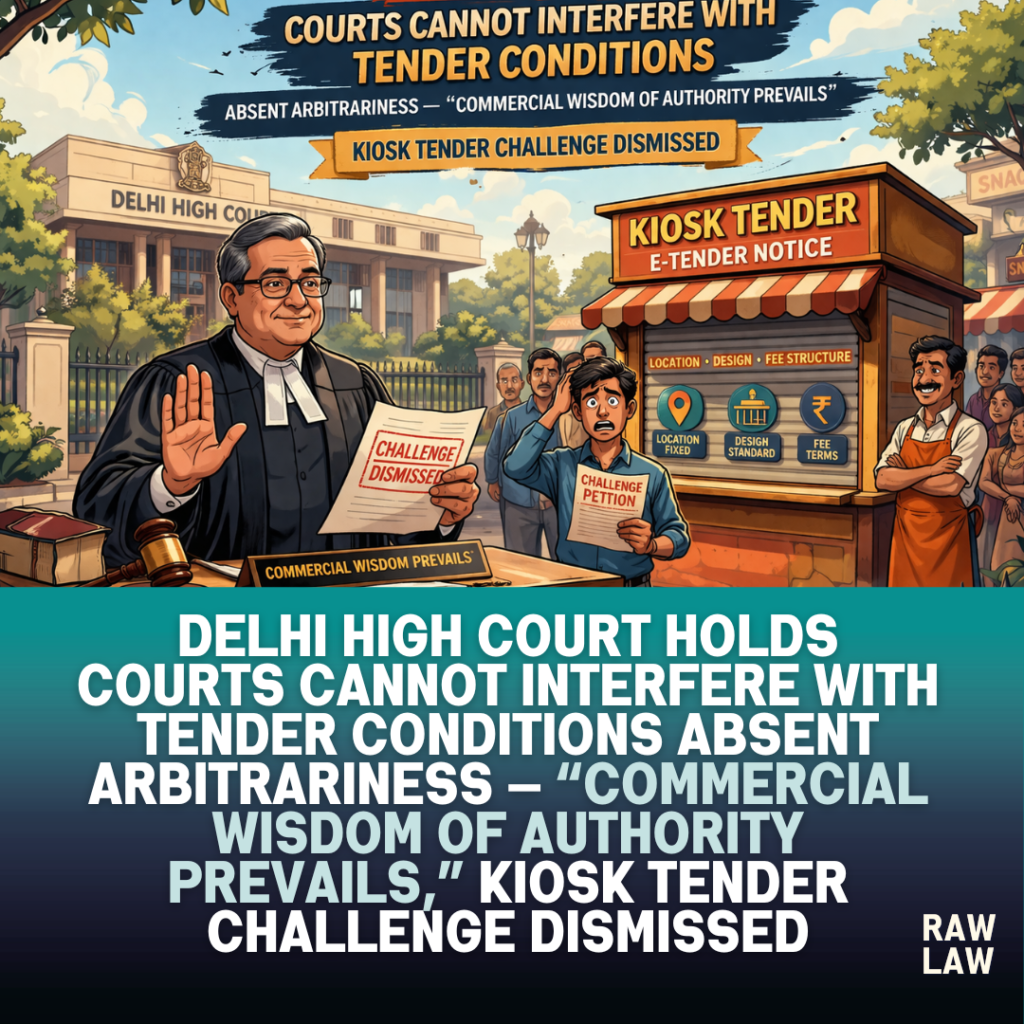
The Delhi High Court dismissed the writ petitions challenging the tender conditions issued for allotment of kiosks within a government hospital. The Court held that the eligibility criteria, including turnover requirements and license fee structure, fall within the domain of the tendering authority and cannot be interfered with unless shown to be arbitrary, discriminatory, or mala fide. Finding no such infirmity, the Court upheld the tender process.
Facts
The petitions arose from tenders floated by a government hospital for allotment of three kiosks within its premises. The petitioners were long-standing kiosk operators who had been running small canteen and photocopy services for several years under earlier allotments.
Their licenses had been periodically extended at subsidized rates. However, the hospital issued fresh tenders introducing revised eligibility criteria, including a minimum average annual turnover requirement and significantly higher license fees.
The petitioners challenged these conditions, alleging that they were designed to exclude small vendors and favor large entities. They also objected to selective inclusion of only three kiosks in the tender process while others were retained under separate arrangements.
Issues
The primary issue was whether the eligibility criteria, particularly the turnover requirement, were arbitrary and violative of constitutional guarantees under Articles 14 and 19(1)(g).
Another issue was whether selective tendering of only certain kiosks amounted to hostile discrimination.
The Court also examined whether the petitioners had any enforceable right or legitimate expectation to continue their operations under earlier arrangements.
Petitioner’s arguments
The petitioners argued that the turnover requirement was excessively high and had no rational nexus with the nature of kiosk operations. They contended that such conditions effectively excluded small vendors who had been operating for decades.
It was further argued that the steep increase in license fees was arbitrary and discriminatory, especially when similarly situated kiosks continued to operate at lower rates.
The petitioners also invoked the doctrine of legitimate expectation, asserting that past extensions created an expectation of continued operation.
Respondent’s arguments
The respondents argued that the tender conditions were formulated based on administrative requirements and commercial considerations. They contended that courts should not interfere with such decisions unless there is clear arbitrariness.
It was submitted that the turnover criteria had already been reduced to encourage wider participation and was necessary to ensure compliance with statutory requirements and service quality.
The respondents also justified the classification of kiosks, stating that certain units were reserved for cooperative societies to ensure availability of essential goods at regulated prices, while others were open for competitive bidding.
Analysis of the law
The Court reiterated settled principles governing judicial review of tenders, emphasizing that courts do not sit in appeal over commercial decisions of the State.
It held that the tendering authority has wide discretion in prescribing eligibility criteria and structuring the tender process, provided such decisions are not arbitrary or discriminatory.
The Court applied the doctrine of “Wednesbury unreasonableness,” holding that interference is warranted only when decisions are irrational or perverse.
It also noted that Article 14 does not prohibit reasonable classification based on intelligible differentia.
Precedent analysis
The Court relied on several Supreme Court decisions that limit judicial interference in tender matters.
In Directorate of Education v. Educomp Datamatics Ltd., it was held that tender conditions are within the domain of the authority and not subject to judicial scrutiny unless arbitrary.
In Uflex Ltd. v. Government of Tamil Nadu, the Court emphasized that commercial decisions should not be interfered with lightly.
Other precedents reaffirmed that courts must exercise restraint and respect administrative discretion in contractual matters.
Court’s reasoning
The Court found that the turnover criteria, even after reduction, was not arbitrary given the scale of operations and compliance requirements.
It held that the petitioners failed to demonstrate how the criteria lacked rational nexus with the objective of ensuring efficient service delivery.
On the issue of license fee, the Court accepted the respondents’ justification that earlier rates were subsidized and could not be claimed as a matter of right.
Regarding selective tendering, the Court held that classification between cooperative societies and private operators was based on legitimate policy considerations and did not violate Article 14.
The Court also rejected the plea of legitimate expectation, noting that extensions were temporary and expressly subject to finalization of fresh tenders.
Conclusion
The Delhi High Court concluded that the petitioners failed to establish arbitrariness, discrimination, or mala fide in the tender process. It upheld the tender conditions and dismissed the writ petitions.
Implications
This judgment reinforces the limited scope of judicial review in government tenders and procurement decisions.
It affirms that commercial and policy decisions of the State will be respected unless they are manifestly unreasonable or discriminatory.
For small vendors, the ruling highlights the challenges in contesting evolving eligibility criteria in public tenders.
For authorities, it provides legal backing to restructure tender frameworks based on administrative and commercial considerations.
Case law references
Directorate of Education v. Educomp Datamatics Ltd.
Held that courts should not interfere with tender conditions unless arbitrary.
Uflex Ltd. v. Government of Tamil Nadu
Reaffirmed restraint in judicial review of commercial decisions.
Air India Ltd. v. Cochin International Airport Ltd.
Recognized State’s freedom in contractual matters subject to fairness.
Monarch Infrastructure v. Ulhasnagar Municipal Corporation
Held that tender conditions are best decided by the authority.
FAQs
1. Can courts interfere with tender conditions in India?
Only if the conditions are arbitrary, discriminatory, or mala fide. Otherwise, courts defer to the authority’s commercial judgment.
2. Are high turnover requirements in tenders illegal?
Not necessarily. They are valid if they have a rational connection to the nature of work and ensure service quality.
3. Do existing vendors have a right to continue after tender is issued?
No. Past extensions do not create a legal right or guarantee continuation.