


1. Court’s decision
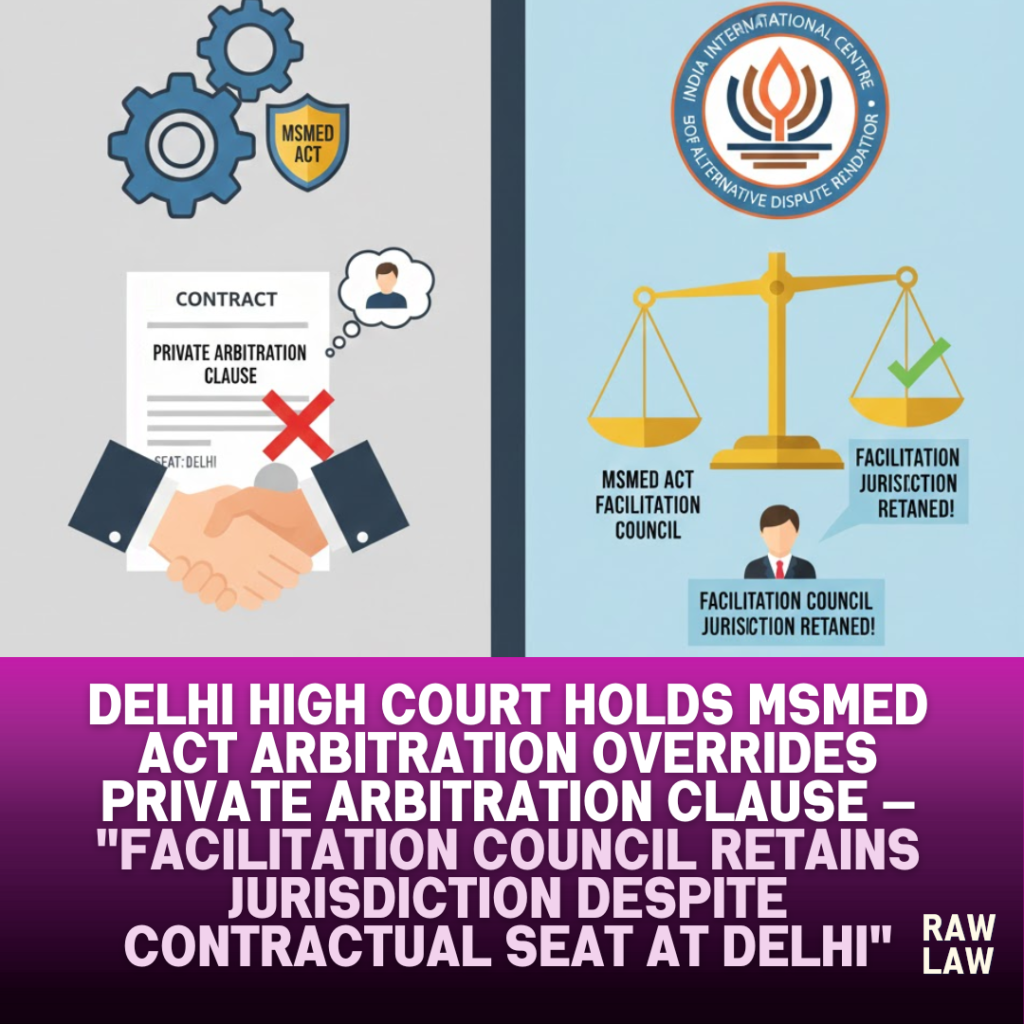
The Delhi High Court declined to appoint an arbitrator under Section 11 of the Arbitration and Conciliation Act, 1996, holding that once the statutory mechanism under the Micro, Small and Medium Enterprises Development Act, 2006 is invoked, it overrides any private arbitration agreement between the parties. The Court ruled that disputes already referred to the MSME Facilitation Council must continue before that forum — “a private arbitration clause cannot eclipse the statutory remedy under the MSMED Act” — and disposed of the petitions accordingly.
2. Facts
The petitioner, a cement manufacturing company, engaged the respondent for fabrication, erection, and installation works at two of its industrial units pursuant to purchase/work orders issued in October–November 2020. Each work order contained a dispute resolution clause providing for arbitration by a sole arbitrator with the seat at New Delhi. Disputes arose regarding delay and alleged non-performance. The respondent raised monetary claims and, in August 2023, invoked the statutory remedy under Section 18 of the MSMED Act before the District Micro and Small Enterprises Facilitation Council at Mohali, Punjab. Parallelly, the petitioner invoked contractual arbitration and approached the Delhi High Court seeking appointment of a sole arbitrator.
3. Issues
The core issues were whether the Delhi High Court could entertain a Section 11 petition when statutory arbitration under the MSMED Act was already pending, whether the MSMED Act overrides a contractual arbitration clause including the agreed seat, and whether disputes arising out of composite works contracts fall outside the jurisdiction of the Facilitation Council.
4. Petitioner’s arguments
The petitioner argued that the contracts were composite works contracts involving supply of goods and services, and therefore outside the scope of the MSMED Act. It was contended that the respondent was not a registered MSME at the time of execution of the contracts and could not retrospectively invoke statutory benefits. The petitioner further submitted that party autonomy under the arbitration clause could not be defeated and that the Facilitation Council had proceeded without proper conciliation, in breach of the Arbitration Act and agreed procedure.
5. Respondent’s arguments
The respondent countered that it was a duly registered MSME since 2009, with continuity preserved under the UDYAM transition framework, and thus validly invoked Section 18 of the MSMED Act. It was submitted that the MSMED Act is a special statute with overriding effect, that statutory arbitration once triggered supersedes any private arbitration agreement, and that the Facilitation Council alone had jurisdiction based on the supplier’s location. The respondent also argued that the petitioner was indulging in forum shopping, having already challenged jurisdiction before the Facilitation Council and the Punjab and Haryana High Court.
6. Analysis of the law
The Court examined the statutory framework of Sections 18 and 24 of the MSMED Act, emphasizing the non-obstante clauses and the deeming fiction treating arbitration under Section 18(3) as arbitration under Section 7 of the Arbitration Act. It reiterated that the MSMED Act is a special legislation enacted to protect micro and small enterprises and must prevail over general arbitration law in case of inconsistency.
7. Precedent analysis
The Court relied extensively on authoritative pronouncements of the Supreme Court of India, particularly Gujarat State Civil Supplies Corporation Ltd. v. Mahakali Foods Pvt. Ltd. and Harcharan Dass Gupta v. Union of India, which conclusively held that statutory arbitration under the MSMED Act overrides private arbitration agreements, including clauses on seat and jurisdiction. The Court noted that once a reference is made under Section 18, contractual autonomy stands displaced by legislative mandate.
8. Court’s reasoning
Applying these principles, the Court found that the respondent had validly invoked the MSMED Act before the Mohali Facilitation Council, which had already assumed seisin of the disputes. The contractual seat of arbitration at New Delhi could not prevail over the statutory determination of jurisdiction based on the supplier’s location. The Court further held that issues regarding the nature of the contract and MSME status were already raised in Section 16 applications pending before the Facilitation Council, which was competent to rule on its own jurisdiction. Judicial propriety demanded that the High Court refrain from parallel adjudication.
9. Conclusion
The Delhi High Court concluded that the petitions under Section 11 were not maintainable. Once the MSME Facilitation Council mechanism was triggered, the Court could not appoint an arbitrator under the Arbitration Act. The statutory remedy prevailed, and the petitioner was left to pursue its objections before the Facilitation Council in accordance with law.
10. Implications
This judgment reinforces the supremacy of the MSMED Act over private arbitration clauses and curtails attempts by buyers to bypass the statutory forum through Section 11 petitions. It strengthens the position of MSME suppliers by affirming that jurisdiction, seat, and procedure are governed by statute once Section 18 is invoked. The ruling also underscores judicial restraint where parallel proceedings are already pending before competent statutory tribunals.
Case Law References
- Gujarat State Civil Supplies Corporation Ltd. v. Mahakali Foods Pvt. Ltd. – Held that MSMED Act arbitration overrides private arbitration agreements; applied as binding precedent.
- Harcharan Dass Gupta v. Union of India – Affirmed statutory determination of seat and jurisdiction under MSMED Act; relied upon to reject Section 11 intervention.
- Silpi Industries v. Kerala State Road Transport Corporation – Recognised mandatory nature of MSMED Act remedies; cited in support of statutory supremacy.
FAQs
Q1. Does the MSMED Act override a private arbitration clause?
Yes. Once Section 18 of the MSMED Act is invoked, the statutory arbitration mechanism overrides any private arbitration agreement, including seat and jurisdiction clauses.
Q2. Can a High Court appoint an arbitrator when MSME Facilitation Council proceedings are pending?
No. Courts have held that Section 11 jurisdiction cannot be exercised once statutory arbitration under the MSMED Act has commenced.
Q3. Who decides jurisdictional objections under the MSMED Act?
The MSME Facilitation Council, acting as an arbitral tribunal, is empowered to rule on its own jurisdiction under principles analogous to Section 16 of the Arbitration Act.