


1. Court’s decision
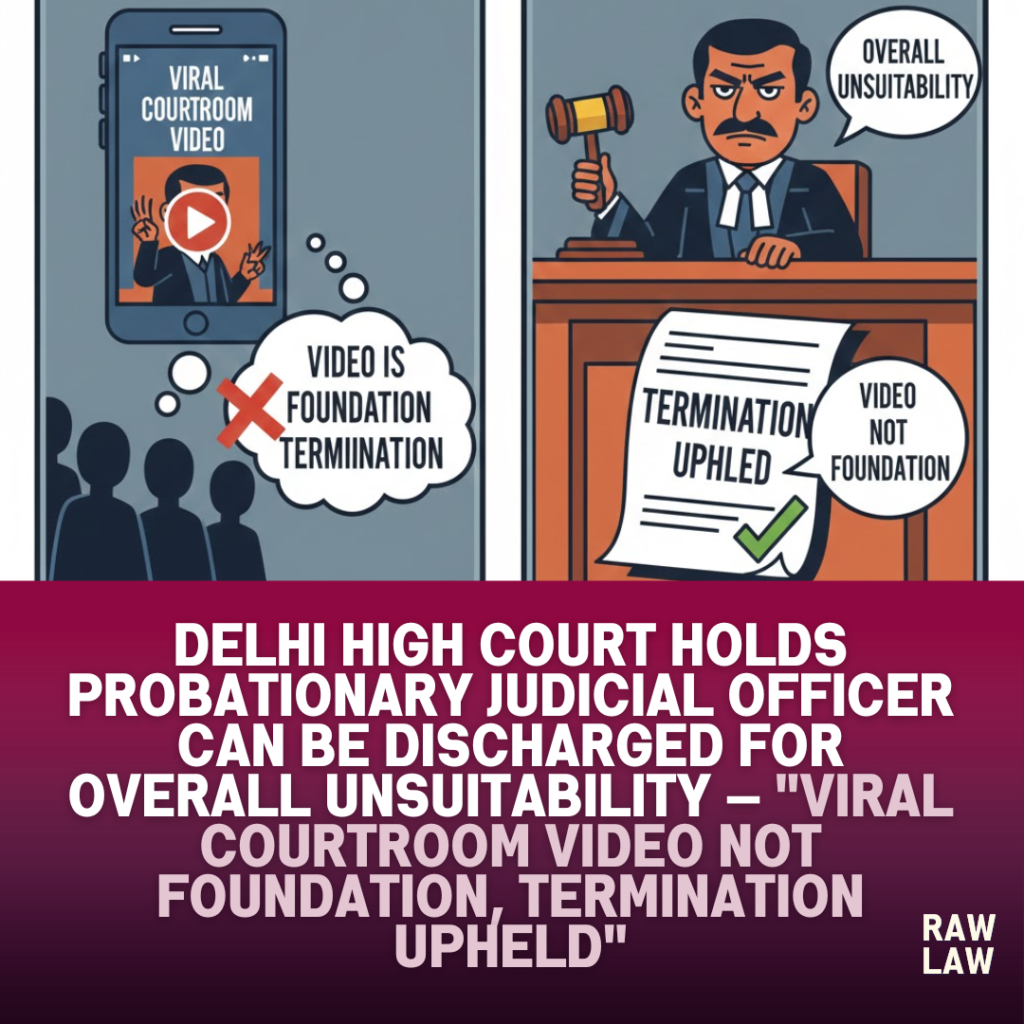
The Delhi High Court dismissed a writ petition challenging the termination of a probationary judicial officer from the Delhi Higher Judicial Service. The Court held that the discharge was a termination simpliciter based on an overall assessment of suitability during probation and not a punitive or stigmatic action founded on misconduct. It ruled that adverse annual confidential remarks, complaints considered by the Full Court, and the statutory power under service rules justified discontinuation without invoking disciplinary safeguards.
2. Facts
The petitioner was appointed to the Delhi Higher Judicial Service on probation for two years and posted as an Additional District Judge after training. During probation, a courtroom incident occurred where a litigant allegedly recorded proceedings without permission. A short video clip of the exchange circulated on social media, portraying the officer negatively. Subsequently, judicial work was withdrawn, and the Full Court resolved not to continue the petitioner in service. A notification and order formally terminated the probationary appointment.
3. Issues
The central issue was whether the termination of a probationary judicial officer was punitive and stigmatic, thereby attracting constitutional safeguards under Articles 14, 21, and 311(2), or whether it was a lawful termination simpliciter based on an assessment of overall suitability during probation under the governing service rules.
4. Petitioner’s arguments
The petitioner contended that the viral video incident was the real and proximate cause of termination. It was argued that a fact-finding exercise was undertaken behind his back, rendering the action punitive in substance. The termination was said to be disproportionate, violative of natural justice, and stigmatic, since it followed an inquiry into alleged misconduct. Reliance was placed on Supreme Court precedents to argue that even probationers are entitled to procedural safeguards when termination is founded on misconduct.
5. Respondent’s arguments
The respondents maintained that the termination was unrelated to the viral video. They relied on the petitioner’s Annual Confidential Report recorded prior to the incident, which contained adverse remarks on courtroom behaviour and quality of judgments. Complaints against the officer were also placed before the Full Court. It was submitted that under the service rules, a probationer could be discharged for unsuitability without assigning reasons, and no formal disciplinary inquiry or finding of misconduct had occurred.
6. Analysis of the law
The Court examined settled jurisprudence on termination of probationers, distinguishing between termination simpliciter and punitive discharge. It reiterated that a probationer has no vested right to hold office and may be discontinued for unsuitability, provided the order is not founded on a finding of misconduct. The Court emphasized the doctrinal distinction between motive and foundation, noting that preliminary fact-finding or background assessment does not convert an administrative discharge into a punitive action.
7. Precedent analysis
Relying on decisions of the Supreme Court of India, the Court referred to principles laid down in cases such as Parshottam Lal Dhingra, Samsher Singh, and Pavanendra Narayan Verma. These judgments establish that termination is punitive only where a full-scale inquiry into misconduct culminates in findings of guilt. The Court also discussed decisions where discharge of probationary judicial officers based on confidential records was upheld.
8. Court’s reasoning
Applying these principles, the Court found that no charge-sheet was issued, no departmental inquiry was conducted, and no finding of guilt was recorded against the petitioner. The termination order contained no stigmatic language. The adverse ACR, recorded before the viral incident, and complaints considered by the Full Court formed the basis of the institutional assessment of unsuitability. Any fact-finding following the video was merely contextual and did not constitute the foundation of the termination.
9. Conclusion
The Court concluded that the termination was a lawful exercise of power under the service rules to discontinue a probationer found unsuitable. Since the action was not punitive or stigmatic, constitutional protections applicable to disciplinary proceedings were not attracted. The writ petition was therefore dismissed.
10. Implications
The ruling reinforces judicial precedent that probationary judicial officers may be discharged for overall unsuitability without a disciplinary inquiry, provided the decision is not founded on proven misconduct. It underscores the autonomy of High Courts in assessing judicial temperament and performance during probation and clarifies that media controversy alone cannot convert an administrative assessment into a punitive action.
Case Law References
- Parshottam Lal Dhingra v Union of India – Established the distinction between termination simpliciter and punitive removal; applied to hold that probationers lack a right to post.
- Samsher Singh v State of Punjab – Affirmed that probationers can be discharged for unsuitability without Article 311(2) safeguards unless termination is punitive.
- Pavanendra Narayan Verma v Sanjay Gandhi PGI – Laid down the threefold test for identifying punitive termination; applied to find no punitive elements present.
- Radhey Shyam Gupta v UP State Agro Industries Corporation – Clarified motive versus foundation; relied upon to hold preliminary inquiries insufficient to make termination punitive.
- H.F. Sangati v Registrar General, High Court of Karnataka – Upheld discharge of probationary judicial officers based on confidential assessments; relied upon for analogous reasoning.
FAQs
Q1. Can a probationary judicial officer be terminated without an inquiry?
Yes. Courts have consistently held that a probationer may be discharged for overall unsuitability without a disciplinary inquiry, provided the termination is not founded on proven misconduct.
Q2. Does a viral courtroom video make termination punitive?
Not necessarily. Unless the termination is based on findings of misconduct arising from a formal inquiry, a viral incident may at most be a motive, not the legal foundation.
Q3. Are natural justice principles applicable to probationary termination?
Natural justice safeguards apply only when termination is punitive or stigmatic. Termination simpliciter for unsuitability during probation does not attract these requirements.