


Court’s decision
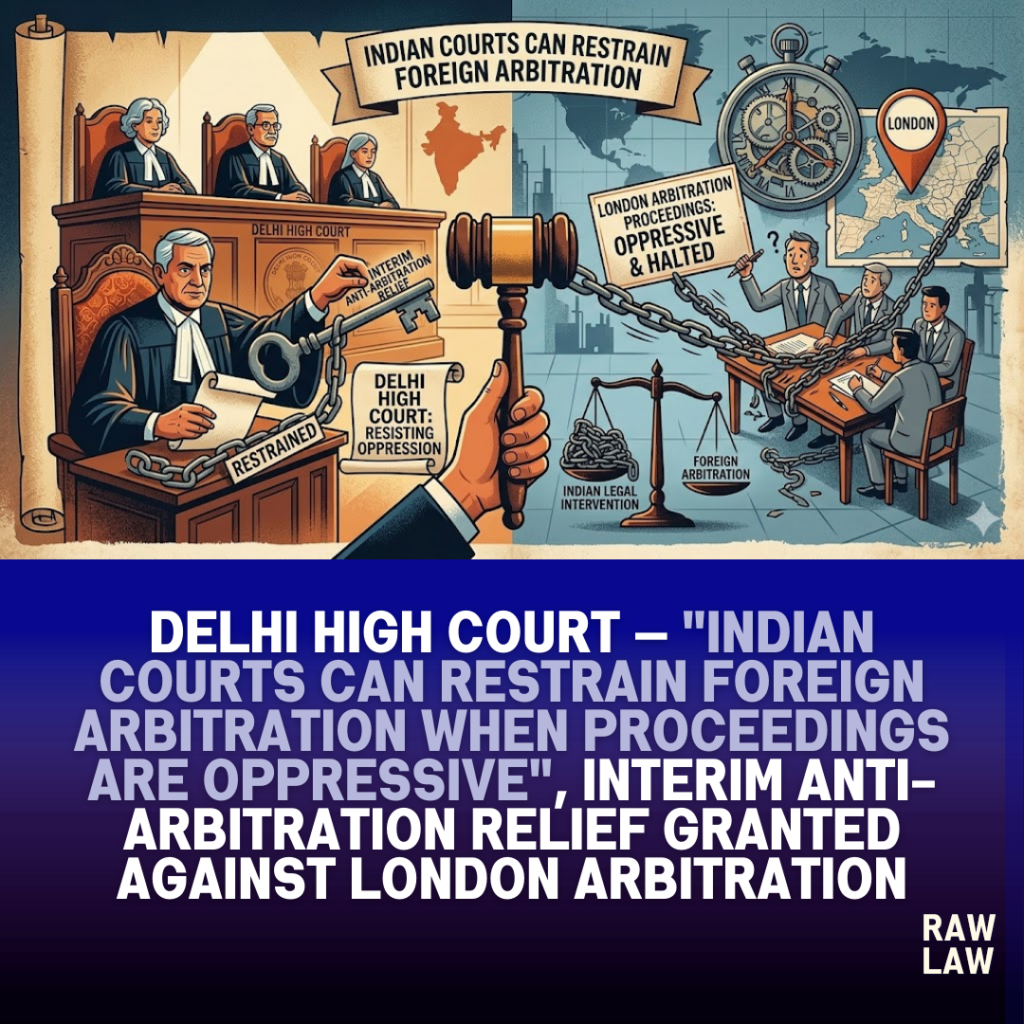
The Delhi High Court considered a suit seeking an injunction against arbitration proceedings initiated before the London Maritime Arbitrators Association (LMAA).
The plaintiffs requested the Court to restrain the defendant from continuing with two arbitration proceedings in London and to declare a partial arbitral award passed by the tribunal as invalid.
At the interim stage, the Court clarified that it was not adjudicating the merits of the arbitral award but was only examining whether the arbitration proceedings themselves should be allowed to continue.
The Court held that it had territorial jurisdiction to entertain the suit and could examine whether the arbitral proceedings were oppressive or vexatious.
Facts
The dispute arose from a voyage charter agreement involving shipment of military cargo for the United Nations Interim Security Force for Abyei (UNISFA).
The plaintiffs, Indian logistics companies headquartered in New Delhi, entered into a Booking Note dated 4 April 2023 for transportation of 159 military equipment items from Nhava Sheva Port in Mumbai to Port Sudan.
The cargo included equipment classified as dangerous goods under international maritime regulations.
However, soon after the agreement was executed, armed conflict erupted in Sudan.
On 18 April 2023, the United Nations issued an advisory declaring port and cargo operations in Sudan unsafe. Consequently, the United Nations terminated its purchase order with the plaintiffs citing force majeure.
Following this development, the plaintiffs informed the shipping counterparties that the Booking Note stood cancelled due to force majeure.
Despite this, the defendant vessel owner issued a Notice of Readiness and claimed damages of approximately USD 584,741 as dead freight.
The defendant subsequently initiated arbitration proceedings in London under the rules of the LMAA.
Issues
The Delhi High Court considered several key legal issues:
- Whether the Delhi High Court had territorial jurisdiction to entertain the suit.
- Whether a binding contract and arbitration agreement existed between the parties.
- Whether the continuation of arbitration proceedings in London was oppressive or vexatious.
- Whether Indian courts can grant anti-arbitration injunctions against foreign-seated arbitrations.
Petitioner’s arguments
The plaintiffs argued that the arbitration proceedings were fundamentally defective and abusive.
According to them, the defendant was not a party to the Booking Note, and therefore there was no privity of contract between the parties.
They further contended that the Booking Note did not contain any arbitration clause and that the arbitral tribunal had effectively rewritten the contract by treating the absence of the arbitration clause as a typographical error.
The plaintiffs also argued that the defendant had initiated two parallel arbitration proceedings arising from the same contract and cause of action, thereby subjecting them to duplicative litigation.
They contended that this conduct was oppressive and justified judicial intervention by Indian courts.
Respondent’s arguments
The defendant opposed the suit and argued that the Delhi High Court lacked jurisdiction.
According to the defendant, the seat of arbitration was London, and therefore the courts in England had exclusive supervisory jurisdiction over the arbitration proceedings.
It was also argued that the plaintiffs had participated in the arbitration proceedings for nearly two years before approaching the Delhi High Court.
Therefore, the plaintiffs were barred by waiver, acquiescence, and estoppel from challenging the arbitration at this stage.
The defendant also argued that the arbitration clause existed in the Fixture Recap agreement, which formed part of the contractual framework between the parties.
Analysis of the law
The Court analysed the jurisdiction of civil courts under Section 9 of the Code of Civil Procedure, which grants courts authority to try all civil suits unless jurisdiction is expressly or impliedly barred.
The Court emphasized that exclusion of civil court jurisdiction cannot be presumed and must be clearly established by law.
The Court further noted that Indian courts retain inherent powers under Section 151 CPC to prevent abuse of judicial or quasi-judicial processes.
In exceptional cases where arbitration proceedings are alleged to be vexatious, oppressive, or unconscionable, civil courts may intervene to protect parties from procedural injustice.
Precedent analysis
The Court relied on the Supreme Court decision in World Sport Group (Mauritius) Ltd. v. MSM Satellite (Singapore) Pte. Ltd., which held that Indian courts can restrain foreign arbitration proceedings if part of the cause of action arises within India.
The Court also relied on Dhulabhai v. State of Madhya Pradesh, which established that jurisdiction of civil courts cannot be excluded unless expressly barred by statute.
Additionally, the Court referred to Engineering Projects (India) Ltd. v. MSA Global LLC, where the Delhi High Court held that civil courts can intervene when arbitration proceedings are used as a tool of oppression or abuse.
Court’s reasoning
The Court found that several elements of the transaction had a clear connection with New Delhi.
The plaintiffs were headquartered in Delhi, the contractual negotiations were conducted from Delhi, and the cargo originated from Army facilities located in New Delhi before being transported to Mumbai.
Furthermore, arbitration notices and related communications were received by the plaintiffs in New Delhi.
The Court therefore concluded that part of the cause of action arose within Delhi, giving the High Court territorial jurisdiction under Section 20(c) of the CPC.
The Court also observed that enforcement of any future arbitral award would likely take place in India because the plaintiffs’ assets were located in Delhi.
Conclusion
The Delhi High Court held that it had jurisdiction to entertain the suit and examine the plaintiffs’ request for an anti-arbitration injunction.
The Court reiterated that while courts should generally refrain from interfering with arbitration proceedings, judicial intervention may be warranted in exceptional cases where the arbitral process itself appears abusive or oppressive.
Accordingly, the Court proceeded to consider whether the continuation of the London arbitration should be restrained.
Implications
This ruling significantly clarifies the scope of anti-arbitration injunctions in India, particularly in the context of foreign-seated arbitrations.
The judgment affirms that Indian courts retain residual jurisdiction to intervene when arbitration proceedings threaten procedural fairness or are used as instruments of harassment.
At the same time, the decision underscores that such intervention is extraordinary and must be exercised sparingly.
For international commercial disputes involving Indian parties, the judgment highlights that choice of a foreign arbitral seat does not completely insulate arbitration proceedings from scrutiny by Indian courts.
Case Law References
- World Sport Group (Mauritius) Ltd. v. MSM Satellite (Singapore) Pte. Ltd. (2014)
Held that Indian courts may restrain foreign arbitration proceedings where part of the cause of action arises in India. - Dhulabhai v. State of Madhya Pradesh (1968)
Established principles governing exclusion of civil court jurisdiction. - Engineering Projects (India) Ltd. v. MSA Global LLC (2025)
Held that civil courts can grant anti-arbitration injunctions in cases of oppressive or abusive arbitral proceedings.
FAQs
1. Can Indian courts stop foreign arbitration proceedings?
Yes, but only in exceptional cases. Courts may grant anti-arbitration injunctions where the arbitration proceedings are oppressive, vexatious, or constitute abuse of process.
2. Does choosing a foreign arbitration seat remove jurisdiction of Indian courts?
No. While foreign courts have supervisory jurisdiction, Indian courts may still intervene if part of the cause of action arises in India or if the arbitration process is abusive.
3. What is an anti-arbitration injunction?
An anti-arbitration injunction is a court order restraining a party from initiating or continuing arbitration proceedings in certain circumstances.