


Court’s decision
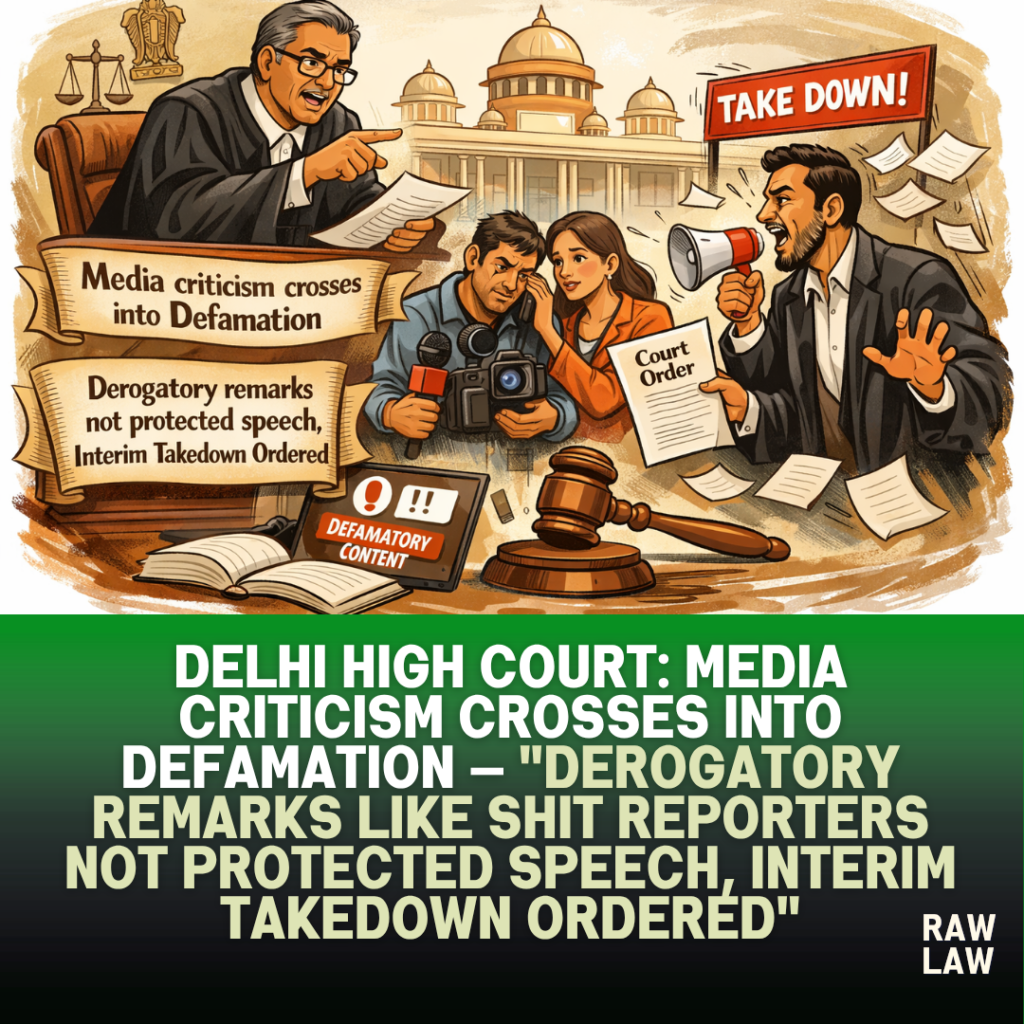
The Delhi High Court partly allowed the appeal and granted interim relief against defamatory and disparaging content published by a digital media platform against a television news network. While upholding the Single Judge’s finding that a prima facie case of defamation and disparagement existed, the Division Bench held that refusal of injunction was erroneous. It directed removal of specific derogatory statements, holding that freedom of speech does not extend to abusive, reputation-damaging expressions lacking factual basis.
Facts
The dispute arose between two prominent media entities operating in the digital and broadcast news ecosystem. The plaintiff, a major television network, alleged that the defendant, a digital media platform, had published videos containing defamatory, disparaging, and copyright-infringing content.
The impugned content included critique programmes where excerpts from the plaintiff’s broadcasts were used alongside commentary.
The plaintiff claimed that these videos contained abusive language and false statements harming its reputation and goodwill, while also infringing copyright.
The Single Judge found a prima facie case but refused interim injunction, leading to cross appeals before the Division Bench.
Issues
The Court examined whether the defendant’s content constituted defamation and commercial disparagement.
It also considered whether use of broadcast excerpts amounted to copyright infringement or was protected under fair dealing.
Another key issue was whether interim injunction should be granted in light of free speech protections and the Bonnard standard.
Additionally, the Court addressed whether composite suits involving copyright and defamation could be maintained before a Commercial Court.
Petitioner’s arguments
The plaintiff argued that the defendant’s content went beyond criticism and entered the realm of abusive disparagement, citing phrases such as “shit reporters” and “shit show.”
It contended that such statements were false, malicious, and intended to harm its commercial reputation.
The plaintiff further argued that the defendant’s use of copyrighted content did not qualify as fair dealing, as it was excessive and commercially exploitative.
It was also submitted that delay or existence of damages does not bar interim injunction in cases of ongoing reputational harm.
Respondent’s arguments
The defendant argued that its content constituted satire, criticism, and commentary on matters of public interest.
It relied on the defence of truth and fair dealing, asserting that excerpts were used for critique and review.
The defendant also argued that interim injunction would violate freedom of speech and expression.
It further contended that both parties operated in different markets, with distinct business models, and hence no commercial disparagement could arise.
Analysis of the law
The Court undertook a detailed analysis of copyright law, defamation, and commercial disparagement.
On copyright, it reiterated that fair dealing under Section 52 protects criticism and review, but the determination is fact-specific and requires trial.
On defamation, the Court applied the Bonnard principle, emphasizing caution in granting injunctions against speech.
However, it clarified that speech loses protection when it is abusive, lacks factual basis, and causes reputational harm.
On commercial disparagement, the Court reiterated that false and injurious statements targeting a competitor’s goods or services are actionable.
Precedent analysis
The Court relied on several key precedents:
- Wander Ltd v Antox India (1990)
Limited appellate interference in interim orders. - Bloomberg v Zee (2024)
Emphasized cautious approach in granting injunctions in defamation cases. - Reckitt Benckiser v Gillette (2016)
Defined principles of disparagement and comparative advertising. - Pepsi Co. v Hindustan Coca Cola (2003)
Distinguished puffery from actionable disparagement. - Super Cassettes v Chintamani Rao
Clarified limits of fair dealing and necessity of genuine critique.
These precedents shaped the Court’s balanced approach between free speech and reputation.
Court’s reasoning
The Court agreed that certain statements made by the defendant were clearly defamatory and disparaging.
It held that expressions like “shit reporters,” “shit show,” and similar remarks were not legitimate criticism but abusive attacks lacking factual basis.
The Court rejected the argument that such remarks were protected as satire or fair comment, noting that they crossed the line into reputational harm.
It further held that both parties operated in overlapping media spaces and competed for audience attention, rejecting the “different market” defence.
Importantly, the Court found that the Single Judge misapplied the balance of convenience test by overemphasizing the need for trial.
It held that continued publication of such statements would cause irreparable harm, which could not be adequately compensated by damages.
Thus, interim protection was necessary to prevent ongoing injury.
Conclusion
The Delhi High Court partly allowed the appeal, set aside the refusal of injunction, and directed removal of defamatory and disparaging statements while leaving other issues for trial.
Implications
This judgment is a landmark in media law, clarifying the limits of free speech in digital journalism.
It reinforces that criticism and satire are protected, but abusive and baseless attacks are not.
The ruling also strengthens protection against commercial disparagement in the digital media landscape.
Importantly, it signals that courts will intervene at the interim stage where reputational harm is clear and ongoing.
The decision balances constitutional free speech with the right to reputation, setting a strong precedent for media accountability.
Case law references
- Wander Ltd v Antox India (1990)
Limits appellate interference in interim matters. - Bloomberg v Zee (2024)
Bonnard standard in defamation injunctions. - Reckitt Benckiser v Gillette (2016)
Tests for disparagement. - Pepsi Co. v Hindustan Coca Cola (2003)
Puffery vs disparagement. - Super Cassettes v Chintamani Rao
Scope of fair dealing in copyright law.
FAQs
1. Is satire protected under Indian law in defamation cases?
Yes, but only if it does not cross into abusive or false statements that harm reputation.
2. Can courts order takedown of defamatory content before trial?
Yes, if a strong prima facie case exists and continued publication causes irreparable harm.
3. What is commercial disparagement in law?
It refers to false or misleading statements that harm the reputation of a competitor’s goods or services.