


1. Court’s decision
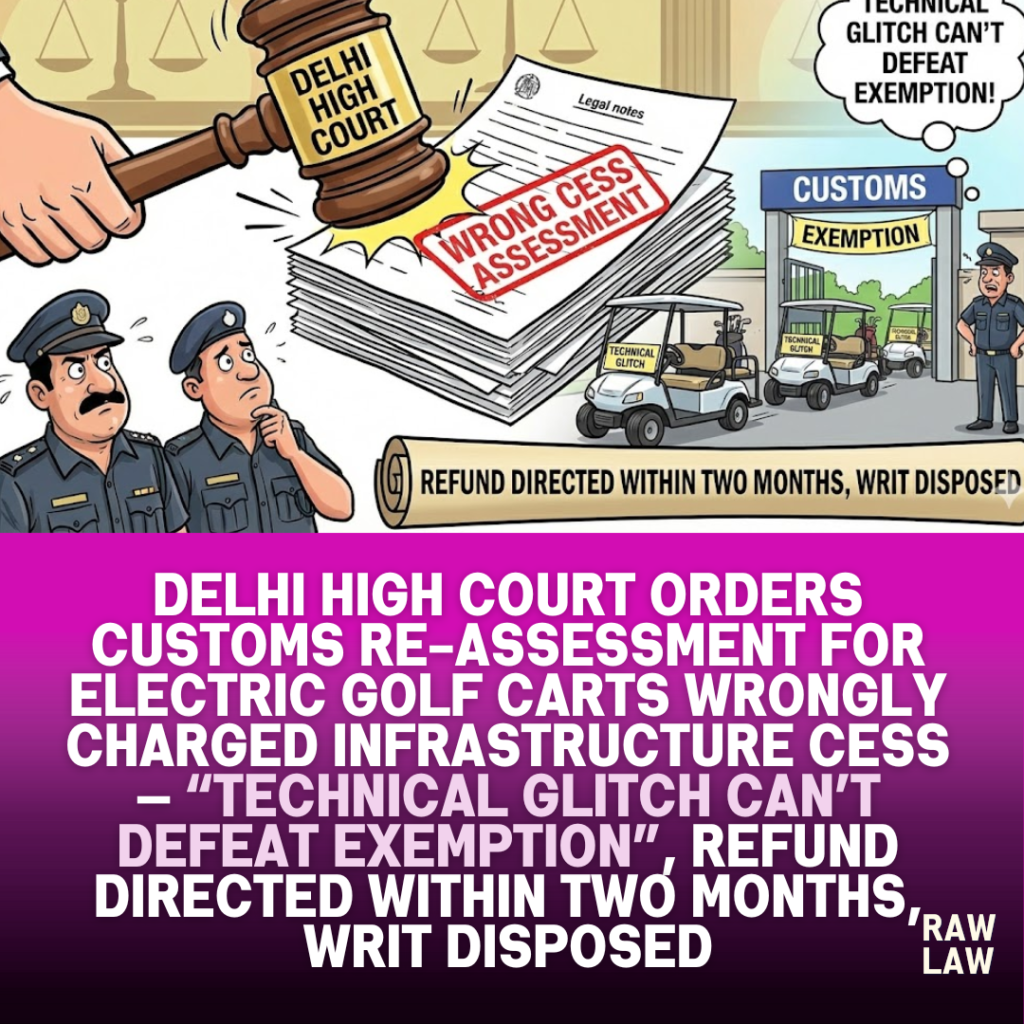
The Delhi High Court disposed of a writ petition by directing Customs to re-assess two bills of entry for imported electric golf carts within two months, and thereafter issue refund of excess duty paid towards infrastructure cess under Notification 1/2016. The Court noted that the petitioner’s goods were covered by the exemption, that the department’s counter affidavit did not answer the allegation of an EDI technical glitch preventing the exemption claim, and held that the amount “cannot be held back” once exemption coverage is clear.
2. Facts
The petitioner imported electrically operated golf carts and filed bills of entry dated 7 March 2016 and 23 September 2016. The petitioner asserted these goods were exempt from infrastructure cess under Notification 1/2016-Infrastructure Cess dated 1 March 2016, which exempts “electrically operated vehicles” under the relevant tariff heading at nil rate.
According to the petitioner, when filing the bills of entry on the EDI system, a technical problem prevented the exemption from being claimed/accepted. As a result, the petitioner paid higher customs duty than what was actually payable and later sought refund of the excess amount paid towards infrastructure cess. Despite repeated representations, the refund did not materialise.
3. Issues
The High Court had to decide whether the petitioner could be granted refund for excess infrastructure cess when the department’s stand was that the bills of entry had been finally assessed and refund would be “premature” unless the petitioner first sought reassessment or filed an appeal against the assessment. The case therefore turned on the procedural sequencing under customs law: can refund be ordered directly, or must it follow reassessment/modification of the assessment order?
4. Petitioner’s arguments
The petitioner’s case was that electric golf carts were squarely covered by Notification 1/2016 and therefore infrastructure cess was not payable. It was argued that due to an EDI technical glitch, the exemption could not be claimed at the time of assessment, and the petitioner was compelled to pay higher duty to secure urgent clearance of goods with the assurance that the excess could be claimed later. The petitioner submitted that repeated requests to enable reassessment and refund were not acted upon, and sought court directions to release the refund for the excess duty paid.
5. Respondent’s arguments
The department’s communications, relied upon in the order, took the position that the refund claim was premature because the bill of entry had been finally assessed and duty was paid as per assessment. It stated that if the importer was dissatisfied with assessment, the proper course was to lodge protest and seek reassessment before the assessing officer, or file an appeal before the Commissioner (Appeals). The department also maintained that refund could not be granted unless reassessment was done.
6. Analysis of the law
The Court placed the dispute in the statutory framework governing refund under Section 27 of the Customs Act and reassessment/appeal mechanisms under the Act. It relied heavily on the Supreme Court’s ruling in M/s ITC Ltd. v. C.C.E., Kolkata-IV, which held that refund cannot be entertained unless the assessment or self-assessment is modified in accordance with law, and that Section 27 cannot be used as a route to effectively set aside an assessment order. In other words, the legal pathway is: first modify assessment through appropriate proceedings; then refund follows.
But the Court also treated the present case as one where reassessment ought to be facilitated swiftly because the goods were clearly exempt under Notification 1/2016 and the record did not rebut the importer’s explanation of a technical inability to claim exemption through EDI.
7. Precedent analysis
The only precedent explicitly relied upon was M/s ITC Ltd. v. C.C.E., Kolkata-IV, for the proposition that a refund claim cannot bypass the assessment framework and must follow modification of assessment through lawful proceedings such as appeal or reassessment. The High Court applied this principle not to deny relief, but to structure relief properly—directing reassessment as the necessary precursor to refund.
8. Court’s reasoning
The High Court noted that the departmental refusal was rooted in the argument that the bills of entry were finally assessed and therefore refund could not be issued without reassessment. The Court accepted the legal sequencing from ITC Ltd. and held that reassessment is indeed required before refund.
However, the Court also observed that the counter affidavit did not respond to the petitioner’s specific allegation that a technical glitch in the EDI system prevented the exemption being claimed. Given the exemption notification’s coverage of electrically operated vehicles and the stated nature of the goods, the Court concluded the benefit “ought to have been extended” and therefore the excess amount could not be indefinitely withheld. It therefore directed Customs to complete reassessment within two months and then issue refund in terms of the exemption notification.
9. Conclusion
The writ petition was disposed of by a time-bound remedial direction: re-assess the relevant bills of entry within two months and then process the refund for excess infrastructure cess paid. The Court balanced the Supreme Court’s insistence on procedural correctness with the practical reality that exemption benefits cannot be defeated by EDI/technical barriers, especially where the department does not dispute the core factual assertion.
10. Implications
This decision is important for importers facing system-based denial of exemptions at the bill of entry stage. It reinforces two propositions: first, that refunds are procedurally tethered to reassessment/modification of assessment and cannot be granted as a shortcut; and second, that where exemption coverage is clear and the denial flows from a documented EDI technical issue, courts may direct the department to undertake reassessment on a strict timeline and release refunds rather than leaving importers to navigate prolonged administrative loops. For customs administration, it signals that failure to rebut key factual allegations—like system glitches—can weigh heavily in judicial directions for time-bound reassessment and refund.
Case law references
1) Supreme Court: M/s ITC Ltd. v. C.C.E., Kolkata-IV
- What it held: Refund cannot be entertained unless the assessment or self-assessment is modified through appropriate legal proceedings; Section 27 cannot itself be used to set aside assessment and reassess duty for refund.
- How applied here: The High Court used it to hold that refund must follow reassessment, and therefore directed reassessment within two months and refund thereafter.
FAQs
1) Can I get a customs refund for infrastructure cess without first challenging or modifying the bill of entry assessment?
Generally no. The Delhi High Court reiterated (following the Supreme Court) that refund under Section 27 cannot be granted unless the assessment/self-assessment is first modified through reassessment or appeal.
2) What if an EDI system glitch prevents claiming an exemption notification at the time of import?
This ruling indicates that where exemption coverage is clear and the importer plausibly shows an EDI technical problem, the court can direct Customs to re-assess the bill of entry and issue refund within a fixed timeline.
3) Are electric golf carts exempt from infrastructure cess under Notification 1/2016?
In this case, the Court proceeded on the basis that electrically operated vehicles falling under the notified entry attracted nil infrastructure cess and held that the exemption benefit ought to have been extended, subject to reassessment.