


1. Court’s decision
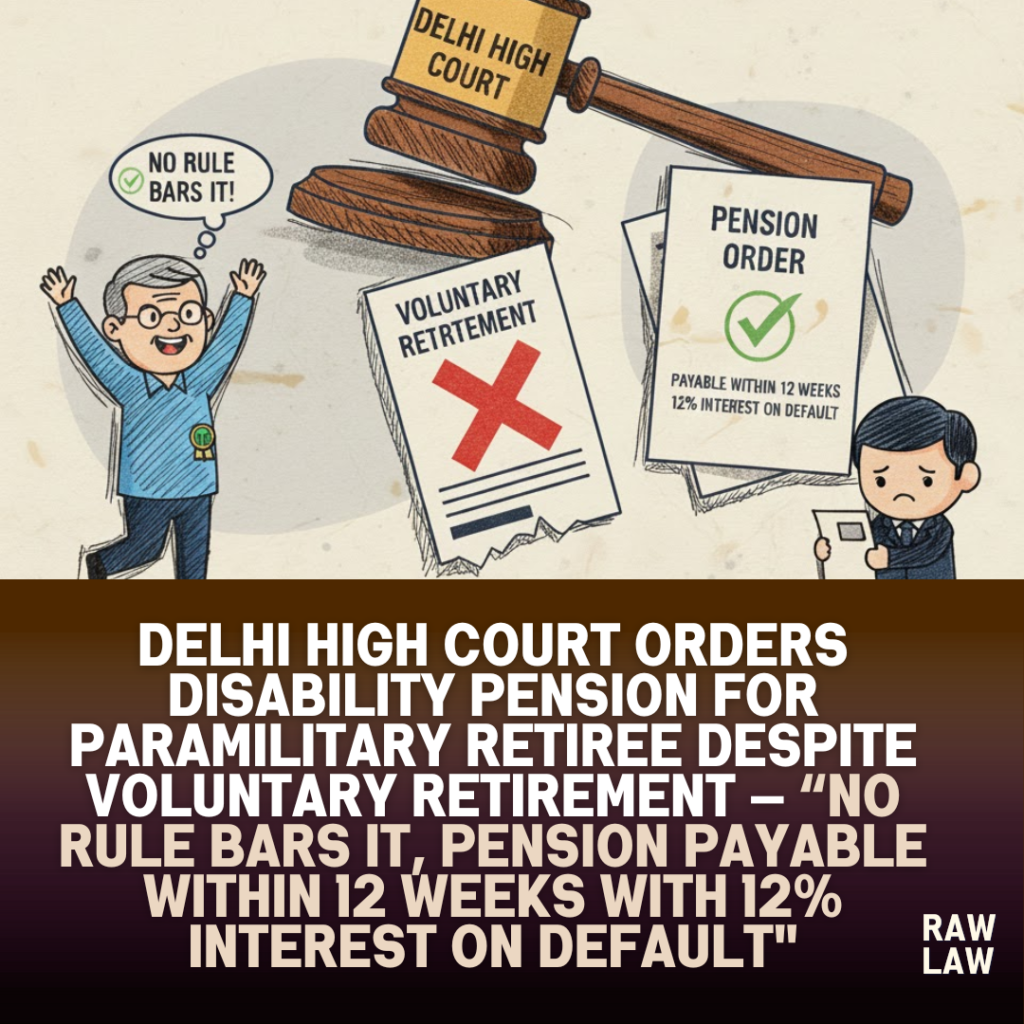
The Delhi High Court allowed a writ petition seeking disability pension under Rule 4(1) and Rule 4(2) of the Central Civil Services (Extraordinary Pension) Rules, 2023. The Court rejected the Union’s stand that voluntary retirement automatically disentitles an employee from disability pension. It held that the pension rules contain no such disqualification and that the case had to be decided on the statutory test of causal connection/attribution or aggravation by service. The Court directed disbursal of disability pension from the date of voluntary retirement within 12 weeks from December 22, 2025, failing which interest at 12% per annum would be payable till actual payment.
2. Facts
The petitioner was enrolled as a Constable in the Border Security Force on July 31, 1994. Nearly three decades later, he was diagnosed on March 3, 2022 by the Medical Superintendent of a Government Psychiatric Diseases Hospital in Srinagar as suffering from Major Depressive Disorder with comorbid Obsessive Compulsive Disorder. A Medical Board was convened on March 20, 2023 to assess his fitness to continue in service. The Board found him unfit for further service, recorded a permanent disability assessment, and noted that the disability was aggravated by service due to “stress & strain.” Thereafter, he took voluntary retirement.
3. Issues
The High Court was required to decide whether an employee who takes voluntary retirement can still claim disability pension under the Central Civil Services (Extraordinary Pension) Rules, 2023, when medical opinion certifies that the disability arose in service and was aggravated by service conditions. Put differently, the core legal issue was whether voluntary retirement operates as a disqualifying event, even in the absence of an express statutory bar, and whether the petitioner satisfied the rule-based requirement of a causal connection between disablement and government service, including the concept of service-related aggravation. A connected issue was the effective date and enforceability of payment, including consequences of default.
4. Petitioner’s arguments
The petitioner sought disability pension under Rule 4(1) and Rule 4(2) of the Central Civil Services (Extraordinary Pension) Rules, 2023. He relied on the Medical Board’s findings that he was suffering from Major Depressive Disorder, that the disability was contracted in service, that it was contracted in circumstances beyond his control, and that even if not directly attributable to service, it was aggravated by service due to stress and strain. The petitioner’s case, as accepted by the Court’s framing, was that the rules focus on attribution/aggravation and do not impose a blanket exclusion merely because the employee opted for voluntary retirement after being medically assessed as unfit.
5. Respondent’s arguments
The Union, through counsel, raised a narrow legal objection: because the petitioner had taken voluntary retirement, he was not entitled to disability pension. The respondents did not appear to dispute that the petitioner had been diagnosed with serious psychiatric illness, that a Medical Board had assessed him as unfit for further service, or that the Board had recorded aggravation by service due to stress and strain with a quantified disability assessment and permanent nature. The principal defence therefore turned on the proposition that voluntary retirement, by itself, breaks the entitlement to disability pension, regardless of what the Extraordinary Pension Rules provide about causal connection and aggravation.
6. Analysis of the law
Rule 4 of the Central Civil Services (Extraordinary Pension) Rules, 2023 sets the legal gateway for disability pension: a pension is grantable if there is a causal connection between disablement and government service, and disablement is treated as due to service when certified as attributable to service or where a disease existed before or arose during service and has been aggravated thereby. The Court treated this as a complete statutory code for deciding eligibility. On this framework, the decisive inquiry is not the mode of exit from service but whether the disability satisfies attribution or aggravation requirements supported by certification. Any disqualification must be traceable to an express rule, not assumed as a policy preference.
7. Precedent analysis
To test the Union’s voluntary retirement objection, the Court contrasted the present rules with a Supreme Court decision where a specific provision expressly disentitled disability pension in cases of voluntary retirement. The Court noted that such an express disentitling clause is absent in the Central Civil Services (Extraordinary Pension) Rules, 2023. It also relied on a recent Delhi High Court decision where the same distinction was acknowledged, reinforcing that entitlement turns on what the governing pension rules state, not on generalized assumptions about voluntary retirement. This precedent-based approach served a rule-of-law function: it prevented importing disqualifications from other statutory contexts into a different pension regime that does not contain them.
8. Court’s reasoning
The High Court held that the respondents’ sole objection could not stand because there is no provision in the Central Civil Services (Extraordinary Pension) Rules, 2023 which bars disability pension merely because the employee opted for voluntary retirement. It underlined that the Supreme Court case cited by the Court itself was distinguishable precisely because the disqualification there was rule-based, whereas the present rules do not contain any such exclusion. On facts, the Court also noted the Medical Board’s findings that the disability was contracted in service, not directly attributable to specific service conditions, yet aggravated by service due to stress and strain, with a quantified disability percentage and a permanent character. On this record, the petitioner’s entitlement was made out.
9. Conclusion
The Delhi High Court concluded that voluntary retirement cannot be treated as a blanket bar to disability pension when the governing Extraordinary Pension Rules do not say so. Applying the statutory test in Rule 4, and taking the Medical Board’s certification on aggravation by service at face value, the Court held that the petitioner was entitled to the disability pension he sought. The writ petition was accordingly allowed. The Court’s remedial direction was also firm and time-bound: disability pension was to be disbursed from the date of voluntary retirement, within 12 weeks from December 22, 2025. To ensure compliance, the Court added a default consequence—interest at 12% per annum until actual payment.
10. Implications
This ruling clarifies an important point for disability pension claims under the Central Civil Services (Extraordinary Pension) Rules, 2023: eligibility is governed by attribution/aggravation standards and the presence (or absence) of express disqualifying clauses, not by assumptions attached to voluntary retirement. For serving personnel and retirees facing psychiatric disability, the judgment reinforces the evidentiary importance of Medical Board proceedings—particularly clear findings on whether the disability was contracted in service, whether it was beyond the employee’s control, and whether it was aggravated by service due to stress and strain. For authorities, the decision signals that denial of disability pension must be anchored in the text of the applicable rules; otherwise, courts may intervene with strict timelines and interest for default.
Case law references
1) Supreme Court: Union of India v. Ajay Wahi ((2010) 11 SCC 213)
- What it held (as discussed): The Supreme Court dealt with a framework where an express provision existed that disentitled disability pension in cases of voluntary retirement.
- How applied/distinguished: The Delhi High Court distinguished it on the ground that the Central Civil Services (Extraordinary Pension) Rules, 2023 contain no comparable disentitling provision; therefore, the voluntary retirement objection could not be imported into this statutory scheme.
2) Delhi High Court: Union of India v. Major Gaurav Sheoran (Retd.) (decision dated October 9, 2025)
- What it held (as referenced): The High Court had previously noted the same point of distinction—eligibility cannot be denied by assuming a voluntary retirement bar when the applicable rules do not provide it.
- How applied: The Court cited its earlier approach to reinforce that the present case must be governed strictly by the text of the Extraordinary Pension Rules, 2023, and not by disqualifications from other pension regimes.
FAQs
1) Can disability pension be granted even if an employee takes voluntary retirement?
Yes—under the Central Civil Services (Extraordinary Pension) Rules, 2023, disability pension depends on whether the disablement is causally connected to service, including attribution or aggravation. The Delhi High Court held that voluntary retirement does not by itself bar disability pension when the rules do not contain an express disqualification.
2) What does “aggravated by service” mean for disability pension?
It refers to a situation where a disease or condition existing before or arising during service becomes worse because of service-related factors. In this case, the Medical Board recorded that the psychiatric disability, though not directly attributable to specific service conditions, was aggravated by service due to “stress & strain.”
3) What relief can courts grant if disability pension is wrongly denied?
Courts can direct payment within a fixed timeline and may impose interest for delay to secure compliance. Here, the Court ordered payment within 12 weeks from December 22, 2025, and directed that default would attract 12% per annum interest until actual payment.