


Court’s decision
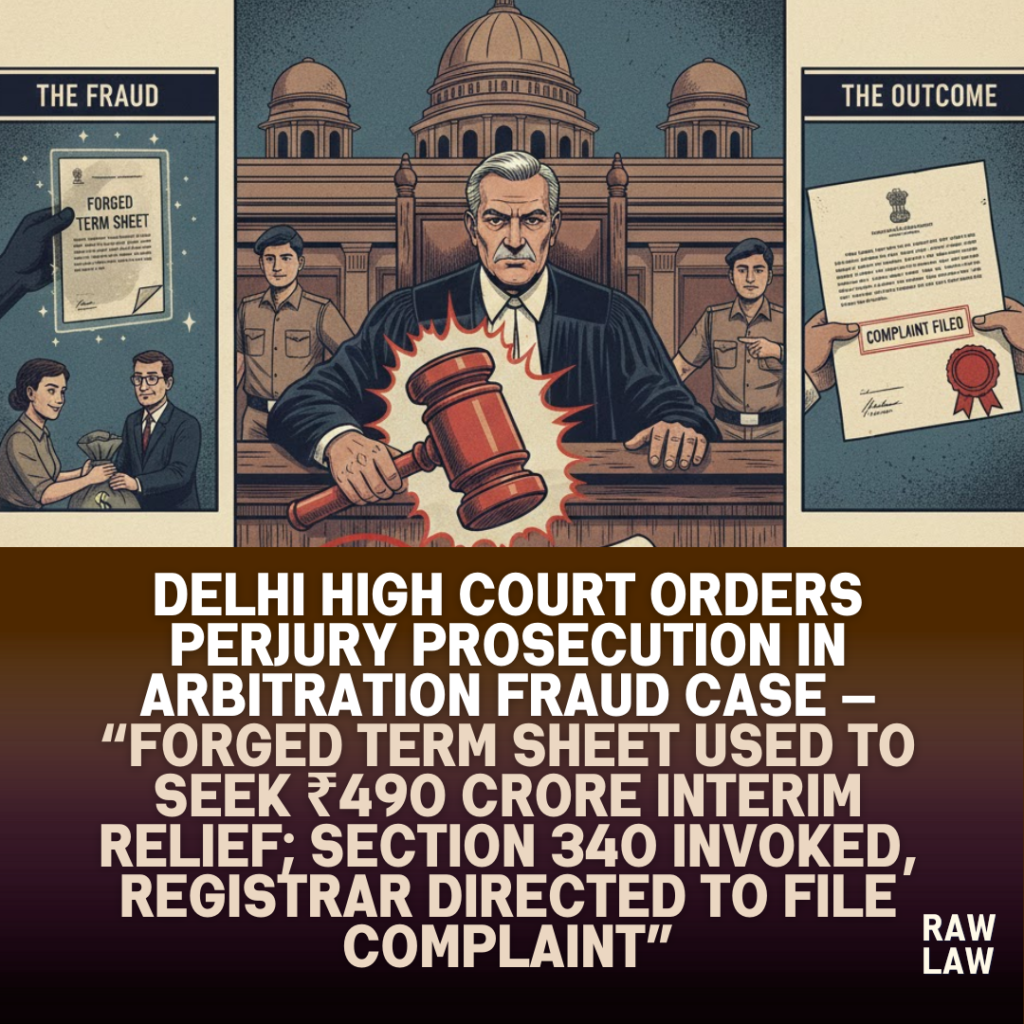
The Delhi High Court allowed an application under Section 340 of the Code of Criminal Procedure and directed initiation of criminal proceedings for perjury and fraud against officials of a foreign investor company, holding that forged documents and false affidavits were deliberately used to mislead the Court and obtain interim relief under Section 9 of the Arbitration Act. The Court found a prima facie case of deliberate falsehood on a matter of substance — “exceptional circumstances warrant prosecution to protect the sanctity of judicial proceedings”; Registrar General ordered to lodge complaint before the Magistrate.
Court’s decision
Justice Amit Bansal directed the Registrar General of the Delhi High Court to file a criminal complaint within four weeks against two officials of the petitioner company for offences under Sections 193, 196, 199, 200, 209 and 464 of the Indian Penal Code, read with Section 195 and Section 340 CrPC (now Section 379 of the Bharatiya Nagarik Suraksha Sanhita, 2023). The Court held that the officials had prima facie committed perjury and fraud by relying on a forged and non-existent term sheet to seek interim arbitral protection.
Facts
The dispute arose out of a failed investment transaction between an overseas investor and a listed healthcare company. In September 2017, the parties executed a non-binding term sheet which was valid only for 30 days and admittedly lapsed without extension.
Between 3 and 6 December 2017, a draft term sheet and certain side letters were prepared during negotiations. Crucially, the draft term sheet was never executed by the healthcare company, and was not signed by its authorised signatory, the then Chief Executive Officer.
Despite this, in 2018–2019, the investor relied upon a version of the term sheet bearing the allegedly forged signature of the CEO. This document surfaced for the first time in complaints filed before market regulators and was subsequently relied upon to institute a petition under Section 9 of the Arbitration and Conciliation Act before the Delhi High Court, seeking interim protection including security of approximately ₹490 crore.
During the Section 9 proceedings, the respondent company categorically disputed execution of the term sheet. Faced with affidavits denying authenticity, the investor withdrew the Section 9 petition. While permitting withdrawal, the High Court expressly granted liberty to the respondent to initiate proceedings under Section 340 CrPC.
Issues
The principal issue before the Court was whether the conduct of the investor company and its officials — in relying upon a forged term sheet and filing affidavits asserting its execution — warranted initiation of criminal proceedings for perjury and fraud under Section 340 CrPC. The Court also examined whether such prosecution was expedient in the interests of justice, the statutory threshold for invoking Section 340.
Applicant’s arguments (respondent company)
The respondent company contended that the investor had knowingly relied upon a fabricated document to mislead the Court. It was argued that:
The draft term sheet never bore the signature of the authorised CEO and this fact was admitted in contemporaneous pleadings, emails and prior court filings.
The forged version of the document was introduced only later and used selectively before regulators and courts.
Affidavits filed in support of the Section 9 petition were false to the knowledge of the deponents.
The conduct was deliberate, calculated and aimed at extracting massive interim relief through judicial process abuse.
Reliance was placed on the Supreme Court’s recent decision in James Kunjwal v. State of Uttarakhand on the scope and standards governing Section 340 CrPC proceedings.
Respondents’ position (investor officials)
Despite service, two of the officials against whom proceedings were sought failed to file any reply or appear before the Court. Earlier, two other officials had filed replies admitting that the term sheet was never signed by the healthcare company, leading the Court to drop proceedings against them. The continued silence of the remaining officials was relied upon as reinforcing adverse inference.
Analysis of the law
The Court undertook an extensive analysis of Section 340 CrPC and the law on perjury. Relying on James Kunjwal and Bhima Razu Prasad, the Court reiterated that prosecution for perjury requires:
A prima facie false statement on oath,
The falsehood to relate to a matter of substance,
Deliberate intent rather than inadvertent error, and
Satisfaction that prosecution is expedient in the interests of justice.
The Court clarified that a preliminary inquiry is not mandatory and that the accused has no right of hearing at the Section 340 stage. The inquiry is limited to deciding whether the judicial process has been sufficiently abused to warrant criminal action.
Precedent analysis
The Court relied on:
James Kunjwal v. State of Uttarakhand — crystallising the standards for invoking Section 340 CrPC;
Pritish v. State of Maharashtra — holding that no prior hearing is required before directing a complaint;
Earlier Delhi High Court judgments emphasising that perjury proceedings are exceptional but necessary where falsehood is used to secure favourable judicial orders.
These precedents were applied to hold that the present case crossed the high threshold for prosecution.
Court’s reasoning
The Court found overwhelming material showing that the term sheet relied upon was never executed by the authorised signatory. Admissions in pleadings, regulator complaints, and affidavits conclusively demonstrated that the document bearing the CEO’s signature did not exist when earlier proceedings were initiated.
Despite this knowledge, the investor filed a Section 9 petition supported by affidavits asserting execution of the term sheet and sought security of ₹490 crore. The Court held that such conduct could not be brushed aside as a commercial dispute or drafting error.
The Court also took note that in a connected commercial suit, the same term sheet had already been declared non est and void, and the suit decreed in favour of the healthcare company. This further fortified the finding of deliberate abuse.
Given the magnitude of relief sought, the seriousness of the falsehood, and the silence of the officials despite service, the Court concluded that this was an exceptional case where failure to prosecute would undermine the integrity of the judicial process.
Conclusion
The Delhi High Court allowed the application under Section 340 CrPC and directed the Registrar General to lodge a criminal complaint against the concerned officials before the jurisdictional Judicial Magistrate. All relevant records from the Section 9 arbitration proceedings were directed to be transmitted for prosecution in accordance with law.
Implications
This ruling is a strong reaffirmation that courts will not tolerate misuse of arbitration proceedings through forged documents and false affidavits. It underscores that withdrawal of a petition does not immunise litigants from criminal consequences if judicial process has already been abused. The judgment sends a clear deterrent signal in high-stakes commercial and arbitration litigation: perjury in aid of interim relief will invite prosecution, not indulgence.
Case law references
- James Kunjwal v. State of Uttarakhand: Laid down sine qua non for Section 340 CrPC action; applied to find prima facie perjury.
- Bhima Razu Prasad v. State (CBI): Deliberate falsehood on a matter of substance required; relied upon.
- Pritish v. State of Maharashtra: No mandatory hearing or preliminary inquiry before directing complaint; followed.
FAQs
1. When can courts initiate perjury proceedings under Section 340 CrPC?
When deliberate false statements on oath are made on material issues and prosecution is expedient in the interests of justice.
2. Is a prior hearing mandatory before ordering prosecution?
No. The accused gets a hearing only before the Magistrate after the complaint is filed.
3. Can perjury proceedings follow withdrawal of a case?
Yes. Withdrawal does not cure earlier abuse of judicial process.