


Court’s decision
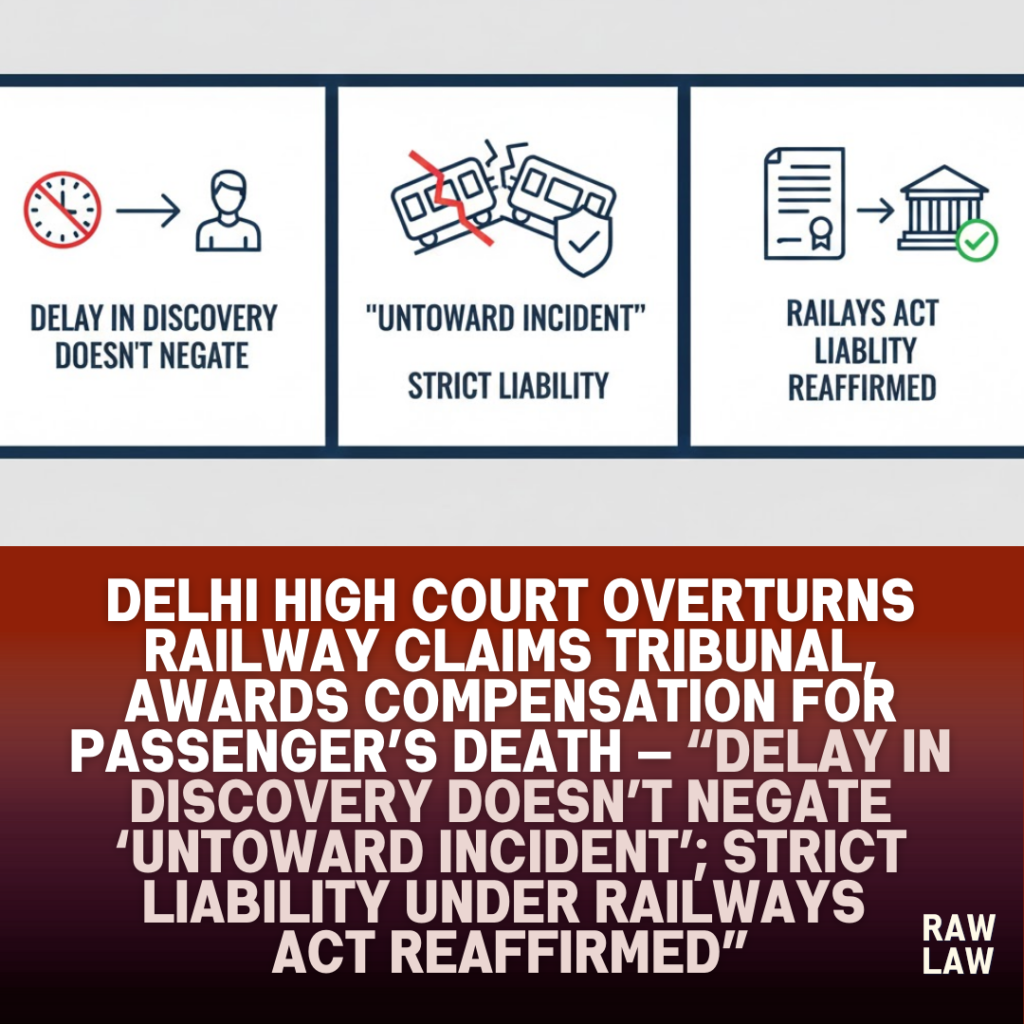
The Delhi High Court allowed an appeal filed by the legal heirs of a deceased passenger and set aside the Railway Claims Tribunal’s rejection of their compensation claim, holding that the death was caused by an “untoward incident” under the Railways Act. The Court ruled that mere delay in discovery of the body or absence of immediate reporting by other train drivers cannot defeat a bona fide claim — “beneficial legislation must receive liberal interpretation”; ₹8 lakh compensation with interest awarded.
Court’s decision
Justice Manoj Kumar Ohri held that the Tribunal had erred in concluding that the deceased was neither a bona fide passenger nor a victim of an untoward incident. The High Court applied the principle of strict or no-fault liability under Section 124A of the Railways Act and directed the Union of India to pay compensation of ₹8,00,000 along with interest at 12% per annum from the date of filing of the claim application till realisation. The appeal was disposed of accordingly.
Facts
The appellants, being the legal heirs of the deceased, filed a claim before the Railway Claims Tribunal seeking compensation for death in a railway accident. It was alleged that the deceased had purchased a valid journey ticket on 23.03.2024 and boarded the Haldighati Express from Gangapur City Railway Station to travel to Fatehpur Sikri.
According to the claim, the deceased was unable to alight at Fatehpur Sikri and, before the train reached the next station, fell down between Kiraoli and Fatehpur Sikri at kilometre number 54/08–09, resulting in his instantaneous death. The body was later discovered on the railway track and the claim was pursued on the footing that the death occurred due to an accidental fall from a running train.
Issues
The principal issue before the High Court was whether the deceased’s death qualified as an “untoward incident” under Section 123(c) of the Railways Act, entitling his legal heirs to compensation under Section 124A. A connected issue was whether the Tribunal was justified in rejecting the claim on the ground that the body was discovered several hours later and that multiple trains had passed the track in the interim without reporting the presence of a body.
Appellants’ arguments
The appellants argued that the deceased was a bona fide passenger, as a valid journey ticket was recovered from his person and subsequently verified during departmental proceedings. It was contended that the Tribunal adopted an unduly restrictive approach by treating the delay in discovery of the body as fatal to the claim.
The appellants submitted that the incident occurred around midnight on a single railway line and it was entirely plausible that other loco pilots did not notice the body in the darkness. They emphasised that the post-mortem report confirmed death due to shock and haemorrhage from ante-mortem injuries, consistent with an accidental fall, and that the Railways Act imposes strict liability irrespective of fault.
Respondent’s arguments
The Union of India opposed the appeal, maintaining that the death was not caused by an untoward incident. It was argued that the deceased’s body was discovered only after approximately four hours by the loco pilot of another train and that several trains had passed through the section earlier without any report of a body on the track.
On this basis, the respondent contended that the deceased could not have fallen from the Haldighati Express as claimed and that the Tribunal had rightly inferred that the death did not occur due to an accidental fall from a train. The respondent supported the Tribunal’s finding that the appellants failed to discharge the burden of proving an untoward incident.
Analysis of the law
The Court analysed Sections 123(c) and 124A of the Railways Act, reiterating that the statute is a beneficial piece of legislation intended to provide prompt compensation to victims of railway accidents and their families. It emphasised that the concept of “untoward incident” must receive a liberal construction so as not to defeat the object of the Act.
The Court reaffirmed that Section 124A embodies strict or no-fault liability, rendering questions of negligence or fault wholly irrelevant once an untoward incident involving a bona fide passenger is established. The burden on claimants is not to prove the exact manner of the fall with mathematical precision, but to show a reasonable and probable connection between the journey and the death.
Precedent analysis
The High Court relied on the Supreme Court’s decision in Union of India v. Prabhakaran Vijaya Kumar, which held that a narrow or pedantic interpretation of “untoward incident” would deprive victims of the benefit of a welfare statute. The Supreme Court in that case clarified that once an accidental fall from a train is established, compensation under Section 124A follows as a matter of course, irrespective of fault. Applying this binding precedent, the High Court rejected the restrictive reasoning adopted by the Tribunal.
Court’s reasoning
On facts, the Court noted that the deceased was found with a valid ticket and his body was discovered on the same railway track on which he was travelling. It accepted the appellants’ explanation that the accident occurred at night on a single-line section and that non-detection by earlier trains was plausible.
The Court held that mere delay in discovery of the body or the fact that the first report referred to a person being run over could not negate the overwhelming circumstantial evidence pointing to an accidental fall. The post-mortem findings of ante-mortem injuries further corroborated the appellants’ case. The Tribunal’s inference was found to be speculative and contrary to the legislative intent.
Conclusion
The Delhi High Court set aside the Railway Claims Tribunal’s judgment dismissing the compensation claim and allowed the appeal. The Union of India was directed to pay compensation of ₹8,00,000 along with interest at 12% per annum from the date of filing of the claim application till realisation, within four weeks. The appeal stood disposed of in these terms.
Implications
This judgment reinforces the liberal and victim-centric approach governing railway accident compensation claims. It clarifies that delays in discovery, gaps in reporting, or speculative doubts cannot be used to defeat legitimate claims under a welfare statute. The ruling strengthens the application of strict liability under the Railways Act and serves as a reminder that tribunals must avoid hyper-technical reasoning that undermines statutory protections for passengers and their families.
Case law references
- Union of India v. Prabhakaran Vijaya Kumar: Railways Act is a beneficial legislation; “untoward incident” must be liberally construed. Applied to overturn Tribunal’s restrictive approach.
- Strict liability under Section 124A: Fault or negligence is irrelevant once accidental fall of a bona fide passenger is established. Applied to award compensation.
- Standard of proof in railway claims: Circumstantial and probabilistic evidence sufficient; mathematical certainty not required. Applied to accept appellants’ case.
FAQs
1. Can compensation be denied if a passenger’s body is discovered hours after the accident?
No. Delay in discovery alone does not negate an untoward incident if surrounding circumstances support an accidental fall.
2. Is fault or negligence relevant under the Railways Act?
No. Section 124A imposes strict liability; once an untoward incident involving a bona fide passenger is shown, compensation follows.
3. What is the standard of proof in railway accident compensation cases?
A reasonable and probable connection between the journey and the death is sufficient; strict or technical proof is not required.