


Court’s decision
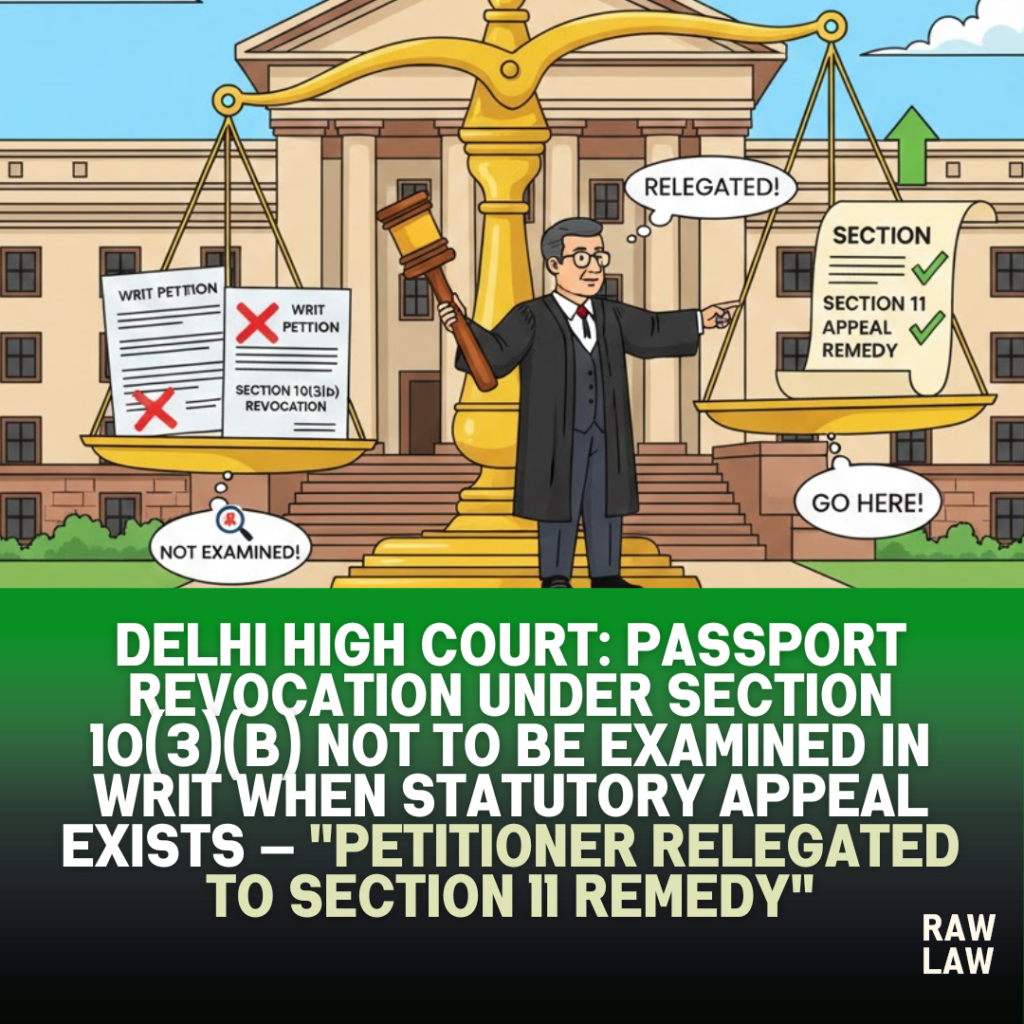
The Delhi High Court disposed of a writ petition challenging revocation of a passport under Section 10(3)(b) of the Passports Act, 1967, holding that the petitioner must avail the statutory appellate remedy under Section 11 of the Act. The Court declined to examine the merits of the revocation order, reiterating that where an efficacious alternative remedy exists—particularly in matters involving disputed factual aspects—Article 226 jurisdiction should not ordinarily be invoked. The petitioner was granted liberty to pursue all legal and factual pleas before the Appellate Authority.
Facts
The petitioner’s passport was revoked by order dated 03.08.2021 under Section 10(3)(b) of the Passports Act. The revocation followed show cause notices dated 16.03.2021 and 20.07.2021 issued by the Regional Passport Office.
The backdrop involved proceedings initiated by the Enforcement Directorate pursuant to an ECIR registered in 2014. The petitioner had failed to appear before the ED in response to summons, resulting in issuance of non-bailable warrants by the Special Judge, Rouse Avenue Courts. Attempts to seek recall of the warrants were unsuccessful.
The petitioner had earlier approached the High Court challenging the show cause notices. By order dated 15.04.2021, the Court permitted the petitioner—who was stated to be in London—to participate in proceedings via video conferencing. Eventually, the passport was revoked, prompting the present writ petition.
Issues
The primary issue was whether the High Court should exercise writ jurisdiction under Article 226 to examine the validity of the passport revocation order, despite the availability of a statutory appellate remedy under Section 11 of the Passports Act.
A related issue concerned whether the alleged procedural irregularities—such as non-consideration of the petitioner’s reply and denial of video conferencing hearing—warranted direct interference by the writ court.
The Court also considered whether disputed factual aspects relating to non-cooperation in investigation justified relegation to the appellate forum.
Petitioner’s arguments
The petitioner contended that the revocation order was passed in violation of the High Court’s earlier direction permitting participation through video conferencing. It was argued that no proper opportunity of hearing was afforded and that the detailed reply submitted to the show cause notice was not duly considered.
The petitioner alleged procedural impropriety and violation of principles of natural justice. It was urged that the writ court should intervene as the impugned order reflected non-application of mind and disregard of prior judicial directions.
Respondents’ arguments
The Union of India and the Enforcement Directorate opposed the writ petition, emphasizing that the petitioner had repeatedly evaded investigation and that non-bailable warrants had been issued.
It was contended that the petitioner had an efficacious statutory remedy under Section 11 of the Passports Act and that intricate factual aspects—particularly concerning alleged non-cooperation—could not appropriately be adjudicated in writ jurisdiction.
The respondents further submitted that the petitioner could seek an emergency certificate from the Indian Embassy to return to India and, thereafter, pursue appropriate remedies regarding re-issuance of passport under applicable rules.
Analysis of the law
The Court reiterated the settled principle that while existence of an alternative remedy does not operate as an absolute bar to writ jurisdiction, it is a significant factor in determining whether Article 226 should be invoked.
Where the statute provides a specific appellate mechanism and disputed questions of fact arise, the threshold for entertaining a writ petition is considerably higher.
Section 11 of the Passports Act expressly provides for an appeal against orders passed under Section 10, including revocation or impounding of passports. The Court observed that the impugned order was squarely appealable under the statutory scheme.
Precedent analysis
The Court referred to established Supreme Court jurisprudence emphasizing judicial restraint where effective alternative remedies exist. It also noted reliance placed by the respondents on a Rajasthan High Court decision reiterating that impounding or revocation of passport is appealable and that writ jurisdiction should not ordinarily be exercised in such cases.
The reasoning reflects consistent judicial approach that Article 226 is not intended to bypass statutory appellate frameworks, particularly where factual evaluation is required.
Court’s reasoning
The Court found merit in the respondent’s contention that the petitioner should avail the statutory appeal. It noted that the petitioner sought to raise intricate factual aspects regarding compliance with summons, opportunity of hearing, and alleged procedural lapses.
Such matters, the Court held, are better adjudicated by the Appellate Authority under Section 11, which is empowered to consider both legal and factual pleas.
The Court clarified that it was not expressing any opinion on merits and that all contentions remain open for adjudication in appeal.
Accordingly, the writ petition was disposed of by relegating the petitioner to the statutory remedy.
Conclusion
The Delhi High Court declined to entertain the writ petition challenging passport revocation under Section 10(3)(b) of the Passports Act, 1967, and directed the petitioner to pursue the statutory appellate remedy under Section 11. The petition was disposed of with liberty to raise all grounds before the Appellate Authority.
Implications
This judgment reinforces the doctrine of alternative remedy in administrative law. Passport revocation orders, being appealable under Section 11 of the Passports Act, should ordinarily be challenged before the designated Appellate Authority.
The ruling underscores that writ courts will exercise restraint, especially where disputed factual elements and allegations of non-cooperation in investigation are involved.
For passport holders facing revocation under Section 10(3)(b), the decision clarifies that statutory appeal remains the primary and appropriate forum for redressal.
Case law references
- Mohammad Yasir v. Union of India & Ors. (Rajasthan High Court) – Held that where an effective appellate remedy exists under Section 11 of the Passports Act, writ jurisdiction should not ordinarily be invoked.
- (Principles relating to alternative remedy and limited writ intervention applied.)
FAQs
1. Can a passport revocation order be challenged directly in the High Court?
Generally, no. Since Section 11 of the Passports Act provides a statutory appeal, courts usually require the aggrieved person to exhaust that remedy first.
2. What is Section 10(3)(b) of the Passports Act?
It empowers authorities to revoke or impound a passport in specified circumstances, including issues affecting sovereignty, integrity, or pending criminal proceedings.
3. When can the High Court entertain a writ despite alternative remedy?
Only in exceptional cases involving violation of fundamental rights, lack of jurisdiction, or breach of natural justice. Otherwise, statutory remedies must be exhausted.