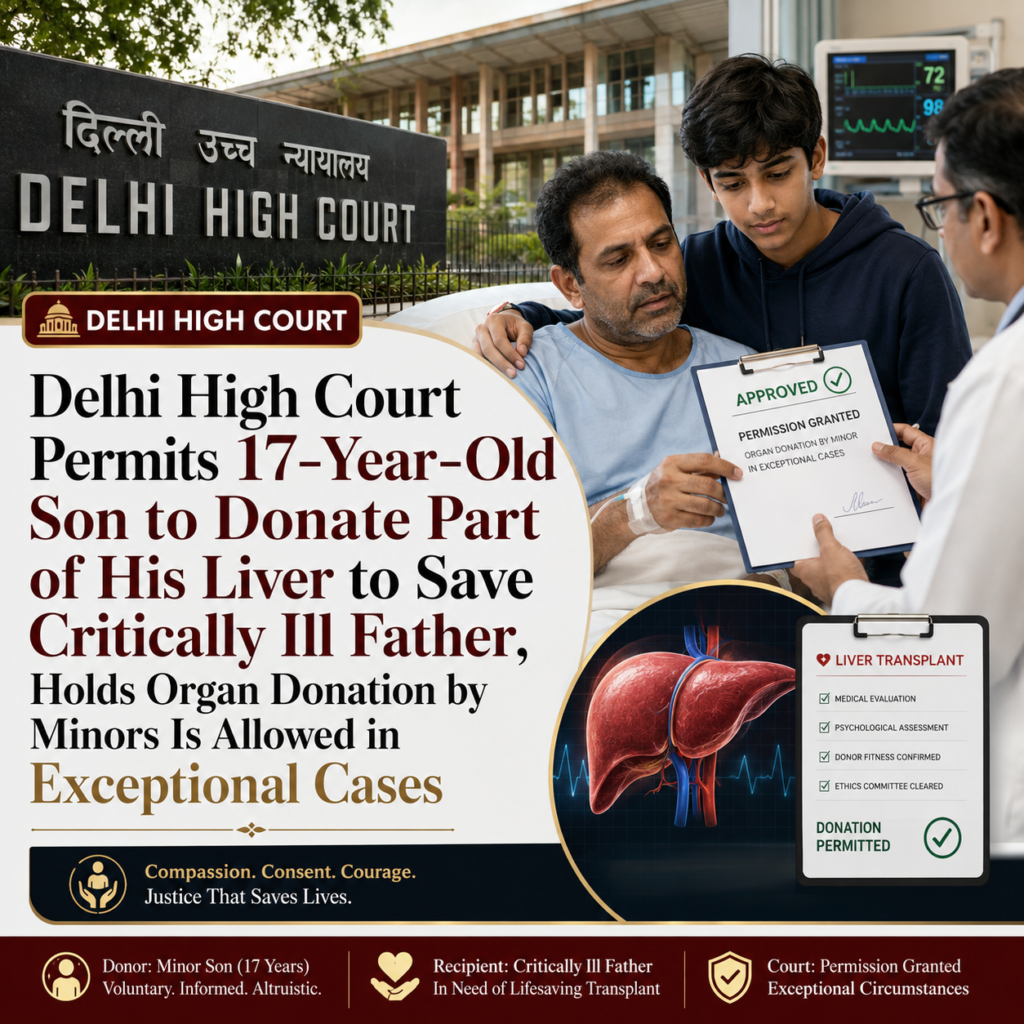
No Absolute Bar on Organ Donation by Minors in Exceptional Medical Cases: Delhi High Court Permits Liver Transplant
Facts
The petitioner, Pratik Shaw, was a minor aged approximately 17 years and 6 months when the writ petition was filed. He approached the Delhi High Court through his mother and natural guardian, Vandana Shaw, seeking permission to donate a part of his liver to his father, Uttam Kumar Shaw.
The petitioner’s father was undergoing treatment at the Institute of Liver and Biliary Sciences, Vasant Kunj, New Delhi. He was suffering from advanced chronic liver disease involving cirrhosis, portal hypertension, mild ascites and hepatocellular carcinoma.
According to the medical assessment placed before the Court, the father’s condition was life-threatening and time-sensitive. Liver transplantation was stated to be the only viable and life-saving treatment available to him.
The petitioner’s family members and other near relatives had been medically evaluated as potential donors. However, the minor petitioner, being the biological son of the recipient, was found to be the only medically suitable and compatible living donor.
Since living organ donation by a minor requires special permission under the Transplantation of Human Organs and Tissues Act, 1994 and the applicable Rules, the petitioner sought directions to the competent authorities to permit the proposed donation.
During the hearing, the Government of NCT of Delhi produced a letter dated 29 June 2026 recording the approval of the Lieutenant Governor of Delhi and the appropriate authority for the petitioner to donate part of his liver to his father. The permission was subject to compliance with all statutory and medical requirements.
Issues
- Whether a minor can legally be permitted to donate a part of his liver to a near relative.
- Whether the father’s critical medical condition and the absence of any other suitable donor constituted “exceptional medical grounds” under Rule 5(3)(g) of the Transplantation of Human Organs and Tissues Rules, 2014.
- Whether the minor’s willingness, physical fitness and relationship with the recipient satisfied the safeguards governing organ donation by minors.
- Whether the Court should exercise its writ jurisdiction under Article 226 to permit the transplantation in order to protect the father’s life.
Petitioner’s Arguments
The petitioner submitted that his father was suffering from advanced chronic liver disease and liver cancer, and that his condition required an urgent liver transplant.
It was argued that all suitable family members and near relatives had been evaluated, but no person other than the petitioner was found medically compatible.
The petitioner was the biological son of the recipient and therefore fell within the statutory definition of a “near relative” under Section 2(i) of the Transplantation of Human Organs and Tissues Act, 1994.
Although he was a minor, the petitioner was physically fit and willing to donate part of his liver voluntarily, out of natural love and affection for his father.
The petitioner asserted that the donation did not involve any commercial consideration, coercion or improper influence. The case was therefore presented as an exceptional medical circumstance warranting permission under the Act and Rules.
Respondent’s Arguments
The judgment does not record any substantive opposition by the respondents to the proposed donation.
The Government of NCT of Delhi placed before the Court the permission letter dated 29 June 2026, confirming that the Lieutenant Governor and the appropriate authority had approved the minor petitioner’s donation under Rule 5(3)(g).
The approval was expressly made subject to fulfilment of all statutory, medical, ethical and procedural requirements under the Transplantation of Human Organs and Tissues Act, 1994 and the 2014 Rules.
The Institute of Liver and Biliary Sciences informed the Court that it had been awaiting the Court’s order and would expeditiously schedule the transplant procedure once permission was granted.
Analysis of the Law
Section 9(1B) of the Transplantation of Human Organs and Tissues Act, 1994 and Rule 5(3)(g) of the 2014 Rules regulate the donation of living organs or tissues by minors.
Rule 5(3)(g) provides that living organ or tissue donation by a minor shall ordinarily not be permitted. However, it creates a limited exception where:
- Exceptional medical grounds exist;
- Those grounds are recorded in detail with full justification;
- Prior approval of the appropriate authority is obtained; and
- Approval of the concerned State Government is also obtained.
The Court clarified that the statutory framework does not impose an absolute prohibition on organ donation by minors. Instead, such donation is permitted only in exceptional circumstances and after strict compliance with the legal safeguards.
The governing framework is intended to protect minors from coercion, exploitation, commercial dealing and medically unjustified procedures. Therefore, the Court had to examine not merely the recipient’s need, but also the minor donor’s fitness, consent, relationship with the recipient and safety.
In the present case, the following statutory and factual safeguards were satisfied:
- The petitioner was the biological son and therefore a near relative;
- The father’s condition was critical and life-threatening;
- Liver transplantation was the only viable life-saving treatment;
- No other medically suitable relative donor was available;
- The minor was physically fit and medically compatible;
- The minor was willing to donate voluntarily;
- No commercial or coercive element was found; and
- The appropriate authority and the Lieutenant Governor had granted prior approval.
The Court therefore found that the case fell within the exceptional medical circumstances contemplated by Rule 5(3)(g).
Precedent Analysis
The judgment does not identify or discuss any earlier decision by name.
The Court nevertheless observed that similar permissions had been granted by the Delhi High Court on earlier occasions after examining the particular facts and circumstances of each case.
Therefore, the judgment proceeds on the understanding that permission for organ donation by a minor is not automatic and must be determined individually. The decisive considerations are:
- The existence of an immediate and serious medical necessity;
- The absence of another compatible adult donor;
- The minor donor’s voluntary willingness;
- Medical and psychological fitness;
- Absence of commercial consideration or coercion;
- Prior statutory approval; and
- Compliance with ethical and clinical safeguards.
The judgment thus follows a fact-sensitive approach rather than laying down a general right of minors to donate organs.
Court’s Reasoning
The Court found that the father was suffering from advanced chronic liver disease coupled with hepatocellular carcinoma and that his condition was both life-threatening and time-sensitive.
The medical material showed that liver transplantation was the only viable life-saving treatment. The petitioner was the only compatible donor available after the evaluation of other family members and near relatives.
The Court also considered that the petitioner was the biological son of the recipient, was physically fit and had expressed his willingness to donate voluntarily out of natural love and affection.
There was no indication of any commercial transaction, coercion or improper pressure. The proposed donation was therefore regarded as arising from filial obligation rather than any prohibited consideration.
Most importantly, the appropriate authority and the Lieutenant Governor of Delhi had already approved the proposed donation. Thus, the statutory requirement of prior governmental approval stood satisfied.
The Court held that the balance of convenience and equities overwhelmingly favoured permitting the transplantation. Refusing permission could result in the loss of the father’s life, whereas the proposed procedure could lawfully proceed subject to strict safeguards protecting the minor.
The Court therefore exercised its jurisdiction under Article 226 and permitted the petitioner to donate part of his liver.
Conclusion
The Delhi High Court allowed the writ petition and permitted the minor petitioner to donate a portion of his liver to his ailing father.
The Court held that there is no absolute statutory prohibition against living organ donation by a minor. Such donation can be permitted on exceptional medical grounds where the statutory approvals and safeguards under the Transplantation of Human Organs and Tissues Act, 1994 and the 2014 Rules are strictly satisfied.
The Court directed that the procedure must be carried out in compliance with all legal, ethical and clinical protocols so as to protect the health and safety of the minor donor.
The Institute of Liver and Biliary Sciences was permitted to expeditiously schedule the transplant operation.
Case Details
Case: Pratik Shaw, Minor Through His Mother and Natural Guardian Smt. Vandana Shaw v. Union of India & Ors.
Court: High Court of Delhi at New Delhi
Case Number: W.P.(C) 4045/2026
Judge: Justice Mini Pushkarna
Date: 29 June 2026
Result: Writ petition allowed; minor son permitted to donate part of his liver to his critically ill father, subject to compliance with all legal, ethical, medical and clinical safeguards.