


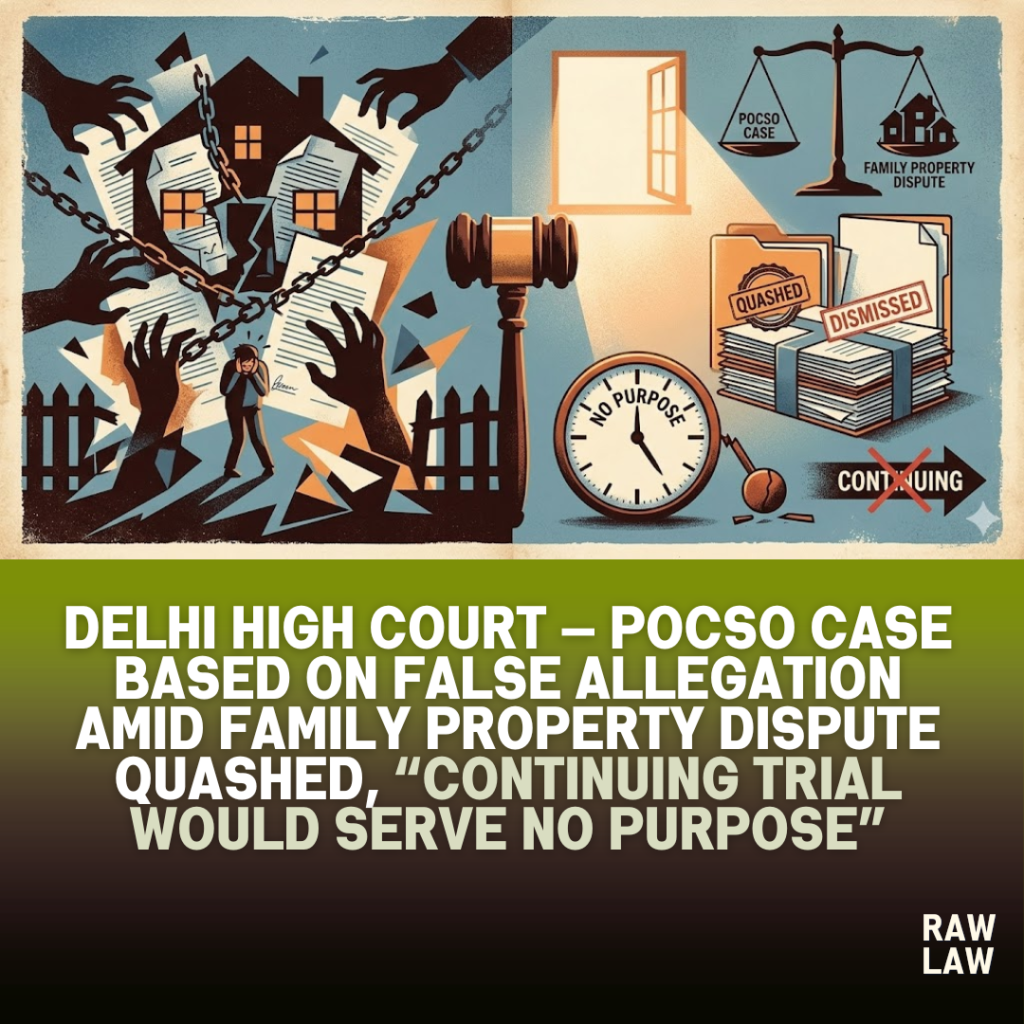
Court’s decision
The Delhi High Court allowed a petition seeking quashing of an FIR registered for offences under Sections 74 and 115(2) of the Indian Penal Code along with Section 10 of the POCSO Act.
The Court observed that the complainant had later admitted that the allegations of inappropriate touching by her brother were false and were made due to ongoing disputes within the family.
Taking note of the settlement between the parties and the complainant’s unwillingness to pursue the case, the Court held that continuing the prosecution would only prolong hostility among family members.
Accordingly, the Court quashed the FIR and all consequential proceedings.
Facts
The FIR was registered in February 2025 at Police Station Sonia Vihar, Delhi based on a complaint made by a young woman against her brother and sister-in-law.
She alleged that her brother had been casting an “evil eye” upon her and had touched her inappropriately on multiple occasions.
She also claimed that when she protested, her sister-in-law supported him and assaulted her.
During the investigation, a chargesheet was filed against the brother and his wife.
The complainant’s mother was also initially charge-sheeted under provisions of the POCSO Act for failing to report the alleged offence, though she was later discharged by the trial court.
Issues
The High Court examined the following issues:
- Whether the FIR alleging sexual assault under POCSO should be quashed based on a settlement between family members.
- Whether the Court could exercise inherent powers to quash proceedings when the complainant admitted the allegations were false.
- Whether continuing the criminal proceedings would serve the ends of justice.
Petitioner’s arguments
The accused petitioners argued that the complaint had been lodged due to ongoing disputes within the family regarding property.
They submitted that the complainant had subsequently acknowledged that the allegations were false and were made under mistaken advice.
The petitioners also relied on a memorandum of understanding (MoU) entered into between the parties, through which all disputes—including property issues—had been settled amicably.
It was argued that the continuation of criminal proceedings would unnecessarily destroy the relationship between siblings and serve no practical purpose.
Respondent’s arguments
The complainant appeared before the Court and confirmed that the allegations were indeed false.
She stated that she had approached the police due to frustration arising from frequent quarrels between her mother and brother over property.
According to her, she had exaggerated the situation and falsely alleged inappropriate conduct based on misguided advice.
She expressed remorse for her actions and requested the Court to close the case.
Analysis of the law
The Court examined the scope of its inherent powers under Section 528 of the Bharatiya Nagarik Suraksha Sanhita (BNSS).
These powers enable the High Court to intervene in criminal proceedings to prevent abuse of process and secure the ends of justice.
The Court acknowledged that allegations under sexual offence laws such as POCSO are serious and ordinarily should not be quashed merely because the parties have reached a settlement.
However, the Court emphasized that every case must be evaluated based on its own facts.
Where the foundational allegations themselves are admitted to be false and the complainant refuses to pursue the matter, continuation of prosecution may become futile.
Precedent analysis
The Court referred to the Supreme Court decision in Madhukar v. State of Maharashtra, where the apex court observed that while serious offences like rape ordinarily cannot be quashed on the basis of compromise, courts must still exercise their inherent powers to secure justice in appropriate cases.
The Court also relied on its earlier decision in Mohammad Parwej v. State (NCT of Delhi), where criminal proceedings were quashed after considering the factual realities of the dispute.
These precedents highlight that courts must balance the seriousness of the allegations with the actual circumstances and likelihood of conviction.
Court’s reasoning
The High Court conducted in-chamber interactions with the complainant and her mother to understand the factual background.
During this interaction, the complainant confirmed that:
- The allegations were false
- The dispute was essentially about property
- She regretted filing the complaint
The Court noted that the complainant had been of impressionable age and had acted impulsively without fully understanding the legal consequences.
It further observed that a full criminal trial would likely not result in conviction given the complainant’s admission that the allegations were fabricated.
The Court therefore concluded that continuing the proceedings would only revive bitterness within the family and serve no constructive purpose.
Conclusion
The Delhi High Court held that the FIR was based on a false narrative arising from a family dispute, and the complainant herself no longer wished to pursue the case.
In these circumstances, the Court exercised its inherent powers to quash the FIR and all related proceedings, emphasizing that the decision was necessary to secure the ends of justice.
Implications
This ruling highlights the nuanced approach courts adopt in cases involving sexual offence allegations within family settings.
While courts generally refuse to quash cases involving serious offences like those under the POCSO Act, this decision shows that exceptions may be made when the complaint itself is admitted to be false and the prosecution has little chance of success.
The judgment also underscores the dangers of misusing criminal law during family disputes, particularly where allegations of sexual misconduct are made without factual basis.
Case Law References
- Madhukar v. State of Maharashtra (2025)
The Supreme Court held that although serious sexual offences should not ordinarily be quashed on settlement, courts retain discretion to secure the ends of justice. - Mohammad Parwej v. State (NCT of Delhi)
Delhi High Court held that courts must consider factual realities before allowing criminal proceedings to continue in cases involving alleged sexual assault.
FAQs
1. Can a POCSO case be quashed if the complainant withdraws the allegation?
Generally no, but courts may quash proceedings in exceptional cases where the complaint itself is admitted to be false and continuation of trial would be futile.
2. What powers does the High Court use to quash an FIR?
High Courts exercise inherent powers under Section 482 CrPC (or corresponding provisions under BNSS) to prevent abuse of process and secure justice.
3. Can family disputes lead to false criminal complaints?
Courts have occasionally observed that family or property disputes sometimes result in exaggerated or false allegations, which must be carefully scrutinized.