


Headnote
Indian Penal Code, 1860 – Sections 498A, 406, 34 – Bharatiya Nagarik Suraksha Sanhita – Quashing of FIR – Matrimonial dispute – Amicable settlement – Resumption of cohabitation – Inherent powers of High Court.
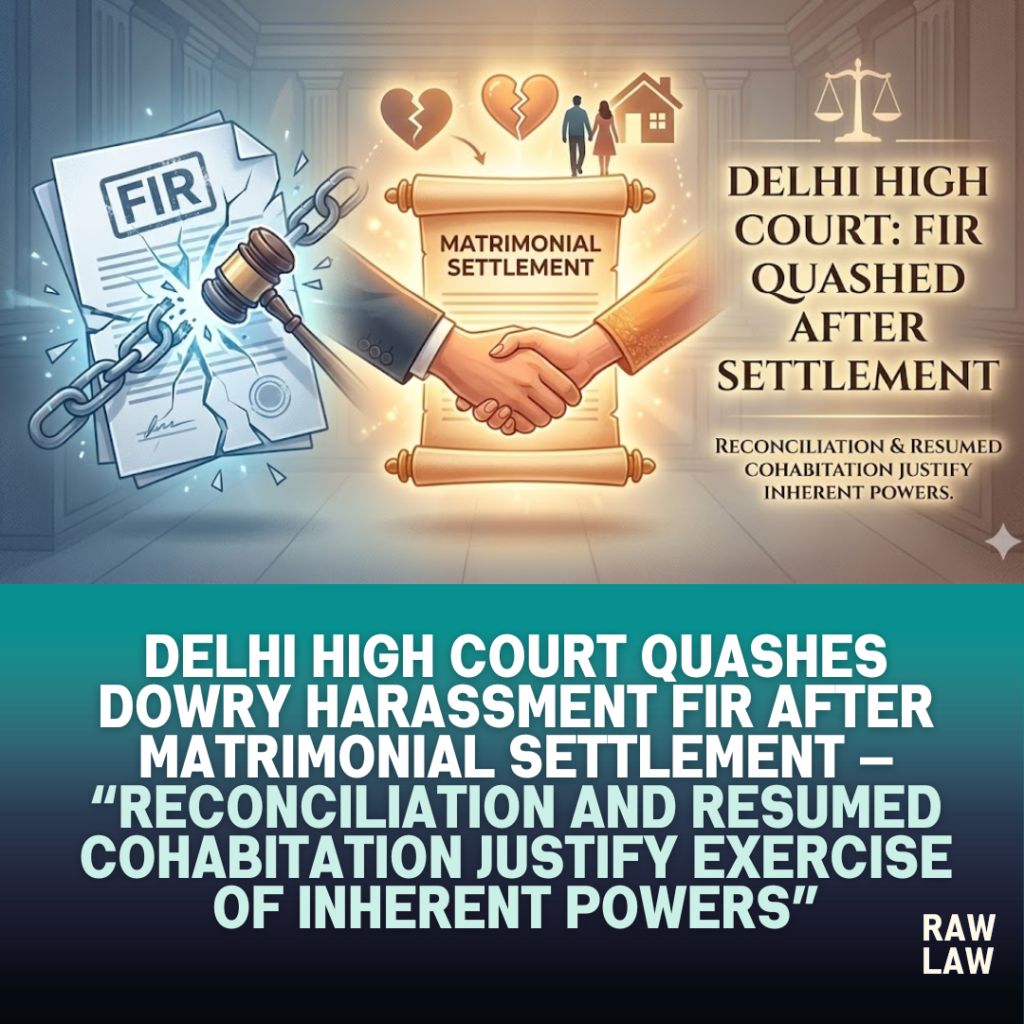
Held, criminal proceedings arising out of matrimonial discord, including allegations of cruelty and misappropriation of stridhan, can be quashed in exercise of inherent jurisdiction where parties have voluntarily and amicably settled their disputes and resumed cohabitation. Once the complainant unequivocally affirms that the settlement is without coercion and expresses no objection to quashing, continuation of criminal proceedings would serve no useful purpose and would amount to an abuse of the process of law. The Court reiterated that matrimonial disputes stand on a distinct footing and, when settled, should be brought to a quietus to secure the ends of justice. Relying on consistent Supreme Court jurisprudence recognising the primacy of settlement in family disputes, the Court quashed the FIR and all consequential proceedings, emphasising reconciliation, family unity, and judicial pragmatism over punitive continuation.
Court’s decision
The Delhi High Court allowed a petition seeking quashing of an FIR registered for offences under Sections 498A and 406 of the Indian Penal Code, holding that continuation of criminal proceedings would be unjustified in light of a genuine matrimonial settlement. The Court accepted the compromise arrived at before the Delhi Mediation Centre and noted that the spouses had resumed cohabitation along with their children. All proceedings arising from the FIR were quashed.
Facts
The marriage between the first petitioner and the complainant was solemnised in August 2015 in accordance with Muslim rites. Two children were born from the wedlock. Owing to temperamental differences, the parties began living separately from 2020. In 2021, the wife lodged an FIR alleging physical and mental cruelty on account of dowry demands and misappropriation of her stridhan, resulting in registration of a criminal case under Sections 498A, 406 and 34 IPC and filing of a chargesheet against the husband and his relatives.
During the pendency of proceedings, the parties were referred to mediation. Before the Delhi Mediation Centre, Tis Hazari Courts, they amicably resolved all disputes, culminating in a written settlement dated July 2025. Pursuant thereto, the spouses resumed cohabitation along with their children.
Issues
The primary issue before the Court was whether criminal proceedings for non-compoundable matrimonial offences could be quashed in exercise of inherent powers when parties had amicably settled their disputes and resumed marital life. A related issue was whether such quashing would advance the ends of justice or undermine the object of penal provisions protecting married women.
Petitioners’ arguments
The petitioners contended that the FIR arose purely from matrimonial discord and that all misunderstandings had been resolved through mediation. It was argued that the complainant had voluntarily entered into the settlement without any pressure and had resumed cohabitation with the husband, rendering continuation of criminal proceedings wholly unnecessary. The petitioners submitted that criminal prosecution would only revive bitterness, jeopardise reconciliation, and constitute an abuse of the judicial process.
Respondent’s arguments
The complainant, appearing in person, confirmed the settlement and unequivocally stated that she had no objection to quashing of the FIR. The State also did not oppose the prayer, acknowledging that the dispute was private and matrimonial in nature and stood fully resolved.
Analysis of the law
The Court examined the scope of inherent powers of the High Court to quash criminal proceedings to secure the ends of justice. While offences under Sections 498A and 406 IPC are technically non-compoundable, judicial precedent has consistently recognised that matrimonial disputes occupy a distinct category. Where parties have genuinely reconciled, the punitive continuation of criminal law may defeat rather than further justice.
The Court emphasised that criminal law is not meant to perpetuate matrimonial bitterness once parties have voluntarily chosen reconciliation. In such circumstances, the focus shifts from deterrence to restoration of family harmony.
Precedent analysis
The Court relied on authoritative pronouncements of the Supreme Court of India, including Gian Singh v. State of Punjab, Jitendra Raghuvanshi v. Babita Raghuvanshi, and B.S. Joshi v. State of Haryana. These decisions recognise that criminal proceedings arising from matrimonial disputes can be quashed on settlement, even if offences are non-compoundable, provided the compromise is genuine and voluntary. The Court reaffirmed that such an approach prevents abuse of process and promotes social harmony.
Court’s reasoning
The Court noted that the parties were present in person, duly identified by their counsel and the investigating officer, and that the complainant expressly confirmed the settlement and resumption of cohabitation. There was no allegation of coercion or undue influence. Given that the marriage had been restored and children were involved, the Court found that continuation of criminal proceedings would be counterproductive and contrary to the interests of justice. The dispute being purely matrimonial and personal in nature, the Court exercised its inherent jurisdiction to quash the FIR.
Conclusion
Allowing the petition, the Delhi High Court quashed the FIR registered under Sections 498A, 406 and 34 IPC and all consequential proceedings. The Court held that the settlement and reconciliation between the parties warranted closure of criminal action to ensure lasting peace and family stability.
Implications
The judgment reinforces the judiciary’s consistent approach of encouraging settlement and reconciliation in matrimonial disputes. It underscores that criminal law should not be used as a tool to perpetuate conflict once parties have chosen to resolve differences amicably. The ruling also highlights the pivotal role of mediation in family disputes and strengthens the jurisprudence supporting quashing of criminal proceedings post-settlement.
Case-law references
- Gian Singh v. State of Punjab – Recognised High Court’s power to quash criminal proceedings on settlement in private disputes.
- Jitendra Raghuvanshi v. Babita Raghuvanshi – Encouraged quashing of matrimonial disputes after compromise.
- B.S. Joshi v. State of Haryana – Held that continuation of Section 498A proceedings after settlement is an abuse of process.
FAQs
1. Can FIRs under Section 498A IPC be quashed after settlement?
Yes, courts can quash such FIRs if the dispute is matrimonial, private in nature, and the settlement is genuine and voluntary.
2. Is resumption of cohabitation relevant for quashing?
Yes, resumption of marital life strongly supports the case for quashing as it reflects genuine reconciliation.
3. Does the State’s consent matter in such cases?
While not decisive, lack of opposition from the State strengthens the case for quashing.