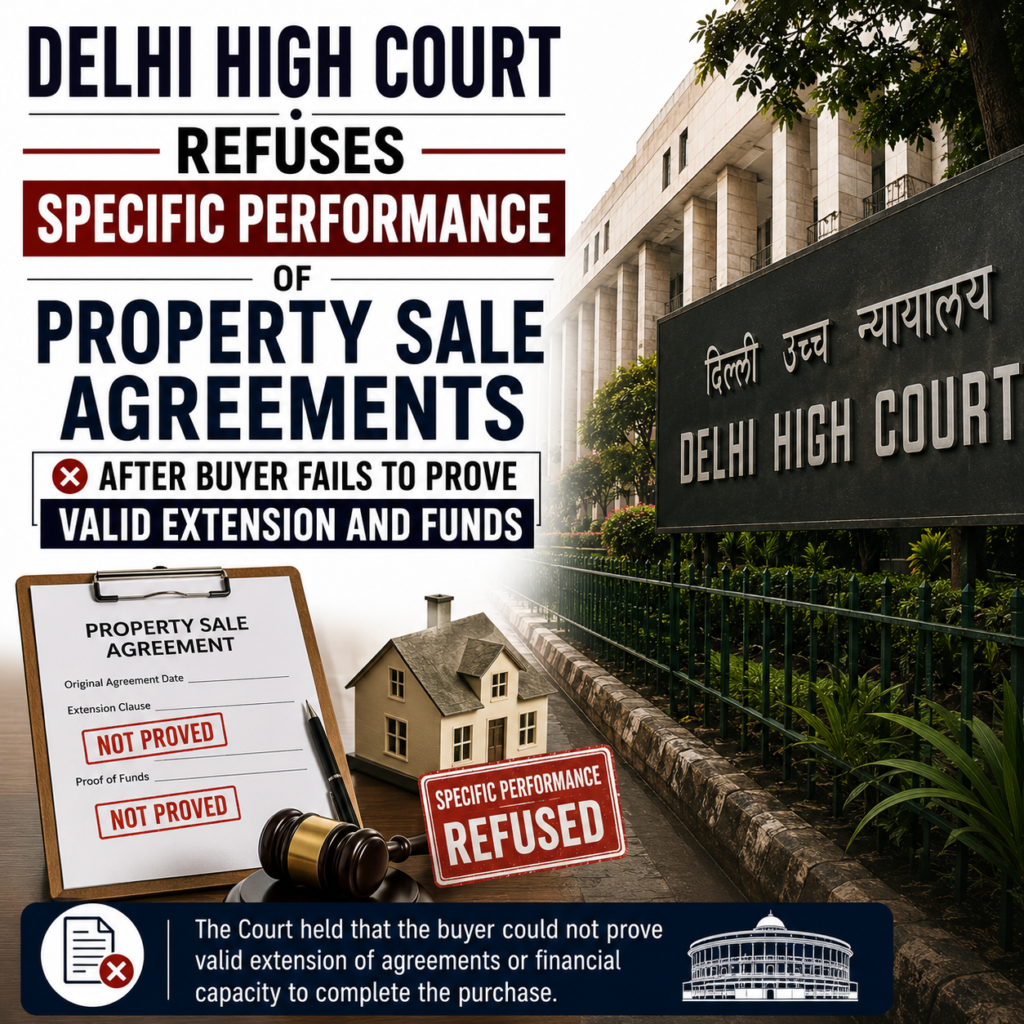
Delhi High Court Refuses Specific Performance of Property Sale Agreements, Says Buyer Must Prove Valid Extension and Financial Readiness
Facts
The Delhi High Court decided two Regular First Appeals filed by Gourave Gupta and M/s La Mode Fashions Pvt. Ltd. against Trial Court judgments dated 26 July 2018, by which their suits for specific performance and permanent injunction were dismissed.
The dispute concerned two interconnected shops forming part of property bearing Municipal No. 6167, Ward No. XII, Jawahar Nagar, Subzi Mandi, Delhi. The respondents, Laxmi Rohra and another, were joint owners of the properties.
Two separate Agreements to Sell dated 18 August 2005 were executed, one in favour of Gourave Gupta and the other in favour of La Mode Fashions Pvt. Ltd. Each agreement was for ₹84 lakh. Under each agreement, ₹9 lakh was paid as advance, and the balance ₹75 lakh was to be paid upon handing over vacant and peaceful possession. The transaction was to be completed on or before 31 December 2005.
The appellants claimed that the deadline was extended to 28 February 2006 by a handwritten endorsement allegedly signed by respondent no. 2 and by Kamal Rohra, son of respondent no. 1. The respondents denied any valid extension and stated that the agreements stood cancelled because the appellants failed to pay the balance amount within time.
The Trial Court dismissed the suits, holding that the extension was not proved, time was of the essence, and the appellants failed to prove readiness and willingness. The appellants challenged those findings before the High Court.
Issues
- Whether the time for completion of the Agreements to Sell was validly extended from 31 December 2005 to 28 February 2006.
- Whether Kamal Rohra, son of one co-owner, had authority to consent to or sign an extension on behalf of his mother.
- Whether time was of the essence of the Agreements to Sell.
- Whether the appellants proved their continuous readiness and willingness to perform their part of the contract.
- Whether the appellants were entitled to specific performance and permanent injunction.
Petitioner’s Arguments
The appellants argued that respondent no. 2 and Kamal Rohra approached them on 2 December 2005 seeking additional time to vacate the suit properties. According to them, they agreed to extend the completion deadline to 28 February 2006, and this extension was recorded by a handwritten endorsement on the Agreements to Sell.
They contended that the Trial Court wrongly rejected the endorsement and that the respondents failed to prove their allegation that the signatures were merely put on a blank portion as acknowledgment of receiving photocopies of the agreements.
The appellants also argued that time is generally not of the essence in contracts relating to immovable property. They submitted that they were ready and willing to pay the balance sale consideration and had even issued a legal notice dated 25 February 2006 stating that pay orders had been prepared.
They further argued that the Trial Court ought to have at least directed refund of the advance amount, as the respondents had not proved any loss justifying forfeiture.
Respondent’s Arguments
The respondents argued that there was no valid extension of time. They submitted that respondent no. 1, Laxmi Rohra, never signed any extension and never authorized her son Kamal Rohra to extend the contractual deadline on her behalf.
They contended that the alleged endorsement was suspicious, written in different ink/pen, and not proved through the person who allegedly wrote it. They also argued that the appellants did not produce the alleged photocopies of the pay orders or any bank evidence proving availability of funds.
The respondents submitted that time was of the essence because the agreements specifically required completion by 31 December 2005 and provided that failure to pay the balance consideration would result in cancellation and forfeiture of the advance.
They further argued that the appellants failed to prove readiness and willingness because they had not shown that they had ₹1.5 crore available to complete both transactions.
Analysis of the Law
The Court held that where a property is jointly owned, any material modification to an Agreement to Sell, including extension of time, requires consent of all co-owners. A third person cannot bind a co-owner unless validly authorized through a proper authority such as a Power of Attorney.
The Court found that Kamal Rohra was not an owner of the suit properties and had no written authority from Laxmi Rohra to extend time. The appellants themselves admitted in cross-examination that there was no written authorization from Laxmi Rohra and no document showing that she had agreed to extend the deadline.
On readiness and willingness, the Court held that a plaintiff seeking specific performance must prove not only intention but also financial capacity. Mere statements that funds were arranged are not enough. The buyer must place credible documentary evidence showing availability of funds during the relevant period.
The Court also held that although time is not presumed to be of the essence in every immovable property transaction, contractual time limits cannot be ignored. In this case, the agreements fixed a specific date and also provided consequences for default, showing that the timeline was significant.
Precedent Analysis
The Court relied on Janardan Das v. Durga Prasad Agarwalla, 2024 SCC OnLine SC 2937, to hold that in contracts involving multiple co-owners, all co-owners must either execute the agreement personally or authorize an agent through valid authority. Without such authority, an agent or family member cannot bind the co-owner.
The Court relied on Alagammal v. Ganesan, (2024) 3 SCC 232, along with K.S. Vidyanadam v. Vairavan, (1997) 3 SCC 1, to explain that even though time is generally not presumed to be the essence in immovable property contracts, the time limit fixed by parties has legal significance and cannot be ignored.
The Court referred to M. Siddiq v. Mahant Suresh Das, (2020) 1 SCC 1, on the civil standard of proof, namely preponderance of probabilities.
On readiness and willingness, the Court relied on R. Shama Naik v. G. Srinivasiah, 2024 SCC OnLine SC 3586, holding that readiness refers to financial capacity, while willingness concerns conduct and intention.
The Court also relied on Vijay Kumar v. Om Parkash, (2019) 17 SCC 429, where the Supreme Court held that a plaintiff seeking specific performance must show credible proof of funds, such as bank records or other financial documents.
The Court also discussed R. Kandasamy v. T.R.K. Sarawathy, 2024 SCC OnLine SC 3377, on maintainability of a suit for specific performance where an agreement has been terminated, but held that it was unnecessary to decide that issue further because the appellants had already failed on readiness and willingness.
Court’s Reasoning
The Court first held that the alleged extension of time was not proved. Laxmi Rohra, being a 50% co-owner, had not signed any extension. Her son Kamal Rohra was not an owner and had no Power of Attorney or written authority to extend the deadline.
The Court also noted that the alleged endorsement was not proved through the person who wrote it. A.K. Gupta admitted that the handwriting appeared to be that of his accountant, but the accountant was never examined as a witness.
The Court further found that the endorsement did not even bear the signature of Gourave Gupta, one of the purchasers. Therefore, on a preponderance of probabilities, the Court held that the alleged extension was not authentic and was legally invalid.
On the issue of time being the essence, the Court held that the agreements expressly fixed 31 December 2005 as the deadline and provided consequences for non-payment. The respondents had also placed material showing financial urgency, including loan documents. The Court therefore accepted that the timeline was essential in the facts of the case.
On readiness and willingness, the Court found that the appellants failed to prove financial capacity. They did not produce the alleged pay orders, bank statements, or any other credible evidence showing availability of funds. Gourave Gupta admitted that he had no personal savings account in 2005 and had not placed documents showing sufficient funds.
The Court concluded that the appellants had only made bald assertions of readiness and willingness without documentary proof.
Conclusion
The Delhi High Court dismissed both appeals.
The Court held that the alleged extension of time from 31 December 2005 to 28 February 2006 was not validly proved. It further held that the appellants failed to establish continuous readiness and willingness to perform the Agreements to Sell.
Since the appellants were not entitled to specific performance, they were also not entitled to permanent injunction.
Case Details
Case: Gourave Gupta v. Laxmi Rohra & Anr.; M/s La Mode Fashions Pvt. Ltd. v. Laxmi Rohra & Anr.
Court: Delhi High Court
Case Number: RFA 729/2018 and RFA 730/2018
Judge: Justice Mini Pushkarna
Date: 6 July 2026
Result: Appeals dismissed; Trial Court judgments refusing specific performance upheld.