


Court’s decision
The Delhi High Court dismissed a criminal appeal filed by the State under Section 378 of the Code of Criminal Procedure, affirming the acquittal of a truck driver charged under Sections 279, 337 and 304-A of the Indian Penal Code. The Court held that rash or negligent driving cannot be presumed solely from the fact that a motorcycle was hit from behind, and that criminal liability under Section 304-A requires proof of culpable rashness or negligence proximate to the cause of death. Finding the Trial Court’s view plausible and supported by evidence, the High Court declined to interfere, reiterating the principle of double presumption of innocence after acquittal .
Facts
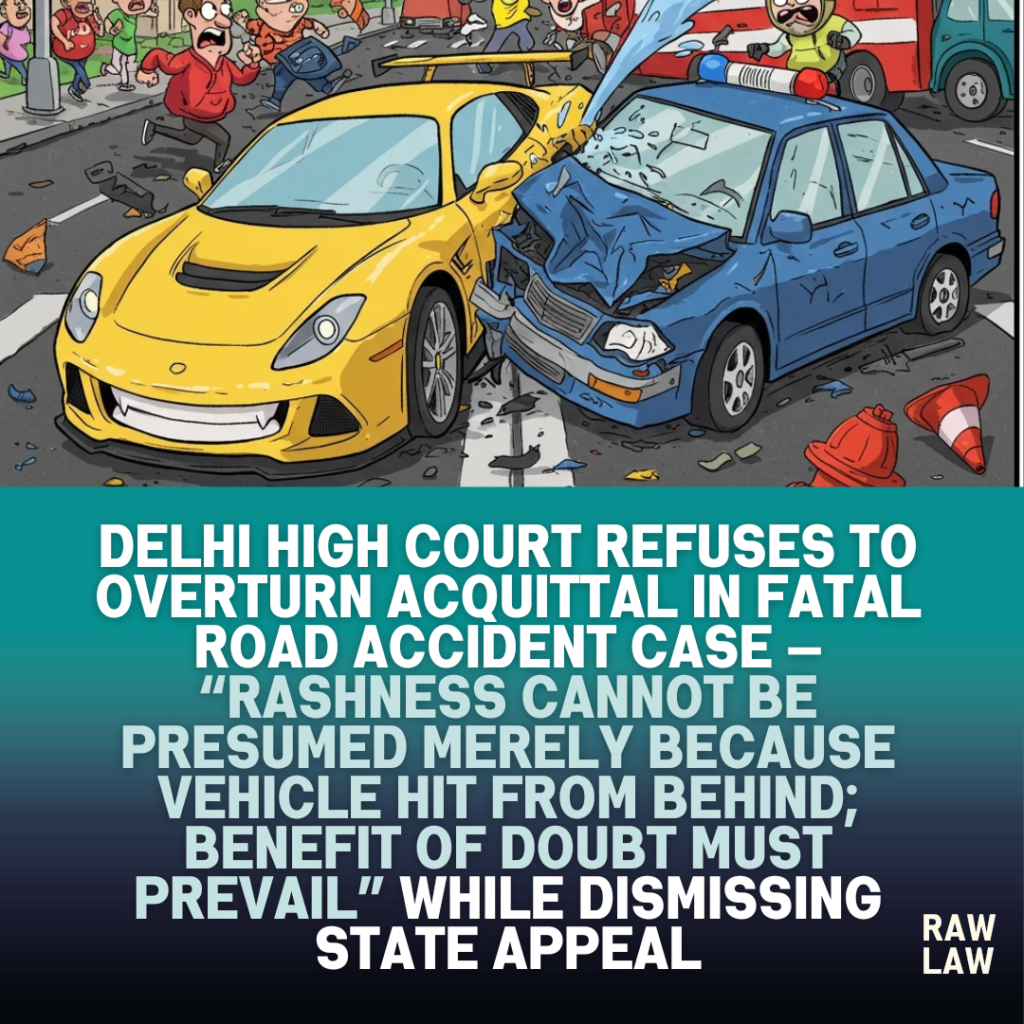
The prosecution case related to a road accident dated 08 October 1998 at around 12:45 PM on Mathura Road near Rajiv Gandhi Camp, Badarpur. It was alleged that the respondent was driving a truck in a rash and negligent manner and struck a motorcycle from behind. As a result, the motorcyclist sustained injuries and the pillion rider later succumbed to his injuries.
An FIR was registered at Police Station Badarpur, and after investigation, the respondent was sent to trial for offences punishable under Sections 279, 337 and 304-A IPC. During trial, the prosecution examined eight witnesses, including the injured complainant as the sole eyewitness, police officials involved in investigation, and witnesses identifying the deceased.
The Trial Court, by judgment dated 29 August 2014, acquitted the respondent, extending the benefit of doubt. The State’s appeal against acquittal was admitted, and leave to appeal was granted in 2016, leading to the present decision.
Issues
The principal issue before the High Court was whether the prosecution had proved beyond reasonable doubt that the respondent was driving the offending vehicle in a rash or negligent manner so as to attract criminal liability under Section 304-A IPC. A connected issue was whether the Trial Court’s acquittal suffered from perversity or misappreciation of evidence warranting appellate interference.
Appellant’s arguments
The State argued that the Trial Court erred in discarding the testimony of the injured eyewitness, who had categorically stated that the truck came from behind and hit the motorcycle, causing fatal injuries. It was contended that the nature of the accident itself indicated negligent driving, and that the Trial Court adopted an unduly technical approach in insisting on further corroboration such as skid marks or exact speed of the vehicles. According to the State, the acquittal resulted in grave miscarriage of justice.
Respondent’s arguments
The respondent opposed the appeal, submitting that the prosecution failed to establish the essential ingredient of rashness or negligence. It was argued that the eyewitness did not depose that the truck was being driven rashly or at a dangerously high speed, nor did he specify the lane position or manner of driving of either vehicle. Serious contradictions were highlighted regarding the place of recording of the eyewitness’s statement and the absence of corroborative physical evidence from the spot. It was contended that the Trial Court’s view was reasonable and did not call for interference.
Analysis of the law
The High Court reiterated the settled legal position governing offences under Section 304-A IPC. It observed that criminal rashness involves recklessness and indifference to consequences, while criminal negligence denotes gross failure to exercise reasonable care. Merely causing an accident or death does not ipso facto establish criminal culpability.
The Court emphasised that the doctrine of res ipsa loquitur is only a rule of evidence and does not automatically apply to presume negligence in every motor accident case. Rashness or negligence must be proved through cogent evidence, showing a direct and proximate nexus between the accused’s conduct and the resulting death.
Precedent analysis
The Court relied on authoritative Supreme Court precedents explaining the scope of Section 304-A IPC, including Mohd. Aynuddin v. State of Andhra Pradesh, which cautions against presuming negligence in motor accidents, and Naresh Giri v. State of Madhya Pradesh, which clarifies that Section 304-A applies only where death is caused by rash or negligent acts not amounting to culpable homicide. The Court also relied on recent decisions reiterating that appellate courts must be slow to interfere with acquittals unless findings are perverse.
Court’s reasoning
On appreciation of evidence, the Court noted that the prosecution case rested almost entirely on the testimony of the injured eyewitness. While he stated that the truck was moving faster than his motorcycle, he did not state that it was being driven rashly or negligently, nor did he specify the speed, lane position, or manner of driving. The Court held that a rear-end collision by itself is insufficient to establish culpable negligence.
The Court also found significant contradictions: the eyewitness claimed his statement was recorded at the police station, whereas the investigating officer stated it was recorded at the spot. The site plan did not show skid marks or dragging marks despite the claim that the motorcycle was dragged for several metres. No photographs of the accident site were taken, and the exact point of impact could not be ascertained.
In these circumstances, the Court held that the Trial Court’s assessment was neither perverse nor unreasonable. Given the double presumption of innocence that operates after acquittal, the High Court found no justification to overturn the verdict.
Conclusion
The Delhi High Court dismissed the State’s appeal and upheld the acquittal of the respondent for offences under Sections 279, 337 and 304-A IPC. The Court held that the prosecution failed to prove rash or negligent driving beyond reasonable doubt and that the Trial Court’s view was a plausible one based on the evidence. The respondent’s personal bond and surety were ordered to be discharged .
Implications
This judgment reinforces the high evidentiary threshold required for securing convictions in cases of causing death by negligence. It reiterates that criminal courts cannot rely on presumptions or moral blameworthiness, and that prosecution must prove culpable rashness or negligence through clear and consistent evidence. The ruling also underscores judicial restraint in appeals against acquittal, particularly in motor accident cases where evidence is often circumstantial and contested.
Case law references
- Mohd. Aynuddin v. State of Andhra Pradesh – Held that negligence cannot be presumed in every motor accident; rashness must be proved.
- Naresh Giri v. State of Madhya Pradesh – Explained scope of Section 304-A IPC and distinction from culpable homicide.
- Ravi Sharma v. State (NCT of Delhi) – Reiterated double presumption of innocence after acquittal.
- Anwar Ali v. State of Himachal Pradesh – Held appellate courts must be slow to interfere with acquittals.
FAQs
1. Is hitting a vehicle from behind enough to prove rash driving?
No. Rear-end collision alone does not establish criminal rashness or negligence.
2. What is required to prove an offence under Section 304-A IPC?
The prosecution must prove death caused by a rash or negligent act directly attributable to the accused.
3. When can a High Court interfere with an acquittal?
Only when the Trial Court’s findings are perverse, illegal, or wholly unsupported by evidence.