


1. Court’s decision
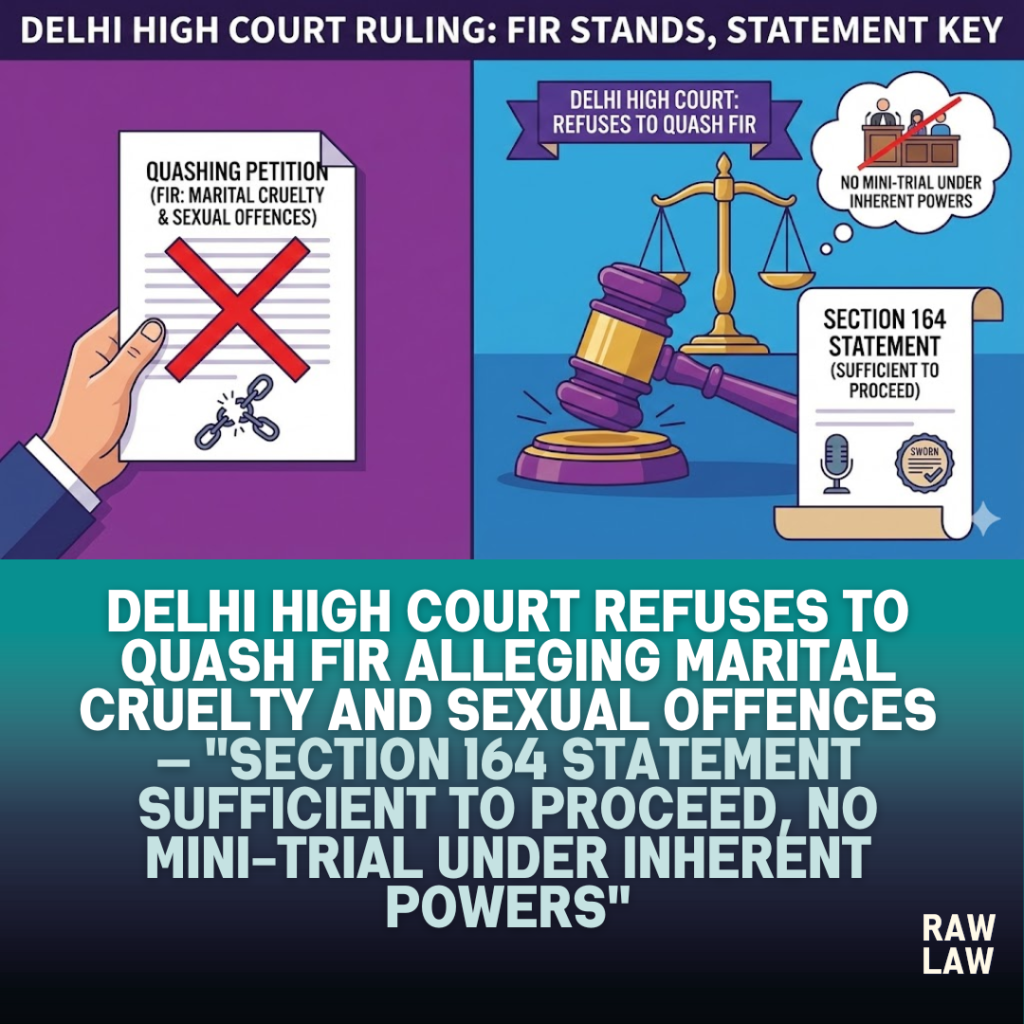
The Delhi High Court dismissed a petition seeking quashing of an FIR registered for offences including cruelty, criminal breach of trust, rape, unnatural offences, and criminal intimidation. The Court held that once serious allegations are specifically made in the complainant’s sworn statement under Section 164 of the Code of Criminal Procedure, a prima facie case is disclosed, and the High Court cannot evaluate truthfulness or conduct a mini-trial while exercising inherent jurisdiction to quash criminal proceedings.
2. Facts
The petitioners approached the High Court challenging FIR No. 328/2022 registered at Police Station Patel Nagar. The FIR stemmed from matrimonial disputes between the complainant and her husband and in-laws. Initially, two complaints were lodged on consecutive days in July 2021, leading to registration of two FIRs at different police stations. The first FIR related to offences of hurt, restraint, and intimidation, while the second FIR pertained to cruelty and misappropriation of stridhan. Subsequently, on the basis of the complainant’s statement recorded on oath before a Magistrate under Section 164 CrPC, allegations of rape, unnatural sexual offences, and intimidation were added to the second FIR.
3. Issues
The principal issues before the Court were whether the FIR deserved to be quashed on the ground that allegations of sexual offences were not made in the initial complaint, whether registration of two FIRs amounted to abuse of process, and whether the High Court could assess the veracity of allegations at the pre-trial stage under its inherent powers.
4. Petitioners’ arguments
The petitioners contended that the FIR was founded on falsehood and exaggeration. It was argued that allegations of rape and unnatural sex were conspicuously absent in the original complaint and surfaced only later in the statement under Section 164 CrPC, rendering them unreliable. The petitioners further submitted that two FIRs on the same set of facts could not be sustained and that proceedings in the first FIR had already been stayed by the High Court, warranting similar relief in the present case. They urged that continuation of criminal proceedings would amount to harassment and abuse of process.
5. Respondents’ arguments
The State opposed the petition, pointing out that the complainant’s detailed sworn statement under Section 164 CrPC contained specific and grave allegations, including attempts to push her into flesh trade. It was argued that the additions to the FIR were legally permissible once such a statement was recorded before a Magistrate. The prosecution submitted that the allegations disclosed cognizable offences requiring trial and that disputed questions of fact could not be examined in quashing proceedings.
6. Analysis of the law
The Court examined the scope of inherent powers under Section 482 CrPC (now Section 528 of the Bharatiya Nagarik Suraksha Sanhita). It reiterated that the jurisdiction is exceptional and must be exercised sparingly to prevent abuse of process or to secure the ends of justice. At the stage of quashing, the Court is confined to examining whether the allegations, taken at face value, disclose the commission of offences. The truth, falsity, or sufficiency of evidence is a matter for trial.
7. Precedent analysis
While not embarking on an extensive survey of case law, the Court relied on settled principles laid down by the Supreme Court that quashing jurisdiction cannot be used to assess credibility of witnesses or weigh evidence. The jurisprudence consistently holds that statements recorded under Section 164 CrPC carry evidentiary value at the threshold and can form the basis of prosecution if they disclose prima facie offences.
8. Court’s reasoning
The Court noted that the complainant’s Section 164 statement was detailed and contained serious allegations beyond mere matrimonial discord. The argument that such allegations were absent in the initial complaint was held insufficient to discard them at the threshold, as improvements or elaborations are matters for trial. The Court rejected the plea of double FIR abuse, clarifying that the two FIRs arose from separate complaints disclosing different offences, and the legality of one could not automatically govern the other. Importantly, the Court emphasised that it could not conduct a mini-trial or adjudicate on the defence that the allegations were false.
9. Conclusion
Finding that the FIR and the Magistrate-recorded statement disclosed a prima facie case for offences under Sections 498A, 406, 323, 376, 377, 506, and 34 of the Indian Penal Code, the Delhi High Court declined to quash the proceedings. The petition and accompanying applications were dismissed.
10. Implications
The ruling reinforces the restrained approach courts must adopt while dealing with petitions to quash FIRs involving serious sexual and matrimonial offences. It underscores that later disclosures in a Section 164 statement cannot be brushed aside merely because they were not part of the earliest complaint, and that issues of credibility and exaggeration must be tested through trial. The judgment strengthens prosecutorial latitude in cases where allegations evolve during investigation.
Case Law References
- Inherent powers under Section 482 CrPC jurisprudence – Reaffirmed that High Courts cannot conduct a mini-trial or assess credibility at the quashing stage.
- Section 164 CrPC evidentiary principles – Statements recorded on oath before a Magistrate can validly form the basis of prosecution if they disclose cognizable offences.
FAQs
Q1. Can an FIR be quashed because sexual offence allegations were added later?
No. If later allegations are supported by a sworn Section 164 statement and disclose a prima facie offence, courts will not quash the FIR at the threshold.
Q2. Can the High Court test truthfulness of allegations while quashing an FIR?
No. The High Court cannot conduct a mini-trial or assess credibility under its inherent powers.
Q3. Does registration of two FIRs automatically amount to abuse of process?
Not necessarily. If the FIRs arise from distinct complaints disclosing different offences, both can proceed independently.