


Court’s decision
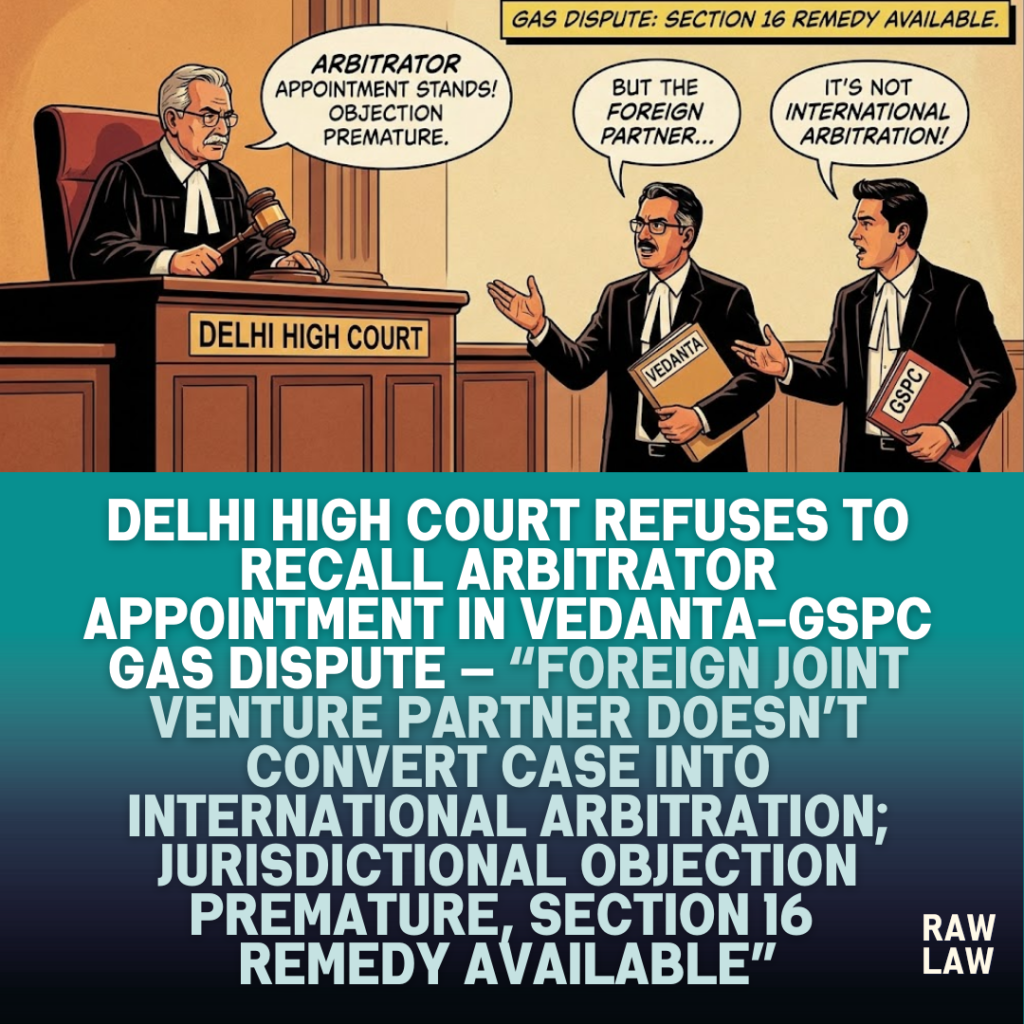
The Delhi High Court dismissed an application seeking recall of its earlier order appointing an arbitrator in the Vedanta–Gujarat State Petroleum Corporation gas supply dispute, holding that the mere presence of a foreign joint venture partner does not automatically render the arbitration an international commercial arbitration. The Court ruled that jurisdictional objections based on the character of arbitration must be raised before the arbitral tribunal under Section 16 of the Arbitration and Conciliation Act — “recall cannot be used to reopen concluded Section 11 proceedings”; recall refused, arbitral process to continue.
Court’s decision
Justice Subramonium Prasad rejected both the recall application filed by Gujarat State Petroleum Corporation Limited and a connected application seeking modification of the arbitrators’ fee direction. The Court held that the recall plea was premature, misconceived, and in substance an attempt to derail arbitral proceedings already underway. It clarified that all issues regarding arbitrability, including whether the dispute qualifies as an international commercial arbitration, remain open to be decided by the arbitral tribunal.
Facts
The dispute arose from a gas sales process initiated by Vedanta Limited, the operator of the RJ-ON-90/1 oil and gas block in Barmer, Rajasthan. The block had been awarded by the Government of India to a joint venture comprising Vedanta, Oil and Natural Gas Corporation Limited, and Cairn Energy Hydrocarbons Limited, a foreign entity incorporated in the United Kingdom. Under the Joint Operating Agreement and related arrangements, Vedanta was designated as the operator and authorised representative of the joint venture.
In December 2022, Vedanta issued a request for proposal and a draft Gas Sales Agreement inviting bids for purchase of gas from the block. Gujarat State Petroleum Corporation participated in the bidding process, uploaded signed bid documents, and emerged as the largest bidder. Subsequently, disputes arose regarding whether a binding Gas Sales Agreement had come into existence, leading Vedanta to invoke arbitration under the arbitration clause contained in the agreement.
When GSPC failed to appoint its nominee arbitrator, Vedanta approached the Delhi High Court under Section 11(6) of the Arbitration and Conciliation Act. By judgment dated 28 July 2025, the Court appointed a nominee arbitrator on behalf of GSPC, resulting in constitution of the arbitral tribunal. GSPC’s challenge to this order before the Supreme Court was dismissed, with liberty to raise arbitrability issues before the tribunal.
Despite this, GSPC filed the present application seeking recall of the Section 11 order, contending that since a foreign entity was part of the joint venture, the dispute was an international commercial arbitration over which only the Supreme Court had jurisdiction under Section 11(9).
Issues
The central issue before the Court was whether its earlier order appointing an arbitrator suffered from a jurisdictional defect warranting recall on the ground that the arbitration was international in nature. Ancillary issues included whether non-joinder of the foreign joint venture partner vitiated the Section 11 proceedings, and whether the Court could revisit its appointment order after constitution of the arbitral tribunal and dismissal of the special leave petition by the Supreme Court.
Petitioner’s arguments
GSPC argued that Vedanta had suppressed a material jurisdictional fact by not impleading Cairn Energy Hydrocarbons Limited and ONGC in the Section 11 petition. It was contended that because Cairn was a foreign entity and a party to the joint venture, the arbitration qualified as an international commercial arbitration under Section 2(1)(f) of the Act. As a result, only the Supreme Court could appoint an arbitrator under Section 11(9), rendering the Delhi High Court’s earlier order a nullity.
Reliance was placed on decisions recognising the power of courts to recall orders passed without jurisdiction, including judgments of the Bombay High Court and Delhi High Court where Section 11 appointments were recalled upon discovery of jurisdictional defects. GSPC further argued that jurisdictional objections could be raised at any stage and were not barred by earlier proceedings.
Respondent’s arguments
Vedanta opposed the recall, contending that the application was a review disguised as a recall and was aimed solely at delaying arbitration. It was argued that the joint venture partners had expressly authorised Vedanta to act as their representative in all legal proceedings, including arbitration, and that the Gas Sales Agreement itself appointed Vedanta as the “seller’s representative”.
Vedanta emphasised that the issue of international commercial arbitration was never raised during the Section 11 proceedings, despite full disclosure of the joint venture structure. It was further submitted that the Supreme Court had already declined to interfere with the Section 11 order and expressly left arbitrability questions open to be decided by the arbitral tribunal. Any jurisdictional objection, therefore, had to be raised under Section 16 before the tribunal, not through a recall application before the High Court.
Analysis of the law
The Court analysed the limited scope of recall in judicial proceedings, reiterating that recall is permissible only where an order is obtained by fraud or where the court lacked inherent jurisdiction. It distinguished such situations from cases where parties seek to reopen concluded issues on disputed questions of fact or law.
The Court also examined the statutory scheme of the Arbitration and Conciliation Act, particularly Sections 11 and 16. It reiterated that post-2015 amendments restrict the Section 11 court’s role to a prima facie examination of the existence of an arbitration agreement. All deeper questions, including arbitrability and jurisdiction, are statutorily reserved for the arbitral tribunal under the kompetenz-kompetenz principle.
Precedent analysis
The Court relied on Supreme Court authority affirming that challenges to arbitrability and jurisdiction should ordinarily be raised before the arbitral tribunal. It also referred to earlier Delhi High Court precedent holding that whether an arbitration is international in character is a matter that can be decided by the tribunal under Section 16, especially where factual determinations regarding control, representation, and party status are involved.
Judgments cited by GSPC on recall were distinguished on facts, as those cases involved clear and undisputed jurisdictional defects, unlike the present dispute which turned on contested interpretations of joint venture arrangements and representative capacity.
Court’s reasoning
The Court noted that all material documents relating to the joint venture, including authorisation letters from the foreign partner, were placed before it at the time of the Section 11 decision. It rejected the allegation of suppression, observing that the existence of a foreign partner was never concealed.
The Court further held that even if the question of international commercial arbitration arose, it involved factual and legal determination best suited for the arbitral tribunal. Since the tribunal had already been constituted and the Supreme Court had declined to interfere, entertaining a recall would undermine the statutory framework and encourage procedural abuse.
The Court also held that the pending application before the arbitral tribunal for joinder of the joint venture partners further demonstrated that the issue was alive before the proper forum, making the recall application premature.
Conclusion
The Delhi High Court dismissed the recall application, holding that its earlier Section 11 order did not suffer from any jurisdictional infirmity warranting recall. It clarified that all objections regarding arbitrability, international character of arbitration, and party joinder may be raised before the arbitral tribunal under Section 16. The connected application seeking modification of arbitrators’ fees was also dismissed for lack of consent.
Implications
This judgment reinforces judicial restraint in post-appointment interference with arbitral proceedings. It strengthens the kompetenz-kompetenz doctrine by affirming that jurisdictional and arbitrability disputes — including whether an arbitration is international — should ordinarily be decided by the arbitral tribunal itself. The ruling also discourages strategic recall applications aimed at stalling arbitrations, particularly after constitution of the tribunal and exhaustion of remedies before the Supreme Court.
Case law references
- Competence of arbitral tribunal under Section 16: Jurisdiction and arbitrability questions must be raised before the tribunal; applied to reject recall.
- Scope of Section 11 post-amendment: Court’s role limited to prima facie examination; relied upon to sustain appointment.
- Recall jurisdiction: Available only for patent lack of jurisdiction or fraud; distinguished and held inapplicable.
FAQs
1. Does presence of a foreign joint venture partner make arbitration international?
Not automatically. The nature of arbitration depends on control, representation, and party status, which can be examined by the arbitral tribunal.
2. Can a High Court recall an arbitrator appointment order?
Only in exceptional cases of clear jurisdictional error or fraud, not on disputed questions after tribunal constitution.
3. Where should arbitrability objections be raised after tribunal is formed?
Before the arbitral tribunal itself under Section 16 of the Arbitration and Conciliation Act.