


Court’s decision
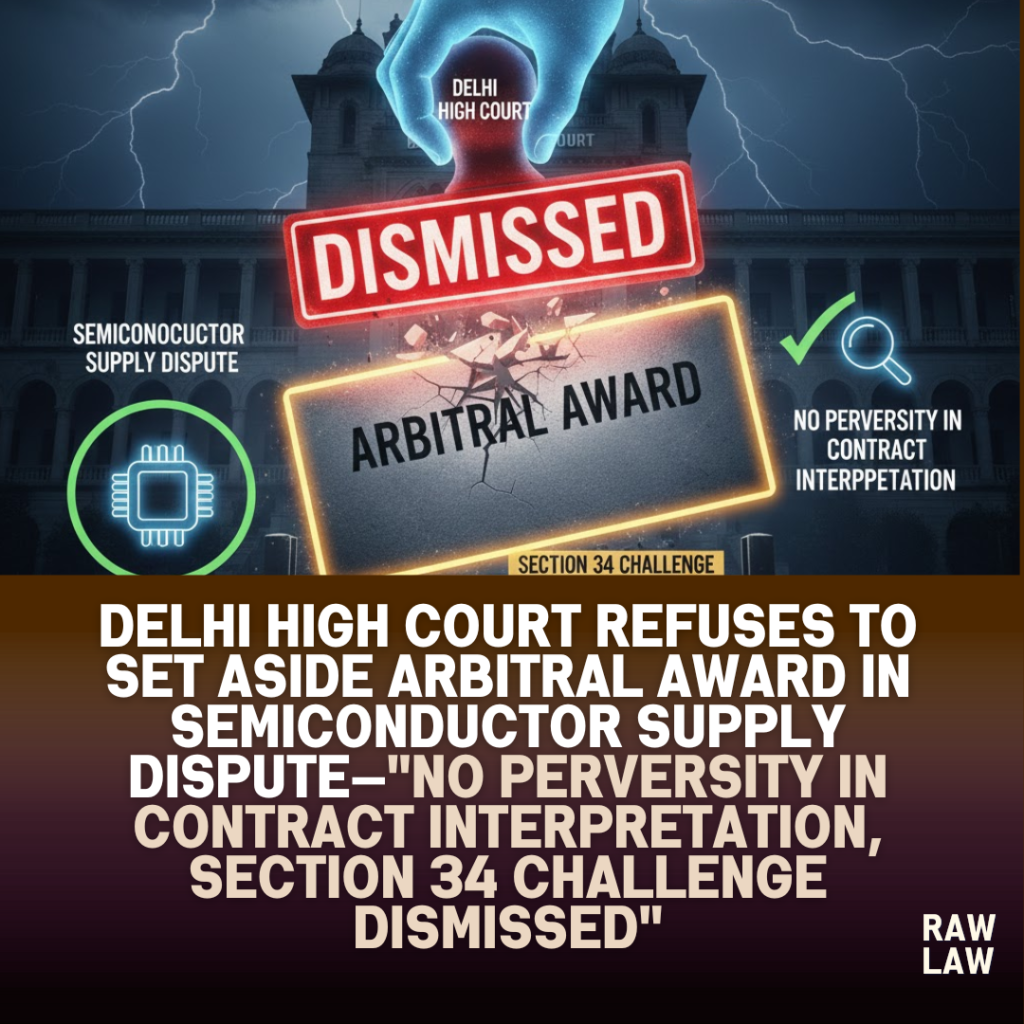
The Delhi High Court dismissed a petition under Section 34 of the Arbitration and Conciliation Act, 1996, challenging an arbitral award arising from a commercial dispute over supply of electronic switches. The Court held that the arbitral tribunal’s interpretation of the Vendor Agreement and Purchase Order was a plausible and reasonable view, not suffering from patent illegality or perversity. Reiterating the narrow scope of judicial interference under Section 34, the Court declined to reappreciate evidence or substitute its own interpretation of contractual terms, and upheld the directions requiring partial delivery of goods and refund with interest.
Court’s decision
The High Court confirmed the arbitral award dated 03 April 2023, which had directed the supplier to deliver 11,000 switches claimed to be ready and to refund ₹2.84 crore along with interest at nine percent per annum. It held that no ground under Section 34—whether patent illegality, conflict with public policy, or violation of fundamental policy of Indian law—was made out. The petition was dismissed along with the pending application.
Facts
The dispute arose from a commercial relationship between a company engaged in manufacturing and supply of electronic components and a hospitality management company. On 26 September 2019, a purchase order was issued for supply of 52,360 electronic switches valued at over ₹10.34 crore, inclusive of taxes. Subsequently, the parties executed a Vendor Agreement on 23 December 2019, which governed the purchase order.
Under the changed commercial arrangement, the supplier was required to procure components itself, including five major components from vendors identified by the buyer in Schedule A to the Vendor Agreement. An advance of fifty percent of the invoice value was paid by the buyer. Disputes arose when the switches were not delivered within the agreed timeline. Alleging breach and non-performance, the buyer invoked arbitration under the Vendor Agreement.
The arbitral tribunal framed issues on breach of the Vendor Agreement and Purchase Orders and entitlement to reliefs. After appreciating evidence, the tribunal concluded that the supplier failed to supply the contracted quantity, directed delivery of 11,000 switches stated to be ready, and ordered refund of the balance advance with interest. The supplier assailed the award under Section 34 of the Act.
Issues
The principal issue before the Court was whether the arbitral award suffered from patent illegality or perversity warranting interference under Section 34. Specifically, the Court examined whether the arbitrator erred in interpreting the Vendor Agreement to hold that there was no obligation on the buyer to make hundred percent advance payment for procurement of components, and whether the finding on breach and refund was contrary to the contractual framework.
Petitioner’s arguments
The supplier contended that it was only an assembler and not a manufacturer, and that the arbitrator erred in characterising the relationship between the parties. It was argued that the buyer had specified the vendors for key components and was obliged to make hundred percent advance payment to enable procurement. The supplier asserted that failure of the buyer to release full advance resulted in non-supply of switches and that the fifty percent advance received was utilised to procure components from which 11,000 switches were assembled.
It was further argued that the Vendor Agreement superseded prior arrangements, and if taken to its logical conclusion, the earlier purchase order could not survive independently. The revised purchase order for 11,000 switches was characterised as unilateral and not binding. On these premises, the petitioner sought setting aside of the award as contrary to the contract and evidence on record.
Respondent’s arguments
The buyer opposed the petition, submitting that the arbitrator’s interpretation was a plausible view and could not be interfered with merely because another interpretation was possible. It was argued that the Vendor Agreement clearly provided for payment against invoices after acceptance of goods, with no clause mandating hundred percent advance payment. The fifty percent advance, according to the buyer, was a goodwill gesture and not a contractual obligation.
Reliance was placed on cross-examination of witnesses to show that the supplier was aware that advance payments to component vendors were its own responsibility. The buyer also relied on correspondence demonstrating prolonged non-supply and contended that the revised purchase order was issued at the supplier’s request. It was submitted that the Section 34 petition sought impermissible reappreciation of evidence.
Analysis of the law
The Court undertook a detailed examination of the Vendor Agreement, particularly clauses governing procurement, delivery, defects, and payment. It noted that the agreement contemplated payment against invoices after acceptance of goods and did not contain any stipulation requiring hundred percent advance payment for procurement of components. The identification of vendors by the buyer for certain components did not, by itself, translate into an obligation to finance procurement in advance.
The Court reiterated the settled position that under Section 34, courts do not sit in appeal over arbitral awards. Interference is permissible only where the award is vitiated by patent illegality, perversity, or conflict with public policy. Where an arbitrator adopts a reasonable construction of contractual terms, even if an alternative view is possible, judicial intervention is barred.
Precedent analysis
The Court relied on authoritative Supreme Court precedents emphasising the narrow scope of Section 34 review. It referred to decisions holding that construction and interpretation of contracts fall primarily within the arbitrator’s domain, and that a “possible view” taken by the tribunal must be respected. The jurisprudence underscored that courts cannot correct errors of fact or substitute their own assessment unless the award shocks the conscience or violates fundamental legal principles. These precedents were applied to reject the challenge.
Court’s reasoning
The Court reasoned that the supplier failed to demonstrate any contractual clause obligating the buyer to make hundred percent advance payment. It observed that no switches were supplied, and even the emails relied upon by the supplier did not establish readiness of the entire contracted quantity. The argument that the Vendor Agreement extinguished the purchase order was rejected, with the Court holding that the agreement merely governed the terms and conditions applicable to such orders.
Importantly, the Court noted that the arbitral tribunal had balanced equities by directing delivery of 11,000 switches claimed to be ready and proportionately adjusting the refund. This, according to the Court, reflected a reasoned and fair approach, not warranting interference.
Conclusion
The Delhi High Court concluded that the arbitral award was based on a plausible interpretation of the contractual framework and appreciation of evidence. No patent illegality, perversity, or violation of public policy was established. Accordingly, the Section 34 petition was dismissed, and the arbitral award was upheld in its entirety.
Implications
This judgment reinforces judicial deference to arbitral autonomy in commercial disputes. It reiterates that Section 34 is not a forum for rehearing contractual disputes or re-evaluating evidence. For commercial parties, the ruling underscores the importance of clear contractual drafting on payment terms and advances, and affirms that courts will uphold arbitral awards where the tribunal’s view is reasonable, even if contested. The decision strengthens certainty and finality in arbitration, particularly in complex supply-chain disputes.
Case law reference
- Limits of Section 34 jurisdiction: Courts cannot reappreciate evidence or substitute their interpretation for that of the arbitrator.
- Contract interpretation: If the arbitrator’s construction is plausible, it must be upheld.
- Application in present case: These principles led to rejection of the challenge to the arbitral award.
FAQs
Q1. Can a court re-examine contractual terms under Section 34 of the Arbitration Act?
No. Courts will interfere only if the arbitral interpretation is perverse or patently illegal, not merely because another view is possible.
Q2. Does identification of vendors imply obligation to pay full advance?
Not unless expressly provided in the contract. Identification alone does not create a payment obligation.
Q3. What is the scope of public policy review in arbitration cases?
It is narrow and applies only to fundamental legal violations, patent illegality, or awards shocking the conscience.