


Court’s decision
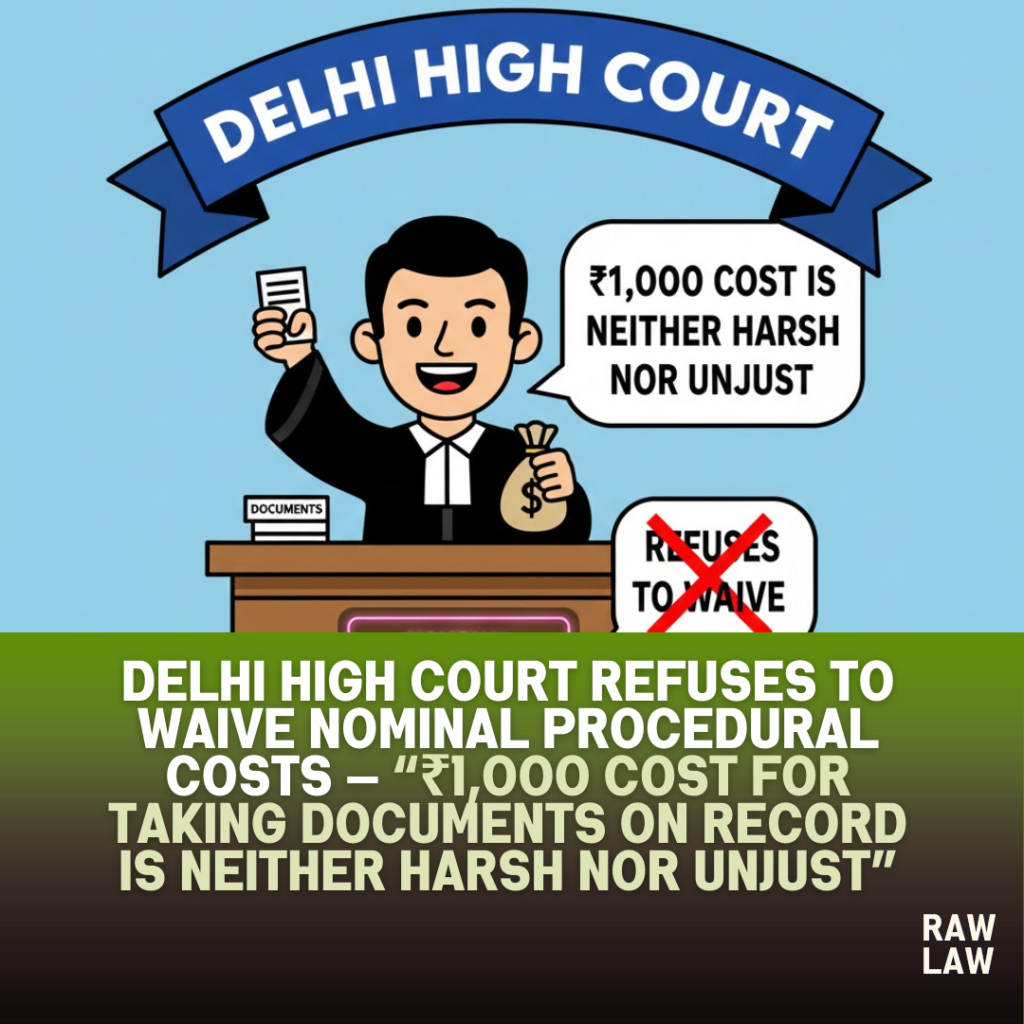
The Delhi High Court dismissed a petition under Article 227 of the Constitution of India challenging a trial court’s order imposing nominal costs of ₹1,000 for taking additional documents on record. The Court held that such costs were minimal, reasonable, and did not warrant supervisory interference. It ruled that once procedural indulgence has been granted by the trial court, imposition of modest costs is a legitimate tool to balance fairness and procedural discipline, even where the litigant pleads financial hardship or disability.
Facts
The petitioner was a plaintiff in a civil suit pending before a trial court in Delhi. During the course of proceedings, he sought permission to place five additional documents on record by filing an application under Order VII Rule 14 of the Code of Civil Procedure, 1908. By an order dated 18 August 2025, the trial court allowed the application, subject to payment of costs of ₹1,500.
Subsequently, on a request made by the petitioner, the trial court partially waived the costs and reduced the amount from ₹1,500 to ₹1,000 by an order dated 17 October 2025. Despite this reduction, the petitioner approached the High Court under Article 227, seeking complete waiver of costs, contending that he was indigent and suffering from 100% visual disability.
Issues
The central issue before the High Court was whether the trial court’s order imposing reduced costs of ₹1,000 for taking documents on record suffered from any illegality, perversity, or jurisdictional error warranting interference under Article 227. A related issue was whether personal circumstances such as disability or alleged financial incapacity justify complete waiver of procedural costs once the court has exercised discretion in favour of the litigant.
Petitioner’s arguments
The petitioner argued that he was an indigent person with 100% visual disability and was therefore not in a position to pay even the reduced cost of ₹1,000. It was contended that the imposition of costs, despite his physical condition and financial hardship, was unjust and oppressive. The petitioner urged the High Court to exercise its supervisory jurisdiction to waive the costs entirely, asserting that procedural requirements should not become a barrier to access to justice for persons with disabilities.
Respondents’ arguments
The respondents opposed the petition, contending that the costs imposed were nominal and could not be characterised as punitive or excessive. It was submitted that the petitioner was involved in multiple litigations with various parties, indicating that he was not as financially incapacitated as claimed. The respondents argued that the trial court had already shown indulgence by reducing the costs and that the High Court should not interfere with such a discretionary procedural order under Article 227.
Analysis of the law
The High Court examined the scope of supervisory jurisdiction under Article 227 of the Constitution. It reiterated that this jurisdiction is intended to ensure that subordinate courts act within the bounds of their authority and do not commit grave procedural injustice. Article 227 does not confer appellate powers, nor does it permit the High Court to interfere with every discretionary or procedural order passed by a trial court.
The Court emphasised that imposition of costs is an accepted and necessary tool in civil procedure. Costs serve to compensate the opposite party for delay or inconvenience and to ensure procedural discipline. When a court permits a party to place additional documents on record at a later stage, it is well within its discretion to impose costs, unless such costs are shockingly disproportionate or arbitrary.
Precedent analysis
While the order was concise, the reasoning aligns with settled jurisprudence that procedural orders imposing nominal costs do not ordinarily warrant interference under Article 227. Courts have consistently held that supervisory jurisdiction cannot be invoked to challenge minor cost orders, particularly when the litigant has already obtained substantive relief, such as permission to place documents on record.
Judicial precedents also recognise that while courts must be sensitive to the circumstances of litigants, including disability, such considerations do not automatically negate the need for procedural discipline or justify total waiver of costs in every case.
Court’s reasoning
The High Court noted that the petitioner’s documents had already been taken on record, which itself was a procedural benefit granted by the trial court. The only surviving grievance was with respect to payment of ₹1,000 as costs. The Court observed that the trial court had initially imposed costs of ₹1,500 and had thereafter reduced the amount, demonstrating a balanced and considerate approach.
The Court held that costs of ₹1,000 could not be regarded as excessive or oppressive by any reasonable standard. It found no material to conclude that the trial court’s order was perverse, arbitrary, or violative of principles of justice. Importantly, the Court clarified that Article 227 cannot be used to micro-manage trial court proceedings or to challenge every minor procedural direction that causes inconvenience to a litigant.
Conclusion
The Delhi High Court concluded that the petition was devoid of merit. It upheld the trial court’s order imposing costs of ₹1,000 and refused to interfere under Article 227. The Court dismissed the petition along with all pending applications, affirming that nominal procedural costs, particularly where indulgence has already been shown, do not constitute a ground for supervisory intervention.
Implications
This decision reinforces judicial restraint in the exercise of supervisory jurisdiction over procedural orders. It underscores that costs imposed by trial courts, when modest and reasonable, will ordinarily be upheld, even where litigants plead personal hardship. The ruling serves as a reminder that Article 227 is not a remedy for every procedural grievance and that trial courts retain autonomy in regulating proceedings through costs and conditions.
Case law references
- Supervisory jurisdiction under Article 227 (general principle)
Held: High Courts should not interfere with discretionary or procedural orders unless there is patent illegality or grave injustice.
Applied: Used to uphold imposition of nominal costs. - Imposition of costs in civil procedure (general principle)
Held: Costs are a legitimate tool to balance procedural indulgence and fairness.
Applied: Justified refusal to waive ₹1,000 costs.
FAQs
Q1. Can the High Court waive costs imposed by a trial court under Article 227?
Only in exceptional cases. Nominal and reasonable costs imposed as a procedural condition are generally not interfered with.
Q2. Does disability automatically entitle a litigant to waiver of court costs?
No. While courts may consider personal circumstances, disability alone does not mandate complete waiver of procedural costs.
Q3. Why do courts impose costs for taking documents on record?
Costs are imposed to compensate the opposite party and to maintain procedural discipline when additional indulgence is granted.