


Court’s decision
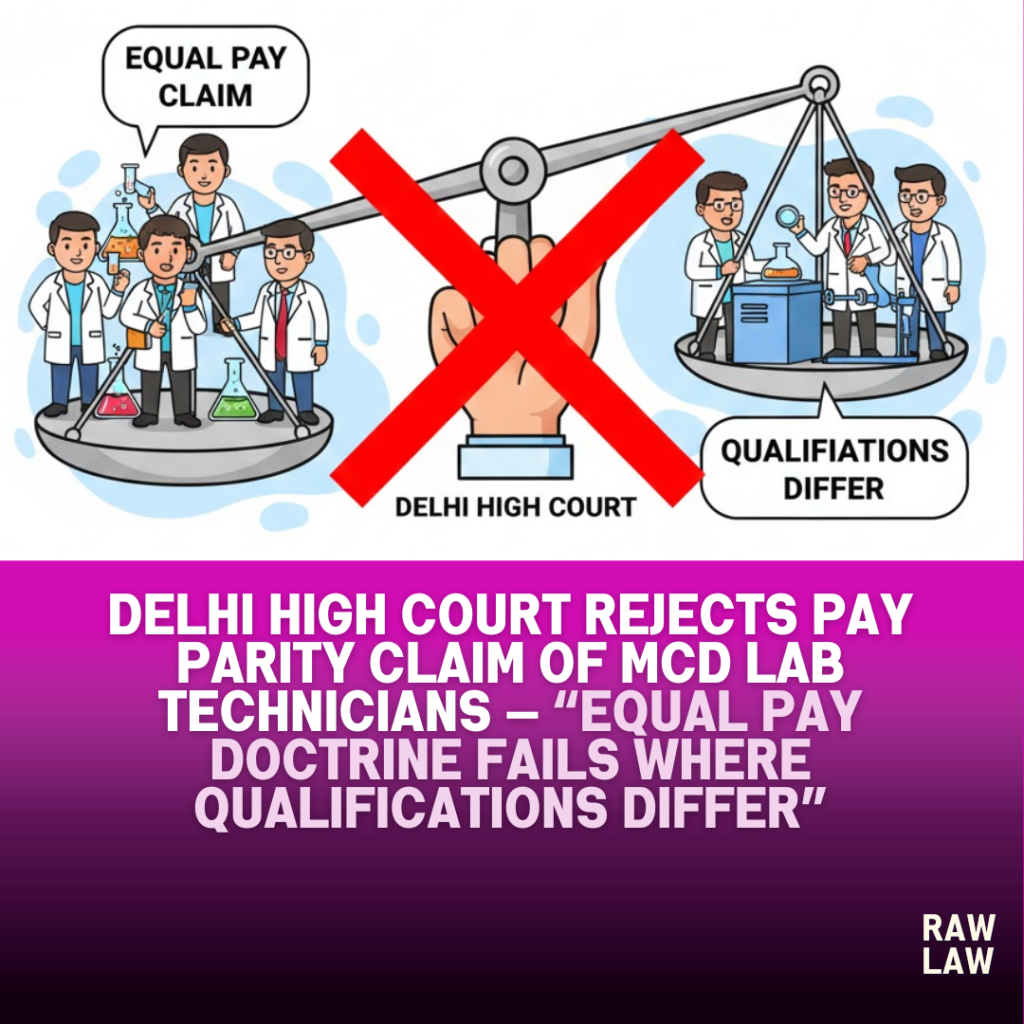
The Delhi High Court dismissed a writ petition filed by an association of laboratory technicians employed with the Municipal Corporation of Delhi, refusing their claim for parity in pay scales with laboratory technicians working under the Central Government. Upholding the Central Administrative Tribunal’s orders, the Court held that the doctrine of “equal pay for equal work” cannot be invoked where there is a clear and admitted difference in educational qualifications prescribed for recruitment. The Court ruled that judicial interference in pay fixation matters is limited and cannot override policy choices or recruitment rules.
Facts
The petition was filed by an association representing laboratory technicians working in hospitals run by the Municipal Corporation of Delhi. The employees claimed entitlement to the pay scale of ₹5000–8000 with effect from 1 January 1996, as recommended by the Fifth Central Pay Commission. Their claim was based on alleged parity with laboratory technicians working under the Central Government, including those employed in premier medical institutions.
The grievance originated from earlier litigation dating back to 2005, which was later transferred to the Central Administrative Tribunal and registered as an original application. By orders passed in 2018 and 2019, the Tribunal dismissed both the original application and the review application, holding that the petitioners failed to establish entitlement to the claimed pay scale. Aggrieved by these orders, the association approached the High Court under Article 226 of the Constitution of India.
Issues
The principal issue before the High Court was whether laboratory technicians employed by the Municipal Corporation of Delhi could claim pay parity with laboratory technicians working under the Central Government despite a difference in prescribed educational qualifications. A related issue was whether the orders passed by the Central Administrative Tribunal suffered from any perversity, illegality, or jurisdictional error warranting interference in writ jurisdiction.
Petitioners’ arguments
The petitioners contended that denial of the Fifth Central Pay Commission scale to MCD laboratory technicians was arbitrary and discriminatory. It was argued that the nature of duties performed by laboratory technicians in municipal hospitals was substantially similar to those performed by their counterparts under the Central Government. According to the petitioners, parity in designation and job functions justified parity in pay.
It was further argued that the educational qualification requirements recommended by the Fifth Central Pay Commission were prospective in nature and intended to apply only to future recruits. Existing employees, it was submitted, could not be denied the benefit of the higher pay scale on the basis of revised qualifications. The petitioners also relied on earlier affidavits of the municipal authorities indicating that recruitment rules were under consideration for amendment, contending that this showed acceptance of their claim in principle.
Respondents’ arguments
The respondents opposed the petition, asserting that recommendations of Central Pay Commissions are not automatically applicable to municipal employees unless specifically adopted by the competent authority. It was submitted that the recruitment rules governing laboratory technicians under the Municipal Corporation of Delhi were materially different from those applicable to Central Government laboratory technicians.
On a specific query by the Court, the municipal authorities clarified that MCD laboratory technicians were required to possess matriculation as the minimum qualification, whereas Central Government laboratory technicians were required to hold a Bachelor of Science degree. This distinction, it was argued, constituted a valid basis for classification and differential pay scales, defeating any claim for parity.
Analysis of the law
The High Court reiterated that determination of pay scales lies primarily within the domain of the executive and expert bodies such as pay commissions. Judicial review in matters of pay fixation is narrow and circumscribed. Courts intervene only when a clear case of arbitrariness, discrimination, or violation of constitutional principles is made out.
The Court emphasized that the principle of “equal pay for equal work” is not a fundamental right enforceable in every case. It operates only where there is a complete and wholesale identity between two sets of employees in terms of recruitment criteria, educational qualifications, duties, and responsibilities. Educational qualification, the Court noted, is a legitimate and rational basis for classification in service jurisprudence.
Precedent analysis
The Court placed reliance on the Supreme Court’s decision in State of Bihar v. Bihar Secondary Teachers Struggle Committee, which held that parity in pay cannot be claimed merely on the basis of similarity in designation or nature of work when there are material differences in recruitment rules or educational qualifications. The Supreme Court had categorically recognised educational qualification as a valid differentiating factor for pay structures.
Applying this precedent, the High Court held that the admitted difference between matriculation-level recruitment for MCD laboratory technicians and graduate-level recruitment for Central Government laboratory technicians defeated the claim for pay parity.
Court’s reasoning
The High Court found that the difference in minimum educational qualifications prescribed for recruitment constituted an intelligible differentia with a rational nexus to pay structure. Once such a distinction existed, the claim for automatic parity could not be sustained as a matter of constitutional right.
The Court rejected the argument that proposed amendments to recruitment rules or administrative intent could confer an enforceable right. It held that unless and until recruitment rules are formally amended, courts cannot direct grant of higher pay scales. The Court also agreed with the Tribunal that anomalies in pay hierarchy, if any, must be addressed by the appropriate anomalies committee or pay commission and not through judicial fiat.
Finding no perversity or illegality in the Tribunal’s reasoning, the Court declined to interfere.
Conclusion
The Delhi High Court concluded that laboratory technicians employed by the Municipal Corporation of Delhi are not entitled to pay parity with Central Government laboratory technicians due to a clear difference in recruitment qualifications. Upholding the Tribunal’s orders, the Court dismissed the writ petition, reaffirming the limited role of courts in matters of pay fixation and service policy.
Implications
This judgment reinforces settled service law principles governing pay parity claims. It clarifies that similarity in designation or duties is insufficient to claim equal pay where recruitment qualifications materially differ. For municipal and state employees, the ruling underscores that pay commission recommendations apply only upon formal adoption and alignment with recruitment rules. The decision also reiterates judicial restraint in interfering with expert determinations relating to pay structures.
Case law references
- State of Bihar v. Bihar Secondary Teachers Struggle Committee
Held: Equal pay cannot be claimed where there are material differences in educational qualifications or recruitment rules.
Applied: Used to reject pay parity claim of MCD laboratory technicians.
FAQs
Q1. Can municipal employees claim pay parity with Central Government employees?
Only if there is complete identity in recruitment rules, qualifications, and duties. Mere similarity in designation is insufficient.
Q2. Does difference in educational qualification justify different pay scales?
Yes. Courts recognise educational qualification as a valid basis for classification in pay fixation.
Q3. Can courts direct implementation of Pay Commission recommendations?
No. Pay Commission recommendations must be adopted by the competent authority and aligned with recruitment rules.