


Court’s decision
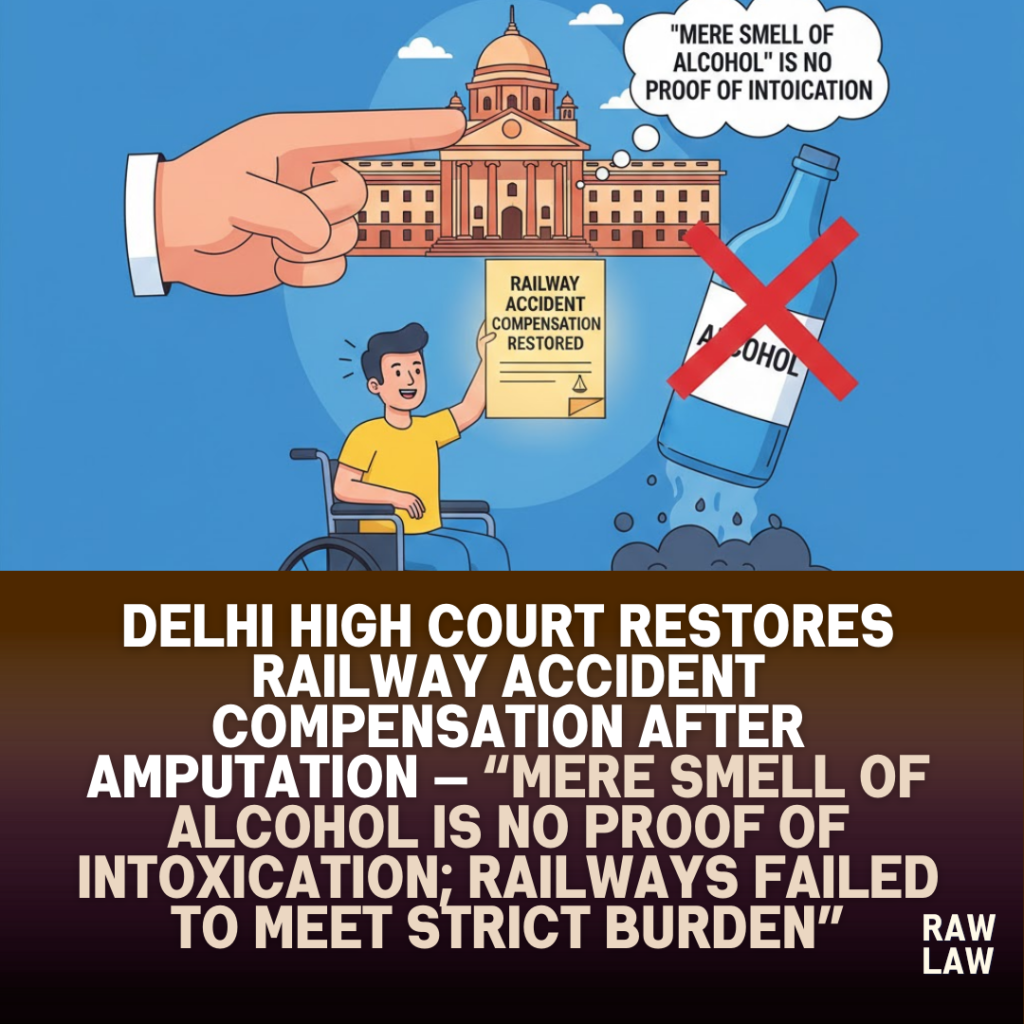
The Delhi High Court allowed an appeal filed by an injured passenger and set aside the Railway Claims Tribunal’s decision denying compensation for a train accident that resulted in amputation of the appellant’s left leg. Holding that the Railways failed to prove that the injuries were self-inflicted due to intoxication, the Court ruled that mere clinical observation or smell of alcohol is insufficient to attract the statutory exceptions under Section 124A of the Railways Act, 1989. The Court awarded statutory compensation of ₹8 lakh with 12% interest, reaffirming the strict liability regime governing railway accident claims.
Facts
The appellant was travelling on 30 January 2025 from New Delhi to Basti on the Vaishali Express. Due to heavy rush in the train, he was compelled to stand near the gate of the compartment. According to the appellant, a sudden jerk of the train coupled with pressure from fellow passengers caused him to fall from the moving train, resulting in grievous injuries. The fall led to traumatic amputation of his left leg above the knee.
A claim was filed before the Railway Claims Tribunal seeking statutory compensation for an “untoward incident” under the Railways Act, 1989. The Tribunal accepted that the appellant was a bona fide passenger holding a valid ticket. However, it dismissed the claim on the ground that the injuries were self-inflicted, allegedly caused by the appellant’s intoxicated state, thereby invoking the exception under Section 124A(d) of the Act.
Issues
The principal issue before the High Court was whether the Tribunal was justified in denying compensation by concluding that the appellant was intoxicated and that the injuries were self-inflicted, falling within the statutory exceptions under Section 124A of the Railways Act. A related issue was the standard of proof required to establish intoxication in railway accident claims, particularly in the absence of scientific evidence such as blood alcohol analysis.
Appellant’s arguments
The appellant argued that the Tribunal’s finding of intoxication was speculative and unsupported by cogent evidence. It was contended that no blood sample was drawn, no medical test was conducted to ascertain alcohol levels, and no scientific basis was furnished for concluding intoxication. The appellant submitted that observations in the hospital discharge summary and the testimony of the attending doctor were insufficient to establish a direct nexus between alleged alcohol consumption and the accident.
Relying on prior Delhi High Court and Supreme Court precedents, the appellant argued that mere smell of alcohol or uncooperative behaviour due to pain and shock cannot justify denial of compensation under a beneficial statute. It was further submitted that official railway records, including the DRM report and the Station Master’s statement, clearly recorded the incident as an accidental fall, without attributing any role to intoxication.
Respondent’s arguments
The Union of India defended the Tribunal’s order, arguing that medical records and the deposition of the attending doctor indicated that the appellant was under the influence of alcohol. It was contended that intoxication could be inferred even in the absence of blood tests, based on clinical observations. The respondent asserted that the appellant voluntarily placed himself in a dangerous position, and therefore the injuries were self-inflicted, squarely attracting the statutory exceptions to compensation liability.
Analysis of the law
The High Court analysed the statutory framework under Sections 123(c)(2) and 124A of the Railways Act, which impose strict liability on the Railways for untoward incidents, subject only to narrowly construed exceptions. The Court reiterated that the Act is a beneficial legislation intended to provide swift and assured compensation to victims of railway accidents.
The Court emphasised that to deny compensation under the intoxication exception, the burden lies squarely on the Railways to establish, through reliable and cogent evidence, that the injury was directly attributable to an act committed in a state of intoxication. Mere suspicion, conjecture, or clinical impression does not satisfy this burden.
Precedent analysis
The Court relied on binding precedent holding that contributory negligence is irrelevant in railway accident claims and that liability under Section 124A is strict. It referred to judgments which clarified that exceptions under the Act must be proved with a high degree of certainty, particularly where intoxication is alleged. The Court distinguished reliance on general insurance law principles, noting that railway accident compensation operates under a distinct statutory scheme.
The Court reaffirmed that absence of scientific evidence such as blood alcohol analysis is fatal to the Railways’ defence when intoxication is pleaded as the sole ground to deny compensation.
Court’s reasoning
The High Court found that the Tribunal placed undue reliance on the doctor’s assertion without any supporting scientific material. It observed that trauma victims suffering amputation, shock, and severe pain may exhibit disorientation or non-cooperation, which cannot automatically be equated with intoxication. The Court noted that neither the DRM report nor the Station Master’s statement attributed the accident to intoxication.
The Court held that the Railways failed to discharge the statutory burden of proving that the appellant’s injuries were self-inflicted due to intoxication. In the absence of reliable medical or scientific evidence, the Tribunal’s conclusion was found to be legally unsustainable.
Conclusion
The Delhi High Court set aside the Tribunal’s judgment and allowed the appeal. Holding that the accident constituted an “untoward incident” under the Railways Act, the Court awarded statutory compensation of ₹8,00,000 along with interest at 12% per annum from the date of the accident. The Railways were directed to release the compensation within four weeks.
Implications
This ruling reinforces the strict liability framework governing railway accident compensation and sends a clear message that statutory exceptions will be applied narrowly. It clarifies that allegations of intoxication must be proved through credible and scientific evidence, not mere clinical impressions. The judgment strengthens passenger rights and ensures that the beneficial object of the Railways Act is not diluted by speculative defences.
Case law references
- Union of India v. Prabhakaran Vijaya Kumar
Held: Liability under Section 124A is strict and contributory negligence is irrelevant.
Applied: Used to reject denial of compensation on alleged fault of passenger. - Bhola Nath v. Union of India (Delhi High Court)
Held: Smell of alcohol without scientific proof is insufficient to establish intoxication.
Applied: Relied upon to discredit Railways’ defence.
FAQs
Q1. Can railway compensation be denied on the ground of intoxication?
Yes, but only if the Railways prove through reliable and scientific evidence that the injury was directly caused by an act committed in a state of intoxication.
Q2. Is smell of alcohol enough to deny compensation under the Railways Act?
No. Courts consistently hold that mere smell or clinical suspicion is insufficient without medical testing.
Q3. What compensation is payable for amputation in railway accidents?
As per the Railway Accidents and Untoward Incidents (Compensation) Rules, 1990, amputation above the knee attracts compensation of ₹8 lakh.