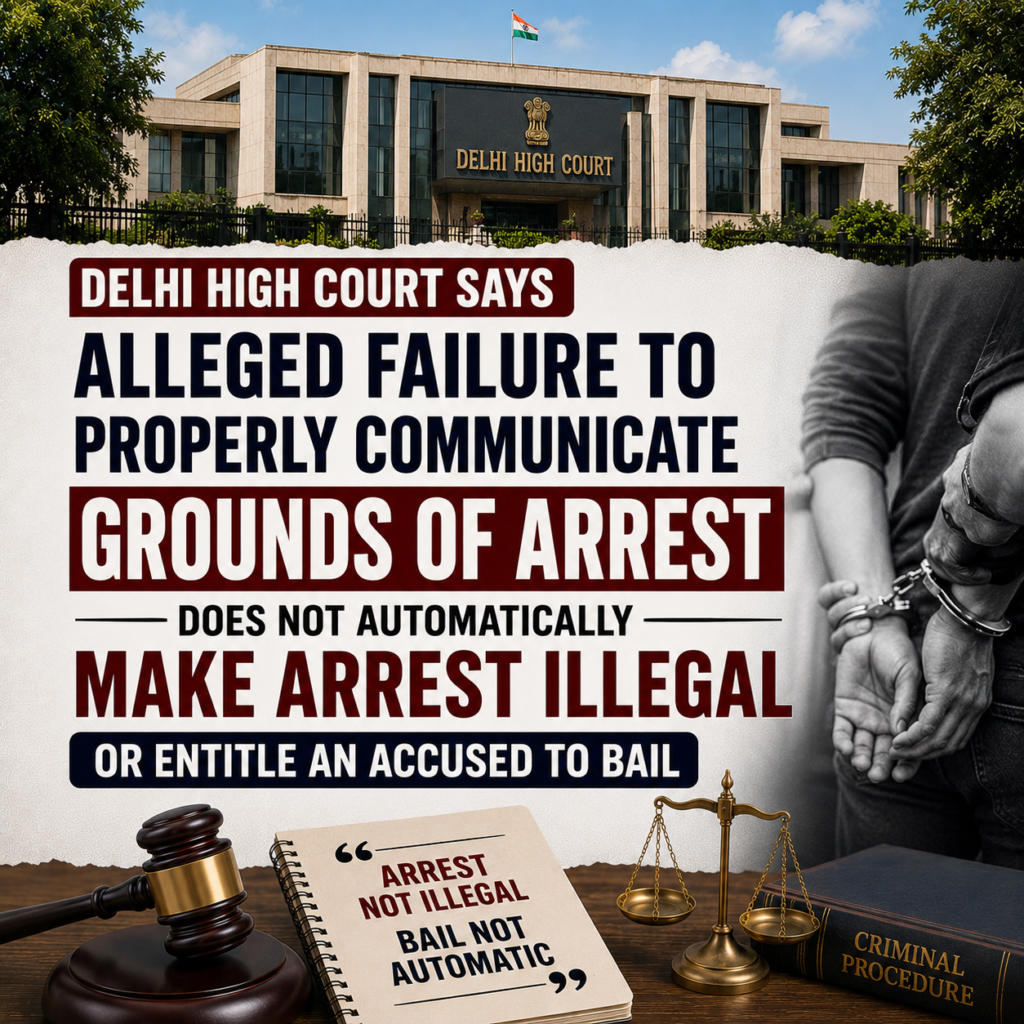
Delhi High Court Refuses Bail in Murder Case, Holds Accused Was Informed of Grounds of Arrest and No Prejudice Was Shown
Facts
The petitioner, Karan, filed a regular bail application before the Delhi High Court in FIR No. 0329 of 2024 registered at Police Station Prasad Nagar.
The FIR was registered for offences under Sections 109(1) and 3(5) of the Bharatiya Nyaya Sanhita, corresponding to Sections 302 and 34 IPC, along with offences under the Arms Act.
The prosecution case was that on 16 August 2024, police received information regarding admission of two injured persons, Dharmender @ Monu and Vimal Prakash @ Akki.
Akki stated that he and his friend Neeraj were travelling in a vehicle when their vehicle collided with a scooty driven by Jugnu. Though the collision was minor, Jugnu allegedly threatened to kill Neeraj.
Thereafter, Akki, Neeraj and Monu went to Jugnu’s house to apologise, but Jugnu was not found there. Later, they were allegedly attacked by Jugnu, Amit, Vicky and Karan.
According to the prosecution, Karan was armed with a knife and attacked Akki and Monu, causing serious stab injuries. Monu later died. The autopsy report stated that death was due to haemorrhagic shock caused by penetrating stab injury to the abdomen.
All four accused, including Karan, were arrested on 16 August 2024. The prosecution also relied on CCTV footage which allegedly corroborated their involvement.
The bail application was argued only on the ground that Karan was not supplied grounds of arrest in writing, and therefore his arrest was illegal.
Issues
- Whether Karan’s arrest was illegal because grounds of arrest were allegedly not supplied to him in writing.
- Whether non-supply or delayed supply of written grounds of arrest automatically entitles an accused to bail.
- Whether the accused had suffered any demonstrable prejudice due to the alleged procedural violation.
- Whether the grounds of arrest were in fact communicated to the accused and his family.
- Whether regular bail could be granted in a murder case solely on the alleged defect in arrest procedure.
Petitioner’s Arguments
The petitioner argued that he was never provided the grounds of arrest in writing.
He submitted that the arrest violated Article 22(1) of the Constitution of India and Sections 36, 47, 48 and 49 of the Bharatiya Nagarik Suraksha Sanhita, 2023.
The petitioner relied on several decisions, including Pankaj Bansal v. Union of India, Prabir Purkayastha v. State (NCT of Delhi), Vihaan Kumar v. State of Haryana, Mihir Rajesh Shah v. State of Maharashtra, Dr. Rajinder Rajan v. Union of India, and Brijesh Kothia v. State of NCT of Delhi.
He argued that non-compliance with the mandatory requirement of informing grounds of arrest vitiates the arrest and that the accused is therefore entitled to release on bail.
At a later stage, the petitioner also argued that even if grounds of arrest were supplied to him, they were not supplied to his family members.
Respondent’s Arguments
The State opposed the bail application.
The State submitted that the petitioner was duly provided the grounds of arrest in writing at the time of arrest.
The APP referred to the case diary and submitted that the written grounds of arrest mentioned:
- identification by spot witness Neeraj;
- visibility of the accused’s face in CCTV footage;
- necessity of arrest for impartial investigation;
- need to recover case property connected with the offence.
The State argued that the grounds were given not only to the petitioner but also to the co-accused, and that they acknowledged the same by signing.
The State further argued that the Supreme Court in Mihir Rajesh Shah held that written communication of grounds of arrest would apply prospectively. Since the arrest in the present case was on 16 August 2024, the petitioner could not rely on later developments in law to invalidate the arrest.
The State also relied on the Delhi High Court Division Bench decision in Karan Singh v. State (NCT of Delhi), where it was held that the law in Mihir Rajesh Shah regarding uniform written communication of grounds of arrest operates prospectively.
Analysis of the Law
The Court examined Article 22(1) of the Constitution and the requirement that an arrested person must be informed of the grounds of arrest.
The Court noted that the petitioner was arrested on 16 August 2024 and was produced before the Magistrate on 17 August 2024. At that time, he and the co-accused were represented by a Legal Aid Counsel.
The remand order recorded that the accused were asked about injuries and they denied police torture. The remand order also recorded that information regarding the arrest of all accused persons had been given to their family members.
The Court further noted that the petitioner did not raise any grievance before the Magistrate that the grounds of arrest had not been supplied.
The Court also considered that the plea of non-supply of grounds of arrest was raised for the first time in May 2026, almost two years after the arrest.
The Court referred to the case diary extract reproduced in the judgment, which showed that the grounds of arrest were recorded in writing and bore the petitioner’s acknowledgment. The reproduced extract specifically referred to witness identification, CCTV footage, necessity of arrest for impartial investigation, and recovery of case property.
The Court held that there was nothing to show that the grounds of arrest were not supplied to the accused or that his family was unaware of the arrest or its reasons.
Precedent Analysis
The petitioner relied on Pankaj Bansal, Prabir Purkayastha, Vihaan Kumar, Mihir Rajesh Shah, Dr. Rajinder Rajan, and Brijesh Kothia to argue that non-supply of grounds of arrest vitiates arrest.
The State relied on Karan Singh v. State (NCT of Delhi) to argue that Mihir Rajesh Shah applies prospectively with respect to mandatory written communication of grounds of arrest.
The Court primarily relied on State of Karnataka v. Sri Darshan, where the Supreme Court held that delay or procedural lapse in furnishing grounds of arrest does not by itself justify bail unless demonstrable prejudice is shown.
The Court noted that Sri Darshan clarified that the accused must be informed of the grounds of arrest, but the mere absence of written grounds or alleged delay does not automatically render arrest illegal unless prejudice is established.
Court’s Reasoning
The Court found that the petitioner had not shown any prejudice.
The petitioner was produced before the Magistrate the next day, was represented by counsel, and did not complain that the grounds of arrest had not been supplied.
The remand order showed that information regarding arrest had been given to the family members.
The Court further held that the petitioner was aware from the beginning as to why he had been arrested. During the remand proceedings, he stated that he had been beaten by the opposite side, which showed that he understood the factual background of the case.
The Court also noted that the petitioner’s argument had shifted. Initially, he claimed that grounds of arrest were not supplied at all. Later, he argued that even if grounds were supplied to him, they were not supplied to his family.
The Court rejected this submission because the first remand order specifically recorded that information regarding the arrest of all accused persons had been given to their family members.
The Court held that the case diary material and remand record showed substantial compliance with the arrest requirements.
Since no demonstrable prejudice was shown, the Court held that the alleged procedural defect could not become a ground for bail in a serious murder case.
Conclusion
The Delhi High Court dismissed the regular bail application filed by Karan.
The Court held that there was no basis to declare the arrest illegal on the ground of non-supply of written grounds of arrest.
It found that the grounds of arrest had been communicated, the petitioner was aware of the reasons for arrest, information had been given to his family, and no prejudice was shown.
The Court therefore refused to grant bail.
Case Details
Case: Karan v. State of NCT of Delhi
Court: Delhi High Court
Case Number: BAIL APPLN. 2544 of 2025 with CRL.M.A. 19868/2025 and CRL.M.A. 16192/2026
Judge: Justice Manoj Jain
Date: 07 July 2026
Result: Regular bail application dismissed.