


Court’s decision
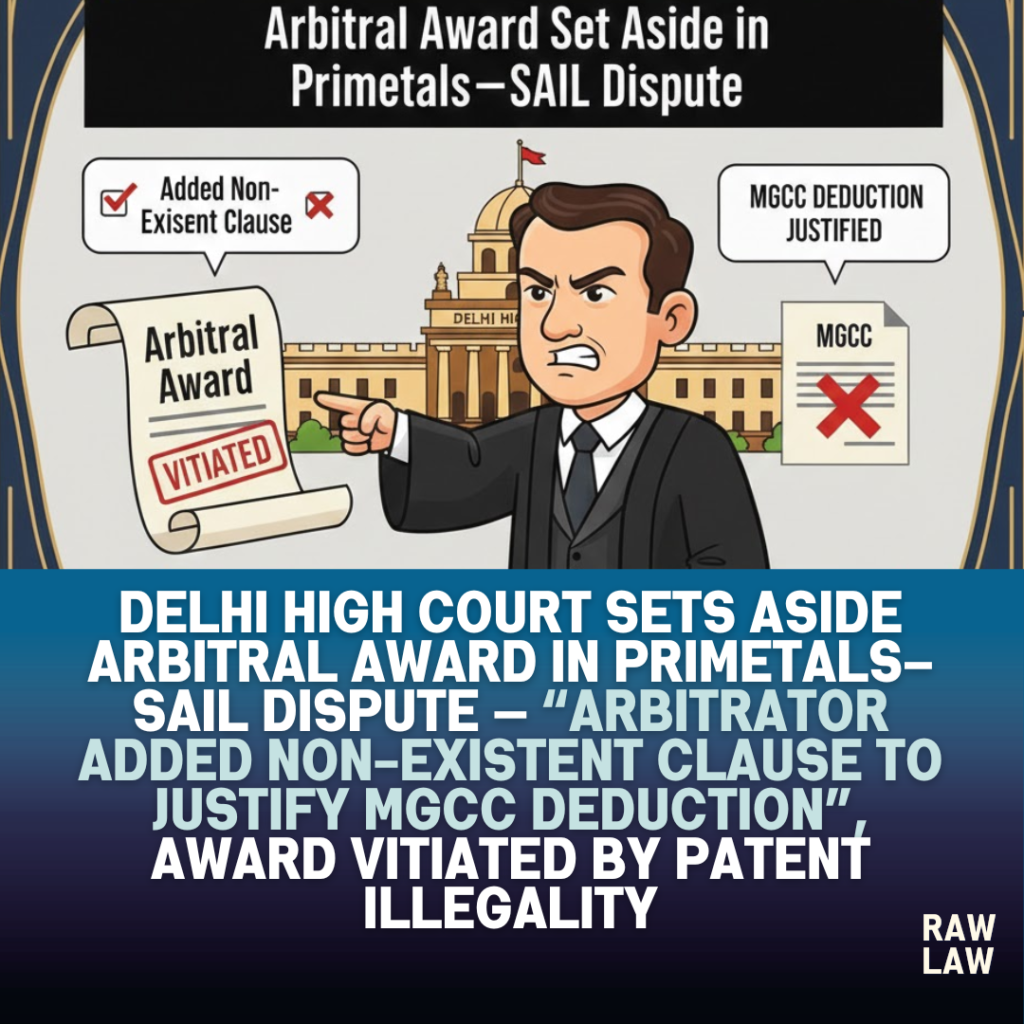
The Delhi High Court allowed a Section 34 petition filed by Primetals Technologies India Private Limited and set aside an arbitral award that had upheld deduction of Rs.1,07,61,378/- on account of shortfall in minimum guaranteed CENVAT credit (MGCC).
The Court held that there was no clause in the contract permitting deduction of shortfall in MGCC from invoices. It found that the arbitrator had travelled beyond the contractual framework and relied upon a non-existent clause to justify the deduction. Such departure from the contract amounted to patent illegality under Section 34 of the Arbitration and Conciliation Act, 1996.
Facts
The parties entered into a contract dated 12.10.2007 for installation of a Power Supply Facility for a 700 TPD ASU-4 at Bhilai Steel Plant. The contract price was Rs.18.45 crore. Article 2.1 required that a minimum amount of Rs.2.16 crore be passed on as CENVAT credit to the employer.
The commissioning certificate was issued in June 2012 and final acceptance in December 2013. Final invoices were submitted in February 2019. While processing payment, the employer deducted Rs.1,07,61,378/- citing shortfall in MGCC.
Arbitration was invoked in February 2022. The arbitral tribunal rejected the contractor’s claim for reimbursement, upholding the deduction. The contractor challenged the award under Section 34.
Issues
The High Court confined itself to a narrow but decisive question:
Whether, in absence of an express contractual clause, the employer was entitled to deduct shortfall in MGCC from invoices raised by the contractor.
Additionally, the Court examined whether the arbitrator’s interpretation amounted to rewriting the contract and thereby attracted the ground of patent illegality.
Petitioner’s arguments
The contractor contended that Clause 14.5.2 of the General Conditions of Contract only provided for non-reimbursement of excise duty in case of failure to furnish documents enabling CENVAT credit. There was no clause permitting deduction of shortfall in MGCC from the contract price or invoices.
It was argued that the arbitrator exceeded jurisdiction by relying on a non-existent clause stating that 50% benefit of excess CENVAT would go to the contractor. This reasoning, according to the petitioner, introduced terms not contemplated by the contract.
The petitioner maintained that the award was vitiated by patent illegality for travelling beyond the four corners of the contract.
Respondents’ arguments
Steel Authority of India Limited contended that Article 2.1 obligated the contractor to pass on MGCC and that failure to do so justified deduction of the shortfall. It argued that Article 2.1 overrode the GCC and imposed a clear responsibility on the contractor.
The respondents also submitted that adjustment of contract price could occur under Clause 14.6 only upon proof of variation in tax rates relating to finished equipment, and that the contractor failed to produce documentary evidence under Clause 14.6.2.
It was emphasized that the arbitrator’s view was plausible and that Section 34 interference is limited.
Analysis of the law
The Court reproduced Article 2.1 and Clauses 14.5.2 and 14.6.1–14.6.3 of the GCC. It observed that Article 2.1 mandated passing on MGCC but did not stipulate consequences for shortfall.
Clause 14.5.2 clearly provided that in case of failure to submit documents enabling CENVAT credit, duty paid to that extent shall not be reimbursed. There was no stipulation for deducting shortfall from invoices.
The Court reiterated the settled principle that an arbitrator must decide within the terms of the contract. Introducing a term not found in the contract amounts to acting beyond jurisdiction and attracts patent illegality.
Precedent analysis
The Court relied on Supreme Court authorities including:
- Indian Oil Corporation Ltd. v. Shree Ganesh Petroleum – An arbitrator must act within the terms of the contract; ignoring specific terms results in patent illegality.
- State of Chhattisgarh v. SAL Udyog (P) Ltd. – Failure to decide in accordance with contractual terms contravenes Section 28(3) of the Act.
- Bharat Coking Coal Ltd. v. Annapurna Construction – Arbitrator has no power beyond what the contract confers; travelling beyond the contract amounts to excess of jurisdiction.
Applying these principles, the Court concluded that the tribunal had ventured outside contractual boundaries.
Court’s reasoning
The Court undertook a financial analysis of the contract structure. The gross contract price was Rs.18.45 crore, with MGCC of Rs.2.16 crore. The net contract value after MGCC was Rs.16.29 crore.
Despite the shortfall in MGCC, the net outgoing of the employer remained unchanged because the shortfall amount was not reimbursed. There was no additional financial loss justifying further deduction.
The arbitrator erred by holding that shortfall could be deducted and by referencing a non-existent clause providing 50% sharing of excess CENVAT. This amounted to rewriting the contract.
Such deviation from contractual text constituted patent illegality apparent on the face of the award.
Conclusion
The Delhi High Court held that:
- No clause permitted deduction of shortfall in MGCC.
- Clause 14.5.2 only provided for non-reimbursement, not recovery.
- The arbitrator relied on a non-existent contractual term.
- The award suffered from patent illegality.
Accordingly, the arbitral award dated 24.05.2024 was set aside.
Implications
This judgment is significant in reinforcing that arbitrators cannot supply omissions in contracts. Contractual silence cannot be converted into implied recovery rights.
The ruling also highlights that public sector undertakings must draft tax and credit clauses with precision if recovery mechanisms are intended.
Importantly, the decision illustrates the distinction between “plausible interpretation” and “jurisdictional overreach.” While courts ordinarily defer to arbitral interpretation, they will intervene when an award adds terms not agreed by the parties.
Case Law References
- Indian Oil Corporation Ltd. v. Shree Ganesh Petroleum (2022) 4 SCC 463 – Arbitrator must act within contractual framework.
- State of Chhattisgarh v. SAL Udyog (P) Ltd. (2022) 2 SCC 275 – Ignoring contract terms attracts patent illegality.
- Bharat Coking Coal Ltd. v. Annapurna Construction (2003) 8 SCC 154 – Arbitrator exceeding contract acts without jurisdiction.
The High Court applied these precedents to hold the award legally unsustainable.
FAQs
1. Can shortfall in minimum guaranteed CENVAT credit be deducted from invoices?
Only if the contract expressly provides for such deduction. In absence of a specific clause, deduction amounts to rewriting the contract.
2. What amounts to patent illegality under Section 34?
If an arbitrator ignores or travels beyond the terms of the contract, the award may be set aside for patent illegality apparent on its face.
3. Does Article 2.1 requiring MGCC automatically permit deduction for shortfall?
No. While it mandates passing on MGCC, it does not specify consequences of shortfall. Such consequences cannot be implied without express contractual provision.