


Court’s decision
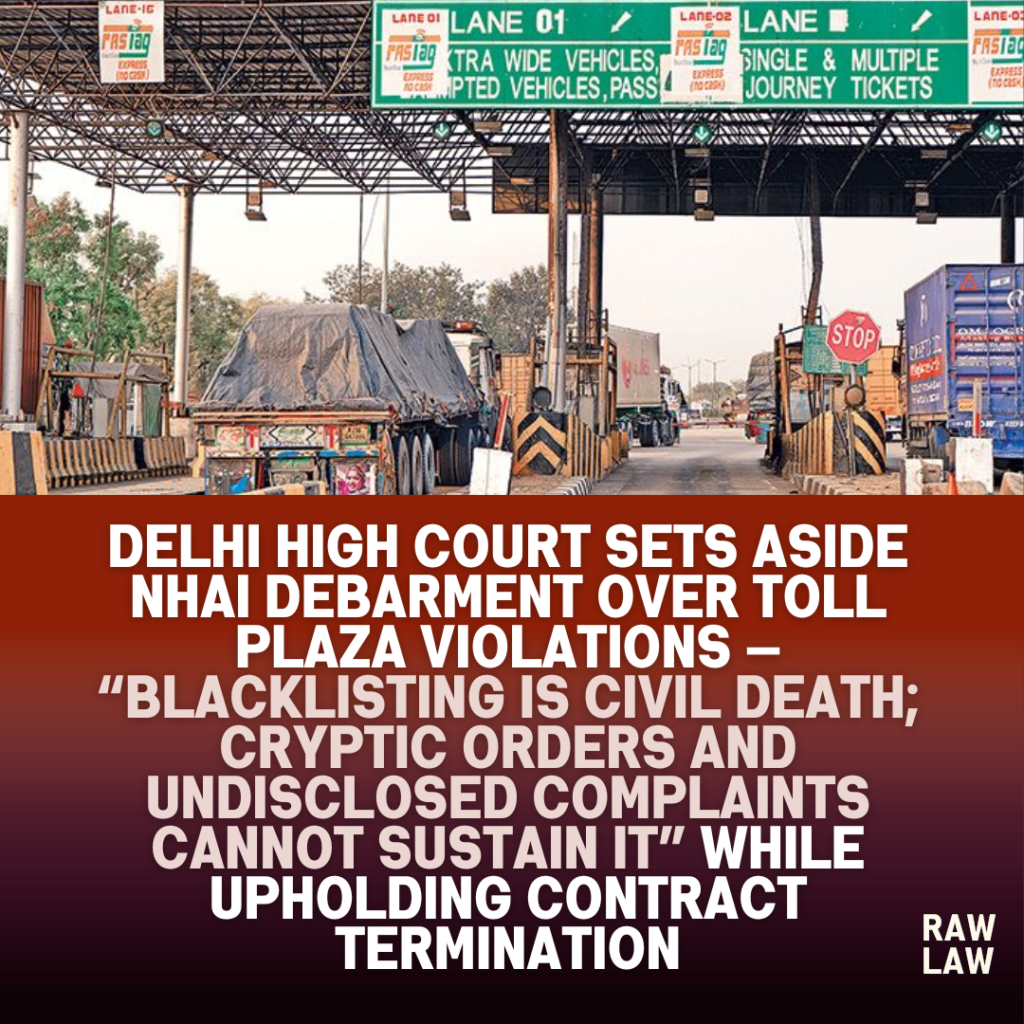
The Delhi High Court partly allowed a writ petition filed by a toll collection contractor, setting aside a one-year debarment imposed by the National Highways Authority of India, while refusing to interfere with termination of the contract and imposition of monetary penalty. The Court held that debarment is a drastic, stigmatic measure amounting to “civil death” and therefore requires strict adherence to principles of natural justice, reasoned decision-making, and proportionality. Finding that the debarment order was unreasoned, mechanical, and based on undisclosed material, the Court quashed it, though leaving the parties to work out contractual remedies in respect of termination and penalty .
Facts
The petitioner was awarded a contract dated 25 July 2024 by the National Highways Authority of India for user fee collection at the Chapwa Fee Plaza on National Highway-24 in Uttar Pradesh, along with upkeep of adjoining facilities. The contract period was from 29 July 2024 to 29 July 2025, with an annual remittance obligation exceeding ₹6.8 crore.
In February 2025, following an email from the Indian Highways Management Company Limited raising an apprehension about use of unauthorised toll collection methods, NHAI officials conducted a surprise inspection at the toll plaza. During inspection, a vehicle deployed by NHAI was allegedly charged ₹50 in cash at ingress without issuance of a receipt, and the transaction was not recorded in the Electronic Toll Collection system. The vehicle was shown as “FASTag Exempt – Local/Farmer” in records, while during egress it was correctly charged and recorded.
Based on inspection reports, system logs, CCTV footage, and inputs from the system integrator, NHAI imposed a penalty of ₹10 lakhs in February 2025, citing violations of contractual clauses relating to operational transparency and prohibition on use of unauthorised Point-of-Sale devices. A show cause notice was thereafter issued in May 2025 proposing penal action. Despite the petitioner’s detailed reply, NHAI terminated the contract and debarred the petitioner for one year from participating in any NHAI tenders or projects by order dated 30 June 2025.
Issues
The principal issues before the High Court were whether the debarment order satisfied the requirements of natural justice, whether the petitioner’s reply to the show cause notice had been meaningfully considered, whether reliance on undisclosed complaints and a solitary inspection incident could justify debarment, and whether the action taken was proportionate. The Court also considered whether termination of contract and penalty could be interfered with in writ jurisdiction.
Petitioner’s arguments
The petitioner contended that the penalty and debarment were imposed without furnishing material relied upon, including CCTV footage, details of alleged complaints, or seizure of any unauthorised device. It was argued that the show cause notice referred vaguely to “a number of complaints” without particulars, denying an effective opportunity of defence. The petitioner maintained that all toll operations were under continuous supervision of NHAI, IHMCL and the system integrator, and denied use of any unauthorised software.
It was further argued that the debarment order failed to deal with the petitioner’s reply, relied on an isolated ₹50 transaction which at best was an aberration, and amounted to double punishment, since a monetary penalty had already been imposed. The petitioner emphasised that blacklisting-like action must meet a higher threshold of procedural fairness and proportionality.
Respondents’ arguments
NHAI defended its action by submitting that surprise inspection, system logs, and video evidence conclusively established use of unauthorised methods for toll collection, amounting to fraudulent activity under the contract. It was argued that the petitioner had earlier been penalised for similar misconduct at the same plaza, demonstrating repeated violations.
The respondents submitted that the petitioner had admitted collection of ₹50 in its reply and that debarment for up to one year was expressly contemplated under the contract. Reliance was placed on Supreme Court precedent recognising the inherent power of public authorities to blacklist or debar contractors in public interest.
Analysis of the law
The Court reiterated settled principles governing blacklisting and debarment, noting that such action has severe civil consequences and is subject to strict judicial review. Compliance with natural justice requires not only issuance of a show cause notice but also meaningful consideration of the reply, disclosure of material relied upon, and recording of reasons. The Court underscored that contractual breaches, by themselves, do not automatically justify debarment unless the conduct is so egregious as to warrant exclusion in public interest.
Precedent analysis
The Court relied on Supreme Court authorities including Gorkha Security Services on the mandatory contents of show cause notices in blacklisting cases, Techno Prints and Blue Dreamz Advertising on the need to avoid mechanical and pre-determined debarment, and Delhi High Court precedent summarising principles of proportionality, reasoned orders, and fairness in exclusionary actions. These decisions were applied to assess whether NHAI’s action met constitutional standards.
Court’s reasoning
The High Court found that the debarment order was vitiated by complete non-consideration of the petitioner’s reply, containing only a bald assertion that the response was “unsatisfactory”. It noted that no unauthorised POS machine or software had been seized, complaints referred to were never disclosed, and the allegation of “continued” fraudulent conduct was unsupported by particulars. The Court observed that reliance on a single inspection incident involving ₹50, without addressing the petitioner’s explanations, could not justify the harsh penalty of debarment.
Holding that debarment is akin to “civil death”, the Court ruled that the impugned order failed the tests of reasonableness, proportionality and natural justice, and therefore could not stand. However, it declined to interfere with termination of the contract and monetary penalty, characterising them as contractual matters to be pursued through appropriate civil or arbitral remedies .
Conclusion
The Delhi High Court set aside the debarment imposed on the petitioner, restoring its eligibility to participate in NHAI tenders. At the same time, the termination of the toll collection contract and imposition of penalty were left undisturbed. The writ petition was disposed of accordingly.
Implications
This judgment reinforces that debarment and blacklisting cannot be imposed casually or mechanically, even where contractual violations are alleged. Public authorities must disclose material, deal with replies, and justify why exclusion is necessary and proportionate. The ruling serves as an important reminder that while government agencies enjoy discretion in safeguarding public interest, such power is tightly constrained by constitutional requirements of fairness and reasoned decision-making.
Case law references
- Gorkha Security Services v. Government (NCT of Delhi) – Mandated detailed show cause notice specifying proposed penalty.
- Techno Prints v. Chhattisgarh Textbook Corporation – Warned against mechanical, pre-determined debarment orders.
- Blue Dreamz Advertising v. Kolkata Municipal Corporation – Held that contractual disputes alone do not justify blacklisting.
- Patel Engineering v. Union of India – Recognised inherent power of public authorities to blacklist, subject to fairness.
FAQs
1. Can NHAI debar a contractor for toll plaza violations?
Yes, but only after following strict principles of natural justice, proportionality, and reasoned decision-making.
2. Is debarment different from contract termination?
Yes. Debarment affects future business and is far more serious, requiring a higher procedural threshold.
3. Did the Court restore the toll collection contract?
No. The Court set aside only the debarment; termination and penalty were left to contractual remedies.