


Court’s decision
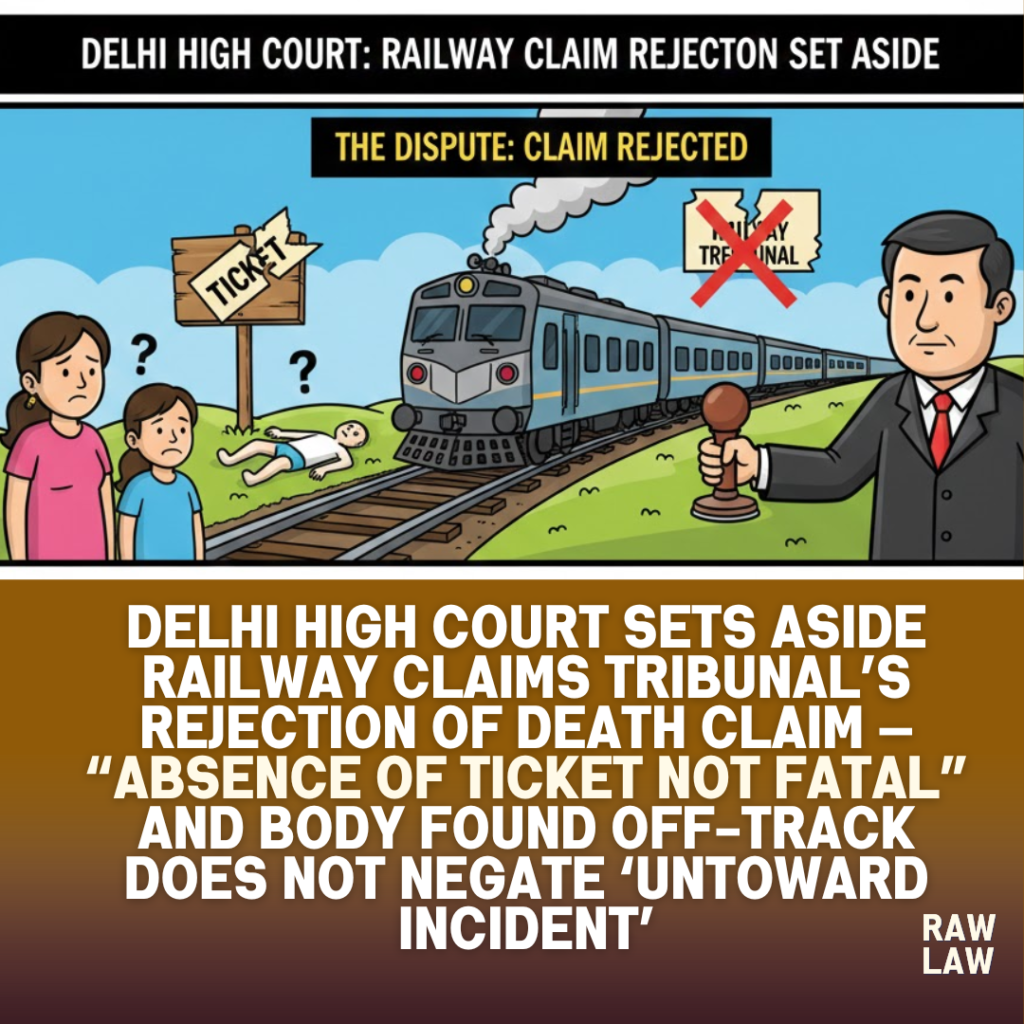
The Delhi High Court allowed an appeal against the Railway Claims Tribunal’s order dismissing a death compensation claim under the Railways Act, 1989. The Court held that mere absence of a journey ticket and the fact that the deceased’s body was found between railway tracks could not, by themselves, defeat the claim. Applying the Supreme Court’s rulings in Union of India v. Rina Devi and Doli Rani Saha v. Union of India, the Court concluded that the deceased was a bona fide passenger who died in an “untoward incident,” and directed the Tribunal to determine and disburse compensation within two months.
Facts
The appeal arose from the dismissal of a claim application filed before the Railway Claims Tribunal concerning the death of an 82-year-old passenger. The deceased had allegedly undertaken a journey on 10 June 2015 from Etawah to Shikohabad on a passenger train.
According to the claimant, the deceased fell from the train near Jaswantnagar Railway Station and suffered fatal injuries. A memo issued by the Station Master at Balrai Railway Station recorded that the body was discovered by a railway keyman on the same day. Postmortem was conducted promptly.
The Tribunal dismissed the claim, holding that the deceased was neither a bona fide passenger nor a victim of an “untoward incident” under Section 123(c) of the Railways Act, 1989. The claimant challenged these findings before the High Court.
Issues
The High Court considered two primary issues:
- Whether the deceased could be treated as a bona fide passenger despite no journey ticket being recovered.
- Whether the incident of falling from the train qualified as an “untoward incident” under Section 123(c) of the Railways Act.
The resolution of these issues would determine the entitlement to statutory compensation.
Appellant’s arguments
The appellant contended that though no ticket was recovered from the deceased’s body, the claim application was supported by an affidavit stating that the journey ticket had been purchased in the presence of the deceased’s son.
It was submitted that the train was overcrowded and the deceased had to stand near the door, resulting in his accidental fall. The appellant relied on the Supreme Court’s decision in Union of India v. Rina Devi, which held that absence of a ticket is not conclusive against a claimant if initial burden is discharged by affidavit.
It was further argued that discovery of the body between two stations supported the claim of accidental fall from the moving train.
Respondent’s arguments
The Union of India contended that the deceased was not a bona fide passenger and had undertaken unlawful travel. It was argued that the body being found between two railway lines contradicted the claim of accidental fall.
The respondent defended the Tribunal’s reasoning and sought dismissal of the appeal.
Analysis of the law
The High Court referred to the Supreme Court’s judgment in Union of India v. Rina Devi, which clarified that while mere presence of a body on railway premises does not automatically establish bona fide travel, mere absence of a ticket does not negate such status either.
The Supreme Court had held that the initial burden lies on the claimant, which can be discharged by filing an affidavit stating relevant facts. Once discharged, the burden shifts to the Railways.
The Court also relied on Doli Rani Saha v. Union of India, which reaffirmed the above principle and emphasized that compensation claims must be assessed based on surrounding circumstances.
Regarding the definition of “untoward incident,” the Court noted that accidental falling from a train is expressly included under Section 123(c) of the Railways Act.
Precedent analysis
In Rina Devi, the Supreme Court laid down that absence of ticket recovery is not decisive and that the burden shifts to Railways once a prima facie case is made.
In Doli Rani Saha, the Supreme Court reiterated that affidavit evidence can suffice to discharge initial burden.
The High Court also referred to its own precedent in Budhu Singh v. Union of India, which held that the mere fact that a body is found a few meters away from the track cannot disprove accidental fall, as injured passengers may move away or be flung aside due to speed.
Applying these precedents, the Court found the Tribunal’s conclusions unsustainable.
Court’s reasoning
The Court observed that the appellant had filed an affidavit detailing purchase of ticket and circumstances of overcrowding. This satisfied the initial burden under Rina Devi.
The discovery of the body between Jaswantnagar and Balrai stations indicated a mid-station incident. The Court rejected the argument that the body’s location between two tracks negated accidental fall.
It reasoned that upon falling, a person may move away from the tracks or be thrown aside due to speed. Thus, the Tribunal erred in drawing adverse inference solely from the body’s position.
The Court held that both conditions—bona fide passenger and untoward incident—stood satisfied.
Conclusion
The Delhi High Court set aside the Tribunal’s order and held the claimant entitled to statutory death compensation. The matter was remitted to the Tribunal for determination and disbursement of compensation within two months.
Implications
This judgment reinforces claimant-friendly principles in railway accident compensation cases. It reiterates that technicalities such as non-recovery of ticket or position of body should not defeat legitimate claims when supported by credible evidence.
The ruling strengthens the application of Rina Devi and clarifies the evidentiary burden in untoward incident cases under the Railways Act.
It also signals judicial reluctance to deny compensation based on speculative reasoning regarding accident location.
Case law references
- Union of India v. Rina Devi (2019) 3 SCC 572 — Absence of ticket not fatal; affidavit can discharge initial burden.
- Doli Rani Saha v. Union of India (2024) 9 SCC 656 — Reaffirmed burden-shifting principle in railway accident cases.
- Budhu Singh v. Union of India (2025 SCC OnLine Del 1718) — Body found away from track does not negate accidental fall.
FAQs
1. Is recovery of a train ticket mandatory to claim railway accident compensation?
No. The Supreme Court has held that absence of a ticket does not automatically defeat a claim if the claimant establishes relevant facts through affidavit and circumstances.
2. What qualifies as an “untoward incident” under the Railways Act?
Accidental falling from a train carrying passengers is expressly included as an “untoward incident” under Section 123(c) of the Railways Act, 1989.
3. Can compensation be denied because the body was found away from the railway track?
Not necessarily. Courts have held that injured persons may move away from the track or be thrown aside; such fact alone does not negate accidental fall.