


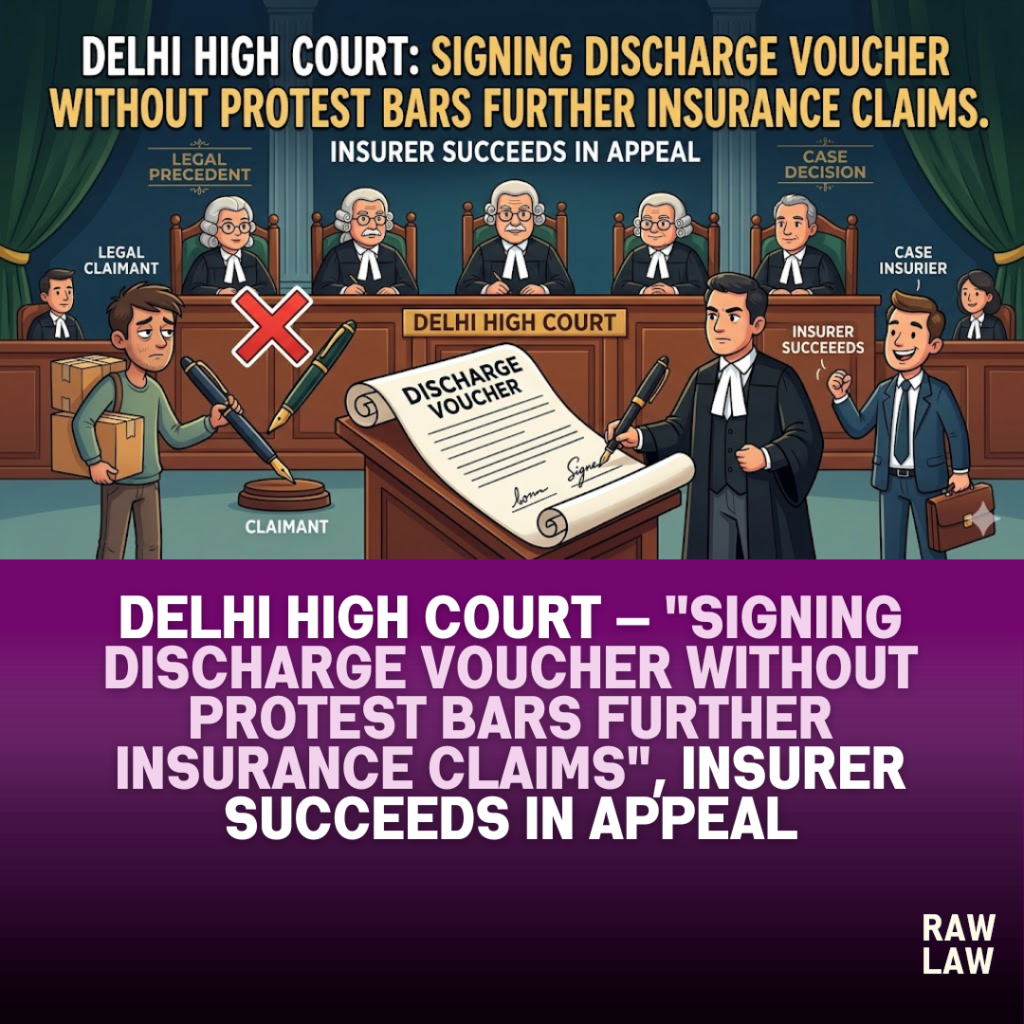
Court’s decision
The Delhi High Court dismissed the appeal filed by the insured company seeking recovery of additional insurance compensation after a fire incident.
The Court affirmed the findings of the arbitral tribunal and the Single Judge that the insured had executed two discharge vouchers accepting payment as “full and final settlement.”
Since the vouchers were signed voluntarily and without reservation, the Court held that the claim stood conclusively settled.
Consequently, the arbitral tribunal was justified in issuing a “nil award”, and the Single Judge had rightly refused to interfere under Section 34 of the Arbitration and Conciliation Act.
Facts
The appellant company was engaged in manufacturing and trading mint and pine-based essential oils and had taken an insurance policy covering its building, machinery, stock, and fixtures.
The policy insured the premises for ₹32.25 crore.
On 13 February 2013, a fire broke out at the insured premises, causing significant damage to the factory, machinery, and stock.
The insured company lodged a claim for ₹27.08 crore.
The insurer appointed surveyors who assessed the loss and submitted a final survey report.
The surveyor assessed the loss at approximately ₹12.18 crore, which was subsequently paid to the insured.
However, after accepting the amount, the insured invoked the arbitration clause in the insurance policy seeking payment of the remaining claim amount.
Issues
The High Court examined the following key questions:
- Whether the insurance claim stood discharged by accord and satisfaction after execution of discharge vouchers.
- Whether the insured had executed the discharge vouchers under economic duress.
- Whether the arbitral award rejecting the claim suffered from patent illegality warranting interference under the Arbitration and Conciliation Act.
Petitioner’s arguments
The insured company argued that the discharge vouchers were executed under severe financial distress.
It contended that after the fire incident the company faced mounting debts and pressure from creditors and bankers.
According to the appellant, the insurer refused to release the assessed claim amount unless a full and final discharge voucher was signed.
Given the company’s financial difficulties, it was compelled to sign the vouchers in order to obtain immediate funds.
The appellant argued that economic distress itself rendered the discharge vouchers involuntary.
Reliance was placed on Supreme Court precedents which held that contracts executed under economic pressure or unequal bargaining power may not amount to genuine consent.
Respondent’s arguments
The insurer argued that the discharge vouchers had been executed voluntarily and consciously by the insured.
It emphasized that the insured had never raised objections to the surveyor’s assessment before signing the vouchers.
Further, the insured had accepted the payment and issued written confirmation that the amount represented full and final settlement of the claim.
The insurer argued that financial difficulties faced by the insured were unrelated to any act of the insurer and therefore could not invalidate the settlement.
Accordingly, the insurer contended that the arbitral tribunal rightly concluded that the dispute was not arbitrable after accord and satisfaction.
Analysis of the law
The Court examined the legal principles governing accord and satisfaction in insurance claims.
Under contract law, a claim is extinguished when parties agree to settle a dispute and the settlement amount is accepted in full and final satisfaction.
The Court noted that such settlement can only be challenged if the discharge voucher was obtained through fraud, coercion, or undue influence.
Mere financial distress or commercial pressure does not automatically invalidate a settlement.
The Court further emphasised that courts exercising jurisdiction under Section 34 of the Arbitration and Conciliation Act cannot reassess evidence or substitute their own conclusions for that of the arbitral tribunal.
Precedent analysis
The Court relied on National Insurance Co. Ltd. v. Boghara Polyfab Pvt. Ltd., where the Supreme Court clarified that arbitration cannot proceed if the contract has been discharged through accord and satisfaction.
However, arbitration may still be invoked where the discharge voucher was obtained through coercion or economic duress caused by the other party.
The Court also examined earlier judgments explaining the limited scope of judicial interference with arbitral awards.
These precedents established that courts cannot interfere merely because another interpretation is possible.
Court’s reasoning
The High Court noted several crucial facts.
First, the insured had received the final survey report assessing the loss but did not challenge the assessment.
Second, the insured executed two discharge vouchers, one in March 2014 and another in July 2014.
Third, the insured accepted payment of the assessed amount without recording any protest or reservation.
Importantly, the Court found no evidence showing that the insurer forced or coerced the insured into signing the vouchers.
The financial difficulties faced by the insured arose from the fire incident and its business circumstances rather than any wrongful conduct by the insurer.
Therefore, the Court concluded that the discharge vouchers were executed voluntarily and constituted valid accord and satisfaction.
Conclusion
The Delhi High Court held that the insurance claim stood fully settled once the insured executed discharge vouchers and accepted payment without protest.
Since the arbitral tribunal’s conclusion was a plausible and legally sustainable view, there was no ground for interference under Sections 34 or 37 of the Arbitration Act.
The Court therefore dismissed the appeal and upheld the arbitral award rejecting the insured’s claim.
Implications
This judgment reinforces the legal principle that full and final settlement vouchers in insurance claims carry significant legal consequences.
Businesses must carefully consider the implications before signing discharge vouchers, as courts may treat them as binding settlements.
The ruling also underscores the limited scope of judicial interference with arbitral awards, particularly where the arbitrator’s findings are based on plausible interpretation of evidence.
For insurance disputes, the decision clarifies that economic hardship alone is insufficient to invalidate a settlement unless coercion by the insurer is proven.
Case Law References
- National Insurance Co. Ltd. v. Boghara Polyfab Pvt. Ltd. (2009)
The Supreme Court held that arbitration cannot proceed once a contract is discharged through accord and satisfaction unless the discharge voucher was obtained by coercion or fraud. - Chairman and MD, NTPC Ltd. v. Reshmi Constructions (2004)
Held that courts must consider whether settlement agreements were executed voluntarily or under economic compulsion. - Central Inland Water Transport Corporation Ltd. v. Brojo Nath Ganguly (1986)
Recognised that unfair contracts arising from unequal bargaining power may be invalidated in certain circumstances.
FAQs
1. What is a discharge voucher in insurance claims?
A discharge voucher is a document signed by the insured acknowledging receipt of payment in full and final settlement of an insurance claim.
2. Can a claim be reopened after signing a discharge voucher?
Generally no. Courts may reopen the claim only if the voucher was signed under fraud, coercion, or undue influence.
3. Does financial hardship invalidate a settlement agreement?
Financial hardship alone is insufficient. The party must show that the other party caused coercion or economic duress leading to the settlement.