


1. Court’s decision
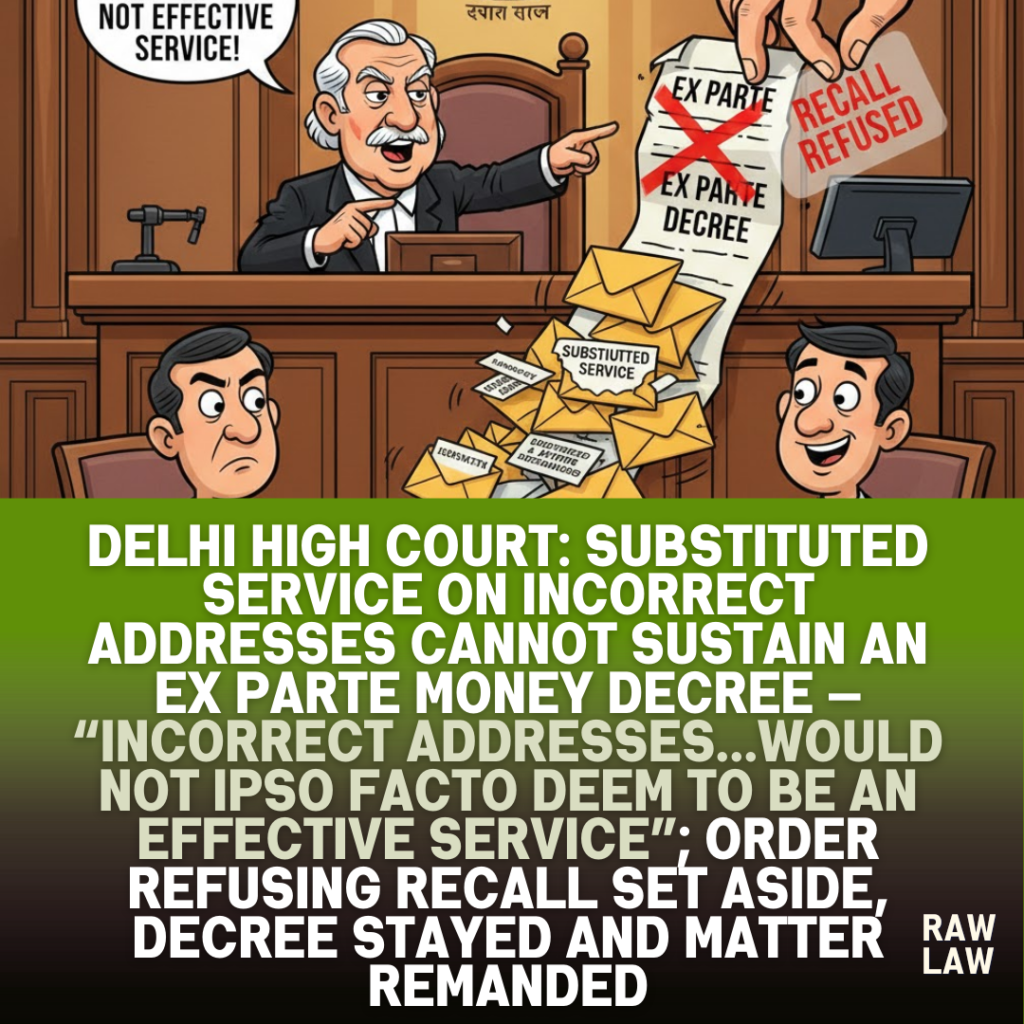
The Delhi High Court set aside a commercial district judge’s order that had rejected an application seeking to set aside an ex parte money decree. The Court found that the plaintiff had proceeded on incorrect addresses in the plaint, and that resort to substituted service by newspaper publication, on those facts, could not automatically be treated as effective service in law. It held that substituted service is a last resort, and that where the addresses used for ordinary service were not correct, the defendant could plausibly explain non-appearance. The High Court remanded the application for fresh adjudication and stayed the ex parte judgment and decree till the trial court decides the recall application.
2. Facts
A commercial recovery suit for ₹7,72,526 was instituted in December 2021 by a supplier against a trader/proprietor. Summons were initially issued for February 2022 but did not result in service. The trial court then directed fresh summons through ordinary and electronic modes, including messaging and email, subject to procedural requirements. On the next date, the trial court noted a report claiming electronic service (including “blue ticks”), but also recorded deficiencies: the court staff had not confirmed receipt on phone, it was unclear whether the email was received or bounced, and screenshots were not annexed. Fresh service through all permissible modes was then directed.
3. Issues
The appeal raised a narrow but recurring procedural question: whether an ex parte decree can stand when the record suggests summons were issued on addresses that were not the defendant’s correct addresses, and when substituted service by publication was permitted thereafter. The defendant argued that the plaintiff concealed the correct residential and business addresses, resulting in an engineered ex parte decree. The plaintiff responded that service was complete through electronic modes and publication, and also relied on the defendant’s participation in pre-litigation mediation to assert prior knowledge. The High Court had to assess whether service was legally effective and whether the refusal to set aside the decree warranted interference.
4. Petitioner’s arguments
The defendant argued that the business premises shown in the plaint had been sold years earlier, that the business had shifted, and therefore service could not have been effected at the old shop. It asserted that the plaintiff knew the defendant’s residential address but did not disclose it in the memo of parties, and that another address and email shown in the suit papers were fictitious. The defendant highlighted that when execution was filed later, the plaintiff mentioned the correct residential address and the new business address, and the bailiff served attachment warrants there—supporting the claim that correct particulars were always available.
5. Respondent’s arguments
The plaintiff contended that the defendant had been served through electronic modes, including messaging and email, and that the trial court had recorded such service. It argued that publication in a national daily was duly carried out after an application for substituted service was allowed, and the trial court proceeded ex parte only after recording such substituted service. The plaintiff further maintained that the suit was a commercial suit preceded by mandatory pre-litigation mediation, during which the defendant’s counsel appeared; this, according to the plaintiff, demonstrated awareness of the dispute and made the “no knowledge” narrative implausible. It also relied on a Supreme Court principle that decrees should not be set aside for mere irregularity if notice and time to appear existed.
6. Analysis of the law
The High Court approached the matter through the service architecture of the Code of Civil Procedure, which prioritises ordinary service and permits substituted service only when the court is satisfied that the defendant is keeping out of the way or service cannot be effected by ordinary means. The Court reiterated that substituted service is not an automatic shortcut; it is a “last resort” tool, and effectiveness must be judged against the steps taken earlier and the reliability of the addresses used. It also treated electronic service with caution when the contemporaneous order itself records gaps in proof—such as missing screenshots and uncertainty about email delivery. The Court framed “effective service” as a substantive safeguard, not a technicality.
7. Precedent analysis
The High Court discussed two Supreme Court strands relevant to ex parte recall. First, it referenced the principle that a decree should not be set aside merely for an irregularity in service when the defendant had notice and sufficient time to appear. Second, it noted the Supreme Court’s guidance on substituted service: before a civil court presses substituted service into action, it should ordinarily ensure that the prescribed steps of ordinary service are exhausted, including the statutory mechanism of service by affixation where appropriate. The High Court, however, emphasised that precedents must be applied to the facts at hand: where addresses themselves are incorrect, mechanical insistence on formal steps like affixation may be futile and does not cure the foundational defect.
8. Court’s reasoning
The Court closely traced the trial record. It noted that process server reports at the two addresses in the plaint consistently suggested that the shop was vacated and that no such person or firm existed at those locations. While an order initially recorded electronic service, the same order also recorded doubts and directed fresh service through all modes—showing the trial court was not satisfied about electronic service. The High Court then found it “apparent” that the addresses provided with the plaint were not the correct addresses. It treated the later execution petition as revealing: it contained the defendant’s residential address and the new business address, and the bailiff executed warrants there. This sequence strengthened the inference that correct addresses could likely have been used earlier.
9. Conclusion
On these facts, the High Court held that permitting substituted service and proceeding ex parte could not, by itself, establish effective service in accordance with law. It found the defendant’s explanation—sale of the old premises in early 2018 and shifting to a new business address—plausible, especially because the recovery claim was founded on invoices issued after that shift. The Court rejected the plaintiff’s reliance on pre-litigation mediation participation as proof of suit knowledge, stressing that the civil procedure for service of summons must be satisfied independently through record evidence. Accordingly, it set aside the order dismissing the recall application, remanded the matter for fresh adjudication, and stayed the decree till the application is decided.
10. Implications
This decision underlines that courts will scrutinise the integrity of service, particularly in commercial recovery litigation where ex parte decrees can quickly translate into coercive execution. Plaintiffs must disclose correct, current addresses in the memo of parties and cannot lean on substituted service as a routine path when ordinary service fails at incorrect locations. The ruling also signals that electronic service claims—such as messaging delivery indicators—must be supported by complete compliance evidence, including screenshots and confirmation of delivery where required by the trial court. For defendants, the judgment shows that prompt action upon discovery in execution, coupled with a credible address and service narrative, can justify a remand and interim protection against execution.
Case law references
- Neerja Realtors (P) Ltd. v. Janglu (Through LRs), (2018) 2 SCC 649
Held: Substituted service is to be adopted after prescribed steps for ordinary service are exhausted; courts should be cautious before invoking substituted service.
Applied/distinguished: The High Court noted the proposition but found it not decisive on these facts because the foundational problem was incorrect addresses—making formal steps like affixation at a wrong address inherently futile. - Parimal v. Veena @ Bharti, (2011) 3 SCC 545
Held: Courts should not set aside a decree for mere irregularity in service when the defendant had notice and sufficient time to appear.
Applied: The plaintiff invoked this principle; the High Court effectively held the case did not fit that mould because the record did not establish effective service or reliable notice on correct addresses, and the trial court’s own order showed doubts about electronic service proof.
FAQs
1. When can an ex parte decree be set aside for non-service of summons?
An ex parte decree can be set aside when the defendant shows that summons were not duly served in accordance with civil procedure, or that the defendant had no real notice and sufficient opportunity to appear. Courts will examine the service record, address correctness, and whether substituted service was used only as a last resort.
2. Is newspaper publication always treated as valid substituted service?
No. Substituted service by publication is not automatically “effective service.” Courts treat it as a last resort and will assess whether ordinary service steps were genuinely attempted on correct addresses and whether the plaintiff acted fairly in disclosing known addresses.
3. Does attending pre-litigation mediation prove knowledge of a later civil suit?
Not necessarily. Participation in pre-litigation mediation does not, by itself, prove knowledge that a suit has been filed thereafter. Service of summons in the suit must still comply with the procedure prescribed for civil courts.