


Court’s decision
The Delhi High Court allowed a criminal appeal filed by the State challenging the acquittal of the accused driver.
The trial court had acquitted the accused on the ground that the prosecution failed to establish rash or negligent driving.
However, the High Court found that the trial court had misappreciated the evidence, ignored crucial material such as the site plan, and overlooked the admissions made by the accused.
Consequently, the Court set aside the acquittal and convicted the accused under Sections 279 and 304A IPC, directing that the matter be listed for sentencing.
Facts
The incident occurred on 5 December 2012 in Delhi.
A two-year-old child was allegedly run over by a TATA Ace truck driven by the accused. The child was immediately taken to the hospital by his mother and neighbours but was declared dead on arrival.
Police reached the spot after receiving information about the accident and found the accused along with the offending vehicle at the location.
During investigation, statements of witnesses including the father and mother of the child were recorded. The truck owner also confirmed that the vehicle had been driven by the accused at the time of the accident.
A charge sheet was filed for offences under Sections 279 and 304A IPC, alleging rash and negligent driving causing death.
However, the trial court acquitted the accused on the ground that the prosecution failed to prove rash or negligent driving beyond reasonable doubt.
Issues
The High Court considered the following questions:
- Whether the prosecution proved that the accused was driving the vehicle involved in the accident.
- Whether the accident occurred due to rash or negligent driving.
- Whether the trial court erred in acquitting the accused despite the evidence on record.
Petitioner’s arguments
The State argued that the trial court had failed to appreciate the evidence properly.
It was submitted that the identity of the accused as the driver of the vehicle was clearly established through witness testimony and documentary evidence.
The prosecution further argued that the death of the child and the involvement of the offending vehicle had been conclusively proved through medical records and the post-mortem report.
The State relied on the Supreme Court decision in Ravi Kapur v. State of Rajasthan, which clarified that rash or negligent driving can be inferred from the manner in which the vehicle is driven and the surrounding circumstances.
It was also argued that the doctrine of res ipsa loquitur was applicable because the nature of the accident itself indicated negligence.
Respondent’s arguments
The accused opposed the appeal and supported the trial court’s acquittal.
He claimed that he had parked the vehicle and had briefly gone to deliver food at a nearby school.
According to his explanation, when he returned and started the vehicle, he noticed that a child had come underneath the truck.
The defence argued that there was no reliable evidence establishing rash or negligent driving.
Analysis of the law
The Court examined the legal requirements for establishing offences under Sections 279 and 304A IPC.
For a conviction, the prosecution must prove:
- The accused was driving the vehicle
- The driving was rash or negligent
- Such rashness or negligence caused the death
The Court reiterated that mere occurrence of an accident is not sufficient for conviction; however, negligence can be inferred from surrounding circumstances and conduct of the driver.
The Court also referred to judicial precedents explaining that rashness involves reckless conduct, while negligence involves failure to take reasonable care.
Precedent analysis
The Court relied on the Supreme Court decision in Ravi Kapur v. State of Rajasthan (2012).
The Supreme Court held that the prosecution must establish three elements for an offence under Section 279 IPC:
- The manner in which the vehicle was driven
- Whether the driving was rash or negligent
- Whether such driving endangered human life
The Court also relied on Braham Dass v. State of Himachal Pradesh, where the Supreme Court clarified that rashness or negligence must be proved through evidence and surrounding circumstances.
Court’s reasoning
The High Court found that the prosecution had successfully established that the accused was driving the offending vehicle at the time of the accident.
The owner of the vehicle confirmed that the accused was driving it, and the accused himself admitted this fact in his statement.
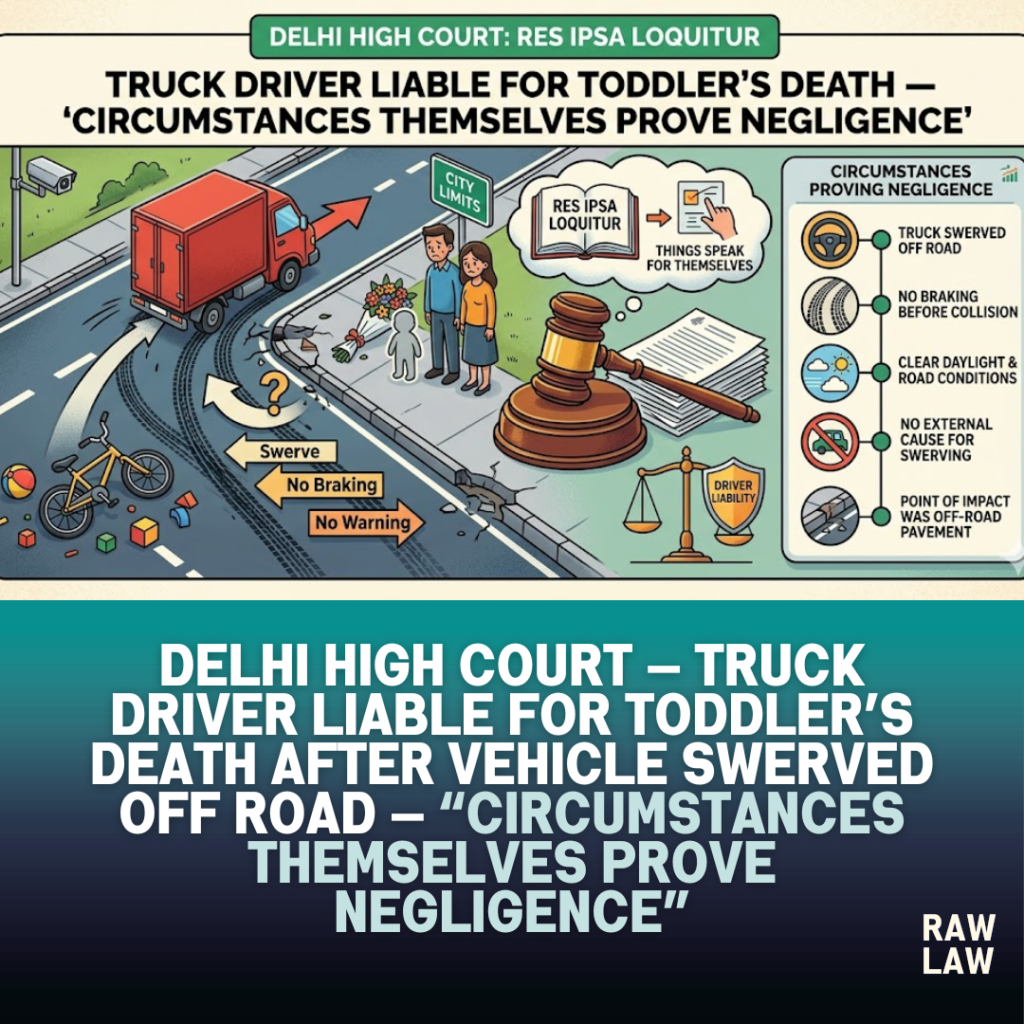
The Court further relied on the site plan, which showed that the truck had left the main road and moved into the roadside area where the child was sitting.
The road was about 10 feet wide with a five-foot empty space on each side, and the truck had moved into this roadside space before striking the child.
The Court observed that this deviation from the main road clearly indicated negligence.
Applying the doctrine of res ipsa loquitur, the Court held that the circumstances themselves demonstrated that the accident would not have occurred without negligent driving.
Conclusion
The Delhi High Court concluded that the trial court had erred in ignoring key evidence and admissions made by the accused.
The prosecution had successfully proved that the accused’s negligent driving caused the death of the child.
Accordingly, the Court set aside the acquittal and convicted the accused under Sections 279 and 304A IPC, listing the matter for sentencing.
Implications
The ruling reinforces the principle that negligence in road accident cases can be inferred from the surrounding circumstances and physical evidence, even where direct proof of reckless driving may be limited.
The judgment also highlights that appellate courts can overturn acquittals when trial courts ignore material evidence or misinterpret the record.
For criminal law practice, the decision underscores the continued relevance of the doctrine of res ipsa loquitur in establishing negligence in road accident prosecutions.
Case Law References
- Ravi Kapur v. State of Rajasthan (2012)
Held that offences under Section 279 IPC require proof of rash or negligent driving endangering human life. - Braham Dass v. State of Himachal Pradesh (2009)
Clarified that rashness or negligence must be established through evidence and circumstances.
FAQs
1. What must be proved to convict someone under Sections 279 and 304A IPC?
The prosecution must prove that the accused was driving the vehicle rashly or negligently and that such conduct directly caused the death.
2. Can negligence be inferred from circumstances in road accident cases?
Yes. Courts may apply the doctrine of res ipsa loquitur, meaning the circumstances of the accident themselves indicate negligence.
3. Can a High Court overturn an acquittal in a criminal case?
Yes. A High Court can set aside an acquittal if the trial court has ignored crucial evidence or misapplied legal principles.