


Court’s decision
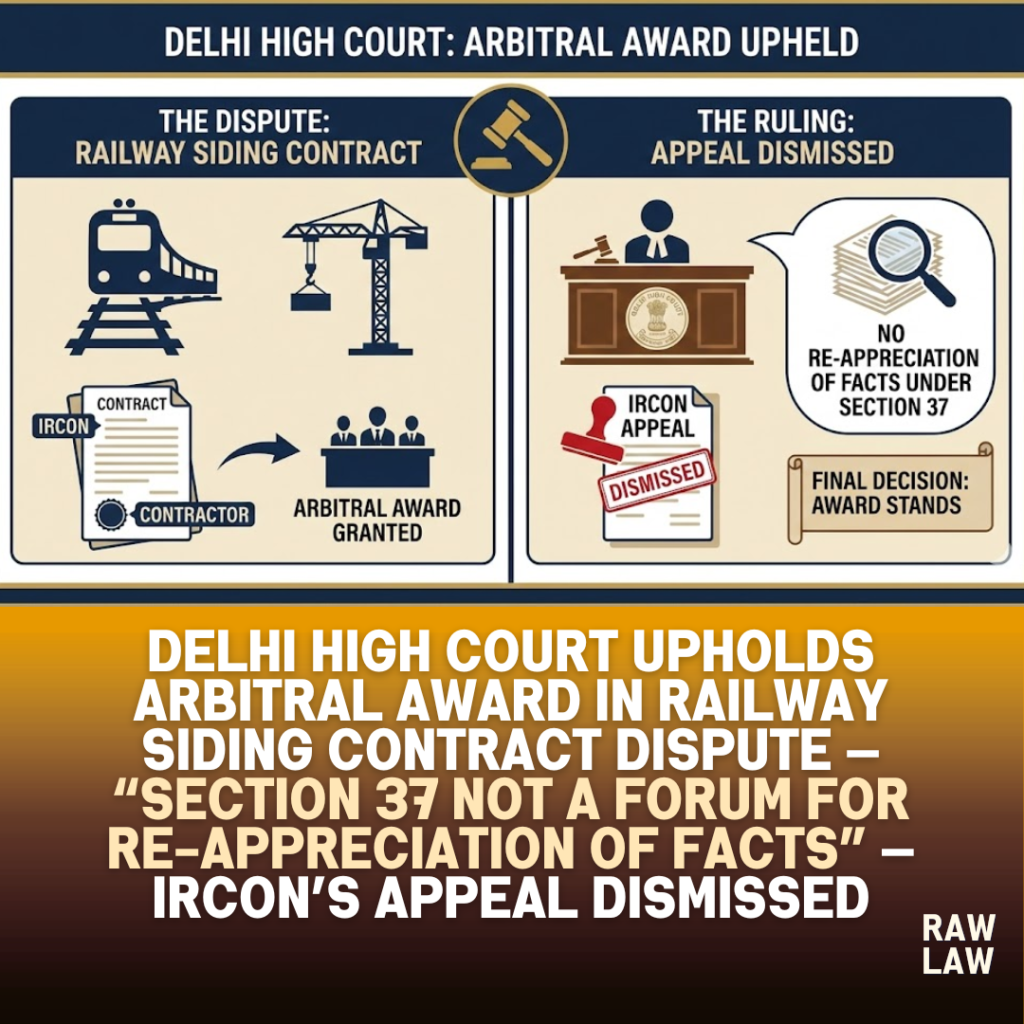
The Delhi High Court dismissed an intra-court appeal under Section 37 of the Arbitration and Conciliation Act, affirming a Single Judge’s refusal to interfere with an arbitral award in a construction contract dispute involving IRCON International Limited. The Division Bench held that findings on hard rock excavation, tie bolts in RCC shuttering, future interest, and costs were pure findings of fact and contractual interpretation, not open to re-appreciation in appellate jurisdiction. The Court reiterated that Section 37 review is “virtually supervisory” and cannot convert into a merits appeal. Finding no patent illegality or perversity, the appeal was dismissed.
Facts
The dispute arose from a 2014 contract for construction of service buildings, a locomotive shed, and RCC trunk drain works for a private railway siding project linked to a thermal power plant in Solapur, Maharashtra. IRCON, acting as project management consultant, awarded the work to the contractor after a competitive tender process.
During execution of Schedule B works relating to the corridor drain, the contractor encountered material it classified as “hard rock.” The contractor contended that excavation in hard rock was not covered by the Bill of Quantities and sought payment at higher rates under CPWD Specifications. Contemporaneous site records, including Field Book entries and site inspections, recorded the material as hard rock.
Disputes also arose regarding separate payment for tie bolts used in RCC wall shuttering, reimbursement of enhanced statutory levies (royalty and excise duty), and withheld final bill amounts. Arbitration was invoked in 2019. The Sole Arbitrator allowed most claims except surface finishing and rejected the employer’s counter-claim.
Issues
The Division Bench examined whether:
- The Tribunal’s classification of excavation as “hard rock” was contrary to CPWD Specifications and therefore patently illegal.
- Payment for tie bolts used in RCC shuttering could be treated as an extra item.
- Clause 10 (Engineer-directed deviations) or Clause 11 (contractor-proposed extra work) governed the claims.
- Future interest could be awarded despite a contractual bar on interest.
- The award of arbitration costs was arbitrary.
The central legal question was whether the Single Judge had exceeded or failed to exercise jurisdiction under Section 34 while upholding the arbitral award.
Appellants’ arguments
IRCON argued that the Tribunal misapplied CPWD Specifications governing classification of soils. It relied on an internal committee report which stated that the material could be loosened by light blasting, asserting that under Clause 2.1(b), such material fell within “ordinary rock.” The Tribunal’s classification as hard rock was said to contradict clear contractual language.
On tie bolts, IRCON contended that the BOQ rate for shuttering was composite and included all accessories. Since no written instruction was issued by the Engineer-in-Charge under Clause 10, the contractor was not entitled to extra payment.
It was further argued that Clause 11 could not operate independently of Clause 10 and that allowing payment without prior written approval amounted to rewriting the contract. IRCON also challenged the award of future interest in view of an express bar on interest “at any stage,” and objected to full costs being granted despite partial rejection of claims.
Respondent’s arguments
The contractor submitted that the Tribunal’s findings were based on Field Book entries, site inspections, and an independent geological report identifying basaltic rock. The internal committee report itself admitted that manual excavation was not feasible, supporting classification as hard rock.
Regarding tie bolts, the contractor argued that CPWD DSR separately prescribed rates for tie bolts, which were not included in the BOQ shuttering item. It contended that Clause 11 governed contractor-initiated extra work and that timely intimation had been given.
On interest, it was argued that post-award interest flows statutorily under Section 31(7)(b) and cannot be contracted out. The award of costs, it was submitted, was within the Tribunal’s discretion under Section 31A.
Analysis of the law
The Division Bench reiterated that Section 37 jurisdiction is narrower than ordinary appellate jurisdiction. Relying on recent Supreme Court jurisprudence, it emphasised that courts cannot reappreciate evidence or substitute an alternative view merely because it appears preferable.
On contractual interpretation, the Court reaffirmed that the arbitrator is the final authority on construction of contract terms unless the interpretation is perverse or one that no reasonable person could adopt.
With respect to interest, the Court drew a distinction between pre-award interest (subject to party autonomy under Section 31(7)(a)) and post-award interest (statutory under Section 31(7)(b)). It held that contractual bars cannot defeat entitlement to post-award interest.
On costs, the Court noted that Section 31A confers broad discretion on arbitral tribunals, and interference is warranted only in cases of manifest arbitrariness.
Precedent analysis
The Bench relied on:
- Punjab State Civil Supplies Corp. Ltd. v. Sanman Rice Mills (2024) — clarifying that Section 37 review is confined to examining whether the Section 34 court acted within jurisdiction.
- Parsa Kente Collieries Ltd. v. Rajasthan Rajya Vidyut Utpadan Nigam Ltd. (2019) — contractual interpretation lies primarily within the arbitrator’s domain.
- Prakash Atlanta (JV) v. NHAI (2026) — plausible interpretation cannot be supplanted by another possible view.
- R.P. Garg v. Telecom Department (2024) — post-award interest under Section 31(7)(b) is statutory and not subject to contractual exclusion.
Applying these authorities, the Court held that the Single Judge correctly refused interference under Section 34.
Court’s reasoning
On hard rock classification, the Bench observed that the internal committee’s own report stated that manual excavation was not feasible. The Tribunal found this inconsistent with classification as ordinary rock. The Court held this interpretation to be plausible and supported by contemporaneous evidence, including Field Book entries and geological assessment.
On tie bolts, the Court accepted the Tribunal’s finding that their use was technically necessary and not covered in the BOQ item. The issue was factual and outside appellate scrutiny.
Regarding Clauses 10 and 11, the Court held that they operate in distinct fields: Clause 10 applies to Engineer-directed deviations, while Clause 11 governs contractor-proposed excess work. Since timely notice was given and the employer remained inactive while benefiting from the work, it could not later resist payment.
On interest, the Court held that post-award interest flows statutorily and cannot be barred by contract.
Conclusion
The Delhi High Court held that the arbitral award represented a reasoned and plausible interpretation of the contract and evidence. No perversity, patent illegality, or jurisdictional error was demonstrated. The appeal was dismissed, and the award stood upheld except for the limited modification already made by the Single Judge regarding pre-award interest.
Implications
This ruling reinforces the high threshold for interference under Sections 34 and 37 of the Arbitration Act. Construction disputes involving technical classification and BOQ interpretation will largely remain within the arbitral domain.
The judgment also clarifies that:
- Contractor-proposed extra work may fall under separate contractual provisions distinct from Engineer-directed deviations.
- Post-award interest under Section 31(7)(b) is mandatory unless otherwise directed in rate.
- Courts will not permit parties to benefit from inaction and later deny payment.
The decision strengthens arbitral finality in infrastructure and public works contracts.
FAQs
1. Can courts re-examine technical findings of an arbitral tribunal under Section 37?
No. Section 37 review is limited. Courts cannot reappreciate evidence or substitute their interpretation unless the award is patently illegal or perverse.
2. Does a contractual bar on interest prevent post-award interest?
No. While pre-award interest may be barred by agreement, post-award interest under Section 31(7)(b) of the Arbitration Act is statutory and cannot be contracted out.
3. What is the difference between Clause 10 and Clause 11 in construction contracts?
Clause 10 typically governs Engineer-directed deviations. Clause 11 addresses contractor-proposed extra or excess work and prescribes notice and rate-determination mechanisms.