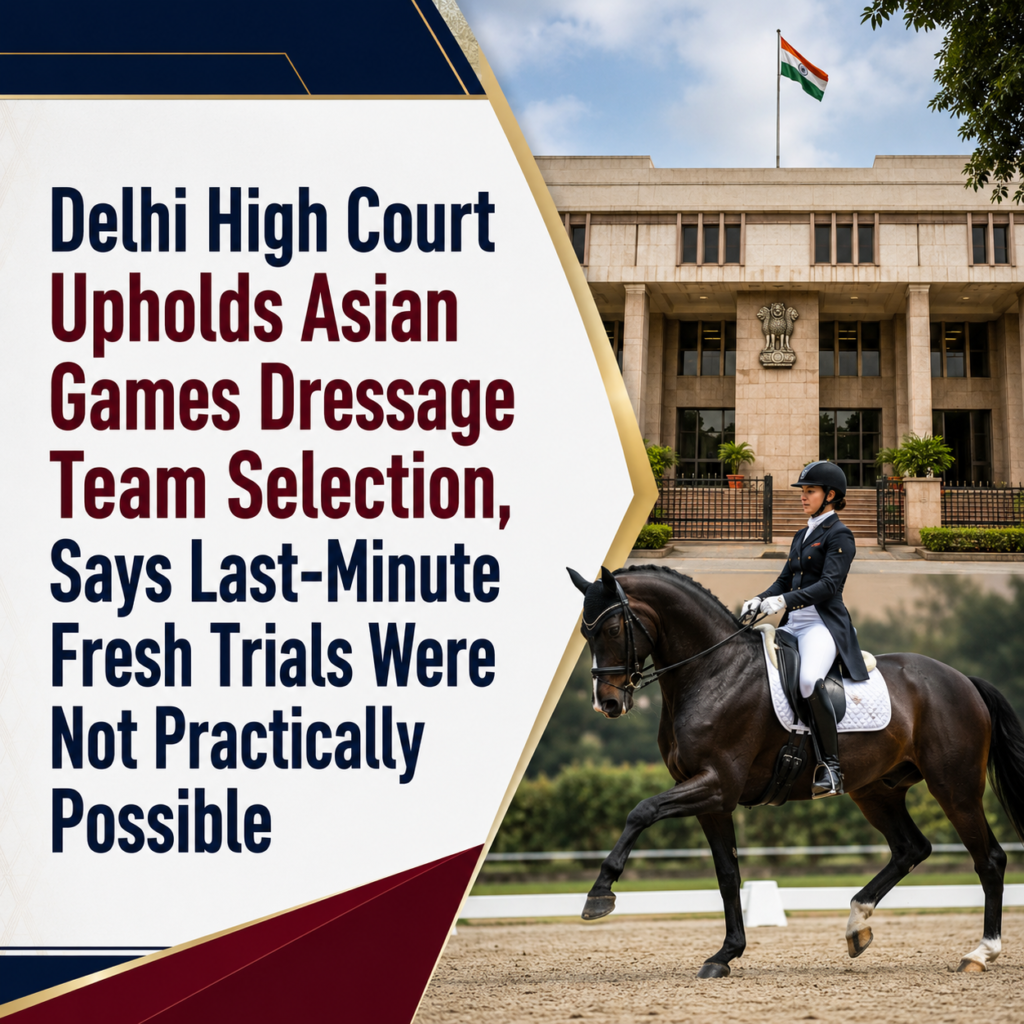
Delhi High Court Refuses to Interfere With Asian Games Dressage Team Selection Despite Finding EFI Did Not Fully Follow Final Selection Procedure
Facts
The Delhi High Court heard two Letters Patent Appeals filed by Anush Agarwalla and Sudipti Hajela against the common judgment dated 29 June 2026 passed by the Single Judge in their writ petitions.
The dispute concerned the selection of the Indian Dressage team for the 20th Asian Games, scheduled to be held in Japan from 19 September 2026 to 4 October 2026.
The Equestrian Federation of India had issued Selection Criteria Version 4.0 on 12 February 2026. The criteria required horse-rider combinations to achieve Minimum Eligibility Requirements, commonly referred to as MERs, through qualifying competitions. For Dressage, riders were evaluated on performances in Prix St. Georges, Intermediate-I, and Intermediate-I Freestyle.
On 17 April 2026, EFI issued an amendment requiring at least one MER during the peak window between 17 April 2026 and 15 June 2026. The amendment also increased the number of permissible qualifying competitions from three to four.
On 16 June 2026, EFI issued the Selection List for Dressage. Four riders were selected for participation, while Anush Agarwalla was placed as Reserve No. 1 and Sudipti Hajela as Reserve No. 2. Both challenged their exclusion from the final team. The Single Judge dismissed their writ petitions, leading to the present appeals.
Issues
- Whether EFI prepared the Selection List in accordance with the published Selection Criteria.
- Whether EFI was required to publish a provisional merit list of six probables before finalising the team.
- Whether EFI violated Clauses 15(a) and 15(b) of the Selection Criteria by not conducting further competitions during the training period before final team selection.
- Whether Anush Agarwalla and Sudipti Hajela were wrongly placed in the reserve list.
- Whether the Court should interfere with the team selection at an advanced stage before the Asian Games deadline.
Petitioner’s Arguments
Anush Agarwalla argued that EFI failed to follow its own Selection Criteria and did not disclose the scoring methodology or the basis for placing him in the reserve list.
He submitted that the Selection Criteria required publication of a provisional merit list of six probables and a further review before submission of final entries. According to him, EFI directly uploaded the definitive entries without undertaking the required final selection process.
He also argued that only the Prix St. Georges score was relevant for Team MER because the Team MER required 66% in PSG and only participation in Intermediate-I and Intermediate-I Freestyle.
He further contended that his PSG score from the CDI Hagen trial should have been considered. EFI, however, refused to consider it on the ground that he had not participated in all three tests at that event.
Anush also raised concerns of conflict of interest against one member of the Selection Committee, though the Division Bench did not examine this issue because the concerned persons were not joined in their personal capacity.
Sudipti Hajela argued that she had achieved two valid Team MERs and had the second-highest cumulative Team MER score among the relevant riders. She submitted that EFI wrongly adopted a methodology after the trials were over and that the process was opaque and non-transparent.
She argued that EFI did not publish the constitution of the Selection Committee, the minutes, score sheets, calculations, or a reasoned decision dealing with her objections.
Respondent’s Arguments
EFI argued that Individual MERs are superior to Team MERs. Therefore, riders with Individual MERs were rightly placed above riders who had only Team MERs.
EFI submitted that the selected riders placed at Rank Nos. 1 to 3 had Individual MERs, while Anush Agarwalla, Sudipti Hajela and Hriday Chheda had Team MERs. Among those with Team MERs, relative merit was determined by aggregate scores across all three tests.
The judgment reproduced a table showing the ranks, horses, MER status and scores considered. The table showed Hriday Chheda ranked fourth with two Team MERs, Anush Agarwalla ranked fifth with two Team MERs, and Sudipti Hajela ranked sixth with two Team MERs.
EFI further argued that a rider could not pick and choose scores from different competitions to create an MER. Since CDI Hagen had all three tests and Anush did not participate in all of them due to his horse’s injury, his score from that competition could not be considered as a valid MER.
The Selection Committee submitted that further competitions were not feasible due to financial constraints, the short timeline, visa requirements, and the need to rest and prepare horses before the Asian Games.
The Ministry of Youth Affairs and Sports submitted that it did not have the technical expertise to decide sporting merit and that selection was primarily the responsibility of the National Sports Federation.
Analysis of the Law
The Court reiterated that courts do not normally sit in appeal over decisions of sports selection committees.
Selection of athletes for international sporting events is generally best left to experts, and judicial interference is justified only where the decision is arbitrary, irrational, perverse, contrary to law, or in violation of the published selection criteria.
At the same time, the Court held that once a sports body frames and publishes selection criteria, it must follow them. The selection body cannot disregard mandatory requirements merely because it believes another process would be more convenient or practical.
The Court therefore examined whether EFI had complied with the Selection Criteria, particularly Clauses 8(f), 13, 15(a), and 15(b).
Precedent Analysis
The judgment primarily turned on interpretation of the Selection Criteria rather than an elaborate discussion of external precedents.
The Court applied the settled principle of limited judicial review in sports selection matters. It recognized that courts should not substitute their own assessment of athletic merit for that of expert bodies.
However, the Court also applied the principle that expert bodies must act within the framework of their own published rules. If the selection process departs from the declared criteria, such departure may invite judicial scrutiny.
Court’s Reasoning
The Court held that the challenge based on bias and conflict of interest need not be examined because the persons against whom allegations were made were not joined as respondents in their individual capacity.
On the merits of the Selection List, the Court accepted that riders with Individual MERs were rightly placed above those with only Team MERs.
The Court also rejected Anush Agarwalla’s argument that only PSG scores should determine Team selection. It held that all three tests had to be considered for determining MER and merit.
The Court agreed with EFI that Anush could not rely on his CDI Hagen PSG score because he did not participate in all three tests at that event. Since CDI Hagen had all three tests available, and Anush did not complete them due to injury near his horse’s mouth, that event was rightly excluded.
The Court also rejected Sudipti Hajela’s argument that she should have been placed above Hriday Chheda. Since both had Team MERs, their relative merit had to be determined by aggregate scores across all three tests. On that basis, Hriday Chheda was rightly ranked above both appellants.
However, the Court found fault with EFI’s process after preparation of the probable list. It held that EFI did not comply with Clause 8(f), as no provisional merit list of six probables was published.
The Court further held that EFI failed to comply with Clauses 15(a) and 15(b), which required the selected combinations to be treated as probables and contemplated a further review and competitions during the training period before final team selection.
The Court observed that EFI acted with undue haste by uploading the definitive entries on 19 June 2026, even though time was available until 1 July 2026.
Despite this non-compliance, the Court declined to set aside the selection because the deadline of 15 July 2026 was very close, the riders and horses were located across the world, and conducting a fresh competition was logistically impracticable.
Conclusion
The Delhi High Court held that EFI had correctly prepared the merit ranking under Clause 13 of the Selection Criteria and that the appellants were not wrongly placed below the selected riders on merit.
However, the Court also held that EFI did not duly comply with Clauses 15(a) and 15(b) of the Selection Criteria, since it failed to conduct the final-stage process contemplated for probables before finalising the team.
Even so, the Court refused to interfere with the Single Judge’s judgment or disturb the Selection List because of the limited time left before the Asian Games deadline and the logistical impossibility of conducting fresh competitions.
The appeals were disposed of without interfering with the selection, but EFI was directed to strictly comply with its Selection Criteria in future.
Case Details
Case: Anush Agarwalla v. Ad-Hoc Committee for Governance of Equestrian Federation of India and Ors.; Sudipti Hajela v. Equestrian Federation of India and Ors.
Court: Delhi High Court
Case Number: LPA 458/2026 and LPA 459/2026
Judge: Chief Justice Devendra Kumar Upadhyaya and Justice Tejas Karia
Date: 6 July 2026
Result: Appeals disposed of; no interference with team selection; EFI directed to strictly follow Selection Criteria henceforth.