

Court’s decision
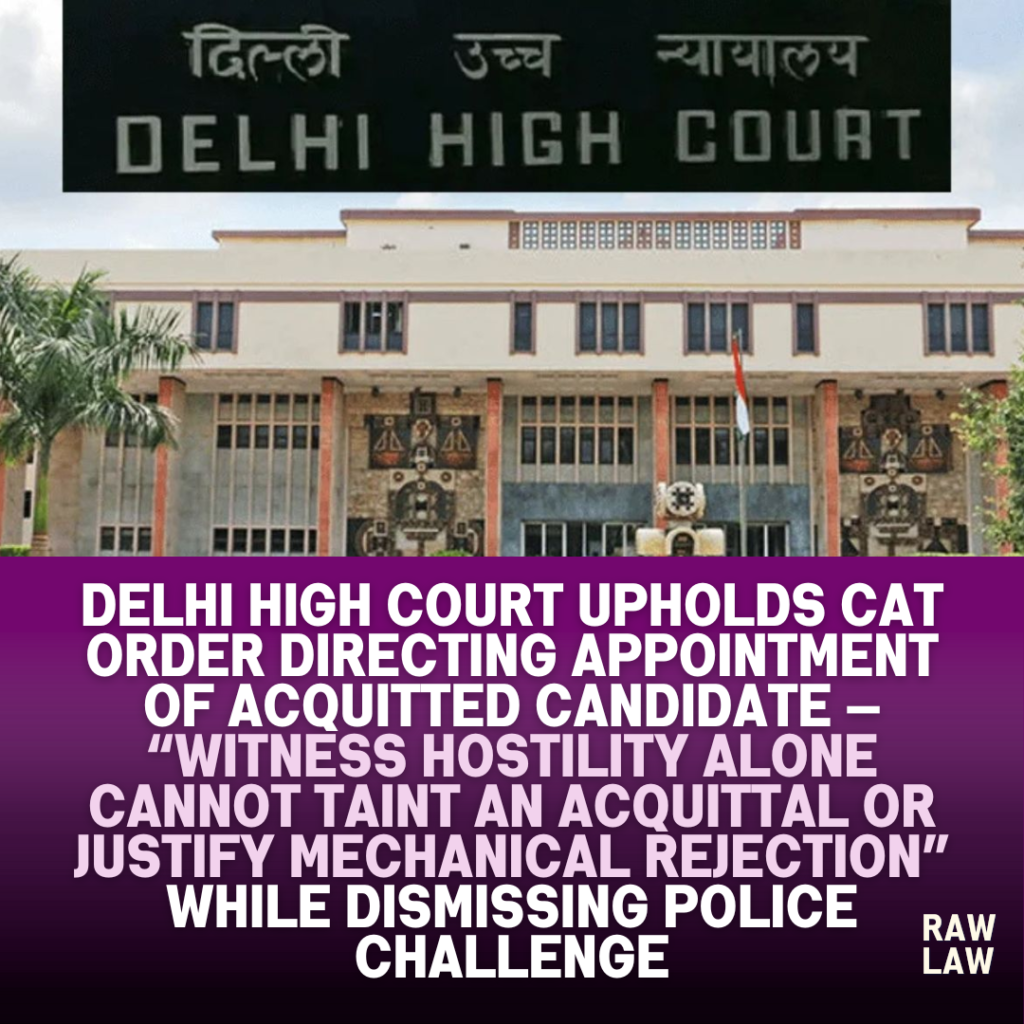
The Delhi High Court dismissed a writ petition filed by the Commissioner of Police challenging an order of the Central Administrative Tribunal that directed appointment of a candidate as Constable (Executive) despite his past involvement in a criminal case. The Court held that where a criminal court records that there is “not an iota of evidence” against the accused, the acquittal must be treated as clean, and the employer cannot mechanically brand it as “not honourable” merely because prosecution witnesses turned hostile. Upholding the Tribunal’s directions, the Court ordered appointment with notional benefits but without back wages .
Facts
The dispute arose out of a recruitment process initiated in September 2016 for the post of Constable (Executive) in the Delhi Police. The respondent candidate, belonging to the Other Backward Classes category, successfully cleared the physical and written examinations.
During the recruitment process, an FIR registered in October 2016 in Faridabad came to light, alleging offences relating to rioting, criminal trespass, hurt, and criminal intimidation arising out of a roadside altercation. The respondent was arrested during investigation, later released on bail, and ultimately faced trial along with other accused.
By a judgment dated March 2018, the Judicial Magistrate First Class, Faridabad acquitted the respondent and co-accused. The trial court recorded that the complainant and prosecution witnesses did not support the case and that there was “not an iota of evidence” to prove the charges. Importantly, while submitting his attestation form in February 2018, the respondent fully disclosed his involvement in the FIR and its outcome.
Despite disclosure and acquittal, the Delhi Police issued a show cause notice and referred the matter to a Screening Committee under Standing Order No. 398/2018. Treating the case as involving a “heinous offence” and terming the acquittal as not honourable because witnesses had turned hostile, the Committee recommended cancellation of candidature. Acting on this recommendation, the respondent’s candidature was cancelled in December 2018.
Aggrieved, the respondent approached the Central Administrative Tribunal, which allowed his application and directed his appointment with notional benefits. The Commissioner of Police challenged this order before the High Court .
Issues
The central issue before the High Court was whether the Delhi Police could lawfully cancel the candidature of a candidate for police service despite a clean acquittal, solely on the ground that prosecution witnesses had turned hostile. The Court also examined whether the Screening Committee’s assessment met constitutional standards of fairness, objectivity, and proportionality, particularly when the candidate had truthfully disclosed his criminal case.
Petitioners’ arguments
The Delhi Police argued that disclosure of a criminal case does not automatically entitle a candidate to appointment. Relying on Standing Order No. 398/2018, it was submitted that all candidates with criminal antecedents must be screened for suitability. The Screening Committee, comprising senior officers, had found the respondent unsuitable due to the serious nature of the offences alleged in the FIR.
It was contended that the acquittal was not honourable because it resulted from witnesses turning hostile rather than a positive finding of innocence. The petitioners relied on Supreme Court judgments such as Avtar Singh v. Union of India, Commissioner of Police v. Mehar Singh, and Pradeep Kumar, to argue that even acquitted candidates may be denied appointment in disciplined forces if the acquittal is not clean. Emphasis was placed on the need for higher standards of integrity in police recruitment.
Respondent’s arguments
The respondent countered that the trial court’s judgment amounted to a complete exoneration. The criminal court had not merely extended benefit of doubt but had categorically held that there was no evidence whatsoever against him. According to the respondent, the police authorities had impermissibly sat in appeal over the criminal court’s findings.
It was further argued that the Screening Committee acted mechanically, without any independent assessment of the trial court’s reasoning or any adverse material regarding the respondent’s conduct. The respondent relied on Supreme Court and Delhi High Court precedents holding that mere hostility of witnesses does not automatically render an acquittal suspect, especially in the absence of any corroborative material suggesting guilt.
Analysis of the law
The High Court revisited the jurisprudence on public employment involving candidates with past criminal cases. It reiterated that while employers, especially in disciplined forces, retain discretion to assess suitability, such discretion must be exercised objectively and on relevant material. Mechanical reliance on the nature of allegations in an FIR or on formulaic labels such as “not honourable acquittal” cannot substitute reasoned decision-making.
The Court emphasised that the concept of “honourable acquittal”, though not statutorily defined, has been judicially understood to mean acquittal after full consideration of evidence where the prosecution has miserably failed to prove its case. Administrative authorities cannot downgrade such acquittals without concrete reasons.
Precedent analysis
The Court closely examined Avtar Singh v. Union of India, noting that it permits employers to consider antecedents even after disclosure and acquittal, but only where the acquittal is on technical grounds or where doubt persists regarding involvement. The Court also referred to S. Samuthiram, Joginder Singh, and several Delhi High Court Division Bench decisions, which clarify that an acquittal following total failure of prosecution evidence can legitimately be treated as honourable.
Distinguishing Mehar Singh, the Court held that it does not authorise blanket rejection of all acquittals following hostile witnesses; rather, it requires a nuanced evaluation of facts, evidence, and the criminal court’s reasoning.
Court’s reasoning
The High Court found that the Screening Committee’s conclusion was based solely on the fact that witnesses had turned hostile, without identifying any independent material casting doubt on the respondent’s innocence. The Committee failed to appreciate that the trial court had itself examined whether any part of hostile testimony supported the prosecution and had found it “totally worthless”.
The Court held that hostility of witnesses, by itself, cannot be treated as adverse material unless supported by circumstances indicating compromise, coercion, or residual suspicion. In the present case, there was no such material. The respondent had no prior antecedents, had made full disclosure, and the criminal court had acquitted him after a complete collapse of the prosecution case.
Treating such an acquittal as “not honourable”, the Court observed, amounts to arbitrariness and violates Articles 14 and 16 of the Constitution. The High Court therefore agreed with the Tribunal that the cancellation of candidature was mechanical, disproportionate, and legally unsustainable .
Conclusion
Upholding the Tribunal’s order, the Delhi High Court directed the Delhi Police to appoint the respondent as Constable (Executive) with effect from the date on which other candidates from the same recruitment batch were appointed. While denying back wages for the intervening period, the Court granted all consequential benefits including notional fixation of pay, seniority, and increments. The writ petition was dismissed, and the authorities were directed to complete the exercise within eight weeks .
Implications
This judgment significantly reinforces safeguards for candidates acquitted in criminal cases seeking public employment, particularly in police and disciplined forces. It clarifies that administrative screening cannot override judicial findings through presumptions or labels, and that hostile witnesses do not automatically taint an acquittal. The ruling strengthens constitutional requirements of fairness and reasoned decision-making in recruitment processes involving antecedent verification.
Case law references
- Avtar Singh v. Union of India – Laid down guidelines on recruitment of candidates with criminal antecedents.
- Commissioner of Police v. Mehar Singh – Recognised employer’s discretion but required nuanced assessment of acquittals.
- Deputy Inspector General of Police v. S. Samuthiram – Explained the meaning of “honourable acquittal”.
- Joginder Singh v. Union Territory of Chandigarh – Held that acquittal after full failure of prosecution may be treated as honourable.
FAQs
1. Can police authorities reject a candidate despite acquittal in a criminal case?
Yes, but only if the acquittal is on technical grounds or supported by material casting doubt on the candidate’s involvement.
2. Does hostility of witnesses automatically make an acquittal “not honourable”?
No. Hostility alone is insufficient unless accompanied by circumstances suggesting guilt or compromise.
3. Is truthful disclosure of a criminal case relevant in recruitment?
Yes. Truthful disclosure weighs in favour of the candidate and prevents allegations of suppression or misrepresentation.


