


Court’s decision
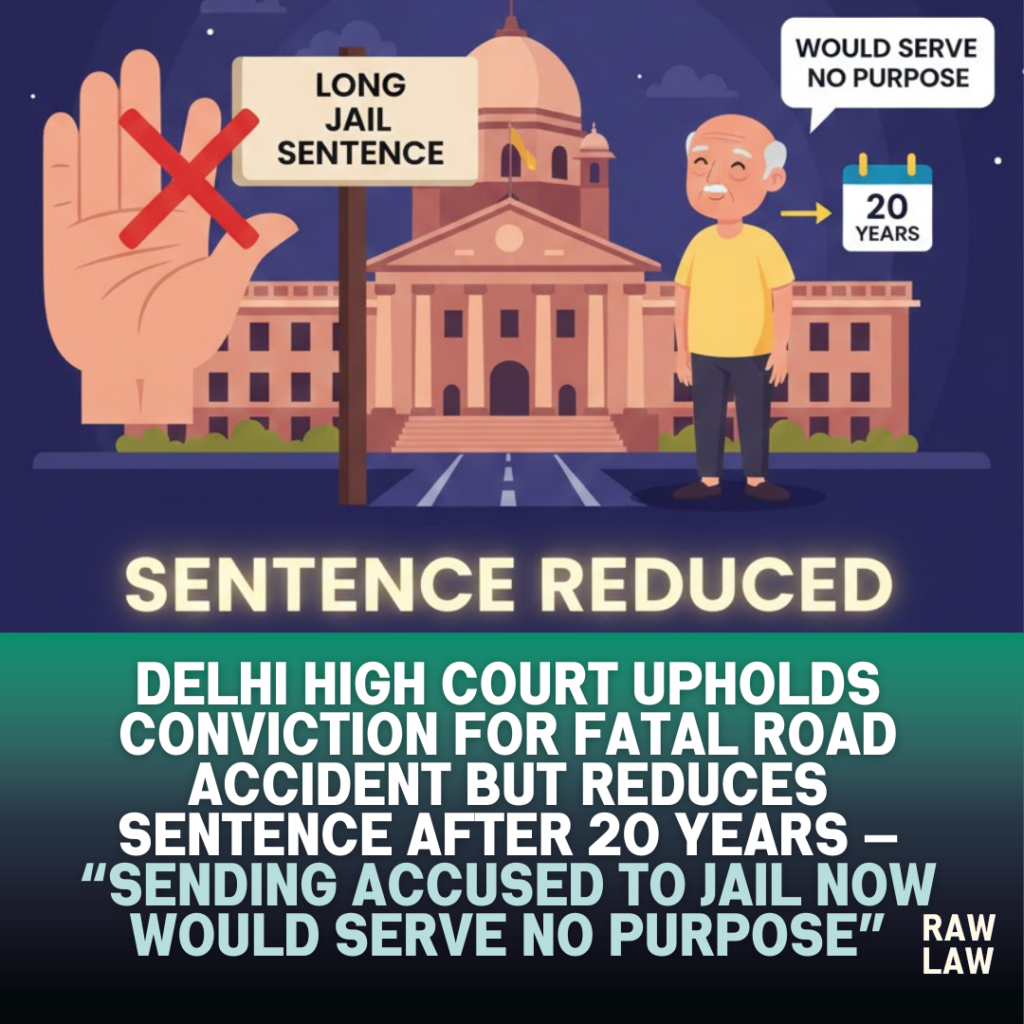
The Delhi High Court upheld the conviction of a motorcyclist for causing death by rash and negligent driving under Sections 279 and 304A of the Indian Penal Code, but significantly reduced the sentence to the period already undergone. While affirming the concurrent findings of the trial court and the appellate court on guilt, the High Court held that after more than two decades since the incident, relegating the petitioner to further imprisonment would not advance the ends of justice. The Court emphasized restraint in revisional jurisdiction and balanced deterrence with reformative sentencing principles.
Facts
The case arose from a road accident that occurred in October 2004 at Baba Khadak Singh Marg near Hanuman Mandir, Connaught Place, New Delhi. The prosecution alleged that the petitioner, while riding a motorcycle at high speed in a rash and negligent manner, struck a pedestrian who was crossing the road. The road was stated to be blocked at the relevant time due to a religious procession. The victim sustained fatal injuries and later succumbed.
An FIR was registered on the statement of a police constable who was on duty at the spot and claimed to be an eye witness to the accident. After trial, the petitioner was convicted under Sections 279 and 304A of the Indian Penal Code. He was initially sentenced to two years’ simple imprisonment for the offence of causing death by negligence, along with a lesser sentence and fine for rash driving.
Issues
The High Court was required to consider whether the concurrent findings of conviction suffered from perversity, illegality, or material irregularity warranting interference in revision. The central issues included whether rashness and negligence were established beyond reasonable doubt, whether reliance on the sole testimony of a police witness was justified, and whether the sentence imposed remained appropriate given the long passage of time since the accident.
Petitioner’s arguments
The petitioner argued that the conviction was based on conjectures and surmises rather than cogent evidence. It was contended that the prosecution failed to establish how the motorcycle was being driven rashly or negligently, emphasizing that high speed alone does not constitute criminal negligence. The credibility of the sole eye witness, a police constable, was questioned on the ground that his testimony contained improbabilities, including the claim that the motorcycle slowed down several metres away from the spot of impact. The petitioner also highlighted limited mechanical damage to the motorcycle and inconsistencies regarding traffic conditions, asserting that these factors undermined the prosecution case. In the alternative, the petitioner urged the Court to take a lenient view on sentencing due to the lapse of over twenty years.
Respondent’s arguments
The State opposed interference with the conviction, submitting that both the trial court and the appellate court had carefully appreciated the evidence on record. It was argued that the testimony of the eye witness was reliable and corroborated by surrounding circumstances, including mechanical inspection and the petitioner’s own admission of presence at the spot. The State, however, fairly conceded that considering the long delay since the incident, it would not oppose a reduction of sentence if the Court deemed it appropriate.
Analysis of the law
The Court began by reiterating the limited scope of revisional jurisdiction under the Code of Criminal Procedure. It observed that revision is a supervisory remedy aimed at correcting glaring illegality or miscarriage of justice, and not an avenue for reappreciation of evidence merely because another view is possible. The High Court stressed that concurrent findings of fact by two courts below deserve deference unless they are wholly unreasonable or perverse.
On the substantive offence under Section 304A of the Indian Penal Code, the Court noted that criminal negligence must be assessed in the context of surrounding circumstances. While speed alone may not invariably establish rashness, driving at high speed on a road blocked due to a procession, where pedestrian movement is foreseeable, was found to be indicative of culpable negligence.
Precedent analysis
The Court relied on State of Kerala v. Puttumana Illath Jathavedan Namboodiri to reiterate that revisional jurisdiction cannot be equated with appellate powers and must be exercised sparingly. It also referred to Amit Kapoor v. Ramesh Chander, which laid down that interference is justified only where findings are grossly erroneous or based on no evidence.
On sentencing, the Court drew guidance from Parkash Chandra Agnihotri v. State of Madhya Pradesh, where the Supreme Court reduced a custodial sentence to fine alone after a long lapse of time. This precedent was applied to balance punishment with fairness and reformative justice.
Court’s reasoning
Applying these principles, the High Court held that the conviction was supported by rational appreciation of evidence. The presence of the eye witness at the spot was undisputed, and there was no material to suggest false implication. The Court rejected the argument that police testimony requires independent corroboration as a rule of law, noting that credibility depends on facts, not status.
However, on sentencing, the Court took a markedly humane approach. It noted that the incident occurred in 2004, the petitioner had undergone a short period of custody, and had remained on bail for years without misuse of liberty. Given the absence of a statutory minimum sentence under Sections 279 and 304A, the Court concluded that further incarceration after two decades would be unduly harsh and purposeless.
Conclusion
The Delhi High Court upheld the petitioner’s conviction for rash and negligent driving causing death, affirming that the findings of guilt did not warrant revisional interference. At the same time, it reduced the sentence to the period already undergone while maintaining the fine imposed. The judgment reflects a careful balance between accountability for road fatalities and the reformative objectives of criminal sentencing.
Implications
This decision reinforces two important principles of criminal jurisprudence. First, it underscores judicial restraint in revision petitions against concurrent findings of fact. Second, it highlights that sentencing is not merely punitive but must account for delay, proportionality, and prospects of reform. For road accident cases under Section 304A of the Indian Penal Code, the ruling signals that while convictions will be upheld where negligence is proved, courts may adopt a compassionate approach on sentencing where extraordinary delay exists.
Case law references
- State of Kerala v. Puttumana Illath Jathavedan Namboodiri
Held: Revisional jurisdiction is supervisory and not appellate in nature.
Applied: Used to limit interference with concurrent findings. - Amit Kapoor v. Ramesh Chander
Held: Revision lies only in cases of gross illegality or perversity.
Applied: Guided the Court’s refusal to reappreciate evidence. - Parkash Chandra Agnihotri v. State of Madhya Pradesh
Held: Long lapse of time can justify reduction of custodial sentence to fine.
Applied: Basis for reducing sentence to period already undergone.
FAQs
Q1. Can the High Court reappreciate evidence in a criminal revision petition?
No. Revisional jurisdiction is limited and does not permit reappreciation of evidence unless findings are perverse or illegal.
Q2. Is high speed alone sufficient to prove rash and negligent driving?
Not always. However, high speed combined with surrounding circumstances—such as driving on a blocked road—can establish negligence.
Q3. Can sentence under Section 304A IPC be reduced after long delay?
Yes. Courts may reduce sentence considering lapse of time, absence of minimum punishment, and reformative principles.