


Court’s decision
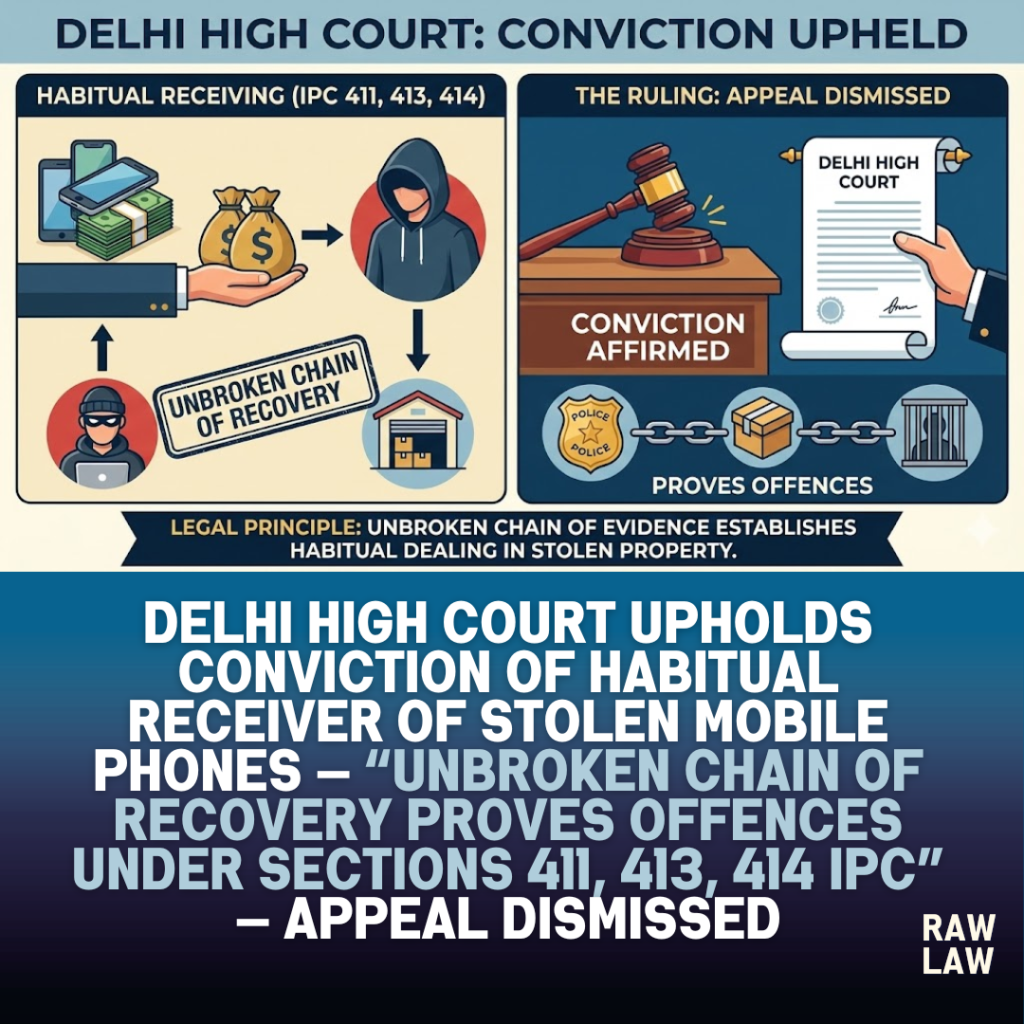
The Delhi High Court dismissed a criminal appeal filed by a man convicted for possession of stolen property and habitual dealing in stolen mobile phones. Upholding the trial court’s judgment and sentence, the Court held that the prosecution had established an unbroken chain of evidence proving recovery of eight stolen mobile phones from the appellant. The Court found no infirmity in the conviction under Sections 411, 413 and 414 of the Indian Penal Code and concluded that the appeal lacked merit.
Facts
The prosecution case originated from an e-FIR lodged on 21 January 2020 regarding theft of a Huawei Y7 Prima 2018 mobile phone while the complainant was travelling in a Delhi Metro train between Hauz Khas and INA Metro stations. The phone was placed on surveillance by the investigating officer.
The device was traced to a woman who disclosed that she had purchased it from the appellant for ₹1,000 but returned it as no bill was furnished. Acting on secret information, a raiding team apprehended the appellant on 6 December 2020 from his jhuggi in Mehrauli.
On cursory search, the stolen Huawei phone was recovered from his possession. Pursuant to his disclosure statement, seven additional mobile phones were recovered from his residence. Subsequent verification revealed that several of these phones were stolen in separate FIRs registered at different police stations.
Issues
The High Court considered:
- Whether the recovery of the stolen mobile phone was duly proved.
- Whether the testimony of the purchaser (PW-1) was reliable.
- Whether the absence of independent witnesses or CCTV footage weakened the prosecution case.
- Whether the appellant was wrongly convicted as a habitual offender under Section 413 IPC.
- Whether the conviction and sentence warranted appellate interference.
Appellant’s arguments
The appellant argued that the prosecution’s case was fabricated and that he had been falsely implicated because he was a known bad character of another police station. It was contended that the purchaser of the stolen phone gave inconsistent statements and implicated him to shield herself from prosecution.
The defence further argued that no independent witnesses were joined during recovery despite the metro being a crowded public place. It was also submitted that no CCTV footage or call detail records were produced to connect him with the theft. The disclosure statement, according to the appellant, was fabricated and planted.
He maintained that there was no credible incriminating evidence linking him to the stolen property and sought acquittal.
Respondent’s arguments
The State contended that the complainant’s testimony regarding theft was unchallenged and corroborated by documentary evidence including the purchase bill. The phone was traced through surveillance to the purchaser, who identified the appellant as the seller.
The raiding party consistently deposed about recovery of the stolen Huawei phone from the appellant’s possession and recovery of seven additional phones from his jhuggi. Malkhana entries corroborated deposit and seizure of the recovered phones.
The prosecution emphasised the appellant’s criminal antecedents, including involvement in 24 cases and conviction in nine cases, establishing habitual dealing in stolen property under Section 413 IPC.
Analysis of the law
The Court examined the ingredients of Sections 411, 413 and 414 IPC.
Section 411 IPC criminalises dishonestly receiving stolen property knowing or having reason to believe it to be stolen. Section 413 IPC punishes habitual dealing in stolen property. Section 414 IPC penalises assisting in concealment or disposal of stolen property.
The Court noted that possession of recently stolen property, coupled with lack of explanation, raises a presumption of knowledge. Recovery of the complainant’s stolen phone directly from the appellant established Section 411 IPC.
The recovery of seven additional stolen mobile phones, some linked to separate FIRs, demonstrated systematic dealing in stolen property, attracting Section 413 IPC. The act of selling phones at cheaper rates to roadside buyers supported the offence under Section 414 IPC.
Precedent analysis
While the judgment primarily rested on factual appreciation, the Court relied on settled principles governing recovery cases:
- Conviction under Section 411 IPC can be sustained if recovery is proved beyond reasonable doubt.
- Testimony of police witnesses is not to be discarded merely for lack of independent witnesses unless prejudice or contradiction is shown.
- Habitual dealing under Section 413 IPC may be inferred from repeated involvement and recovery of multiple stolen articles.
The Court distinguished mere suspicion from legally admissible recovery evidence supported by consistent testimony and documentary corroboration.
Court’s reasoning
The High Court found no material contradictions in the testimonies of the complainant, purchaser, and police officials. The complainant’s testimony regarding theft remained unchallenged in cross-examination.
The purchaser’s disclosure led the police to the appellant, forming a crucial evidentiary link. The raiding team’s testimony regarding recovery was consistent and corroborated by Malkhana register entries.
Importantly, the appellant’s previous involvement report reflected participation in 24 cases, with nine convictions. His history sheet corroborated habitual dealing in stolen property.
The Court rejected the plea of false implication, noting that he was listed as a bad character of a different police station and no motive was shown for false prosecution by the investigating agency.
The absence of independent witnesses or CCTV footage did not demolish the prosecution case when direct recovery was proved.
Conclusion
The Delhi High Court held that the prosecution successfully established the appellant’s guilt under Sections 411, 413 and 414 IPC beyond reasonable doubt. The recovery of eight stolen mobile phones, corroborated by documentary and oral evidence, formed a complete chain.
The conviction and sentence imposed by the trial court were affirmed. The appeal was dismissed.
Implications
This judgment reinforces that recovery-based convictions remain robust when supported by consistent police testimony and proper documentation. Courts will not discard recovery evidence merely for want of independent witnesses.
The ruling also underscores that habitual offenders dealing in stolen property face enhanced penal consequences under Section 413 IPC. Criminal antecedents and recovery of multiple stolen articles can substantiate habituality.
The decision sends a strong deterrent message in cases of organised mobile phone thefts and resale networks operating in public transport systems.
FAQs
1. What is Section 411 IPC?
Section 411 IPC punishes dishonestly receiving or retaining stolen property knowing or having reason to believe it to be stolen.
2. What qualifies as “habitually dealing in stolen property” under Section 413 IPC?
Repeated involvement in theft-related cases and recovery of multiple stolen items can establish habitual dealing.
3. Can conviction be based solely on police witnesses?
Yes. If police testimony is consistent and corroborated by documentary evidence, absence of independent witnesses does not automatically weaken the prosecution case.