


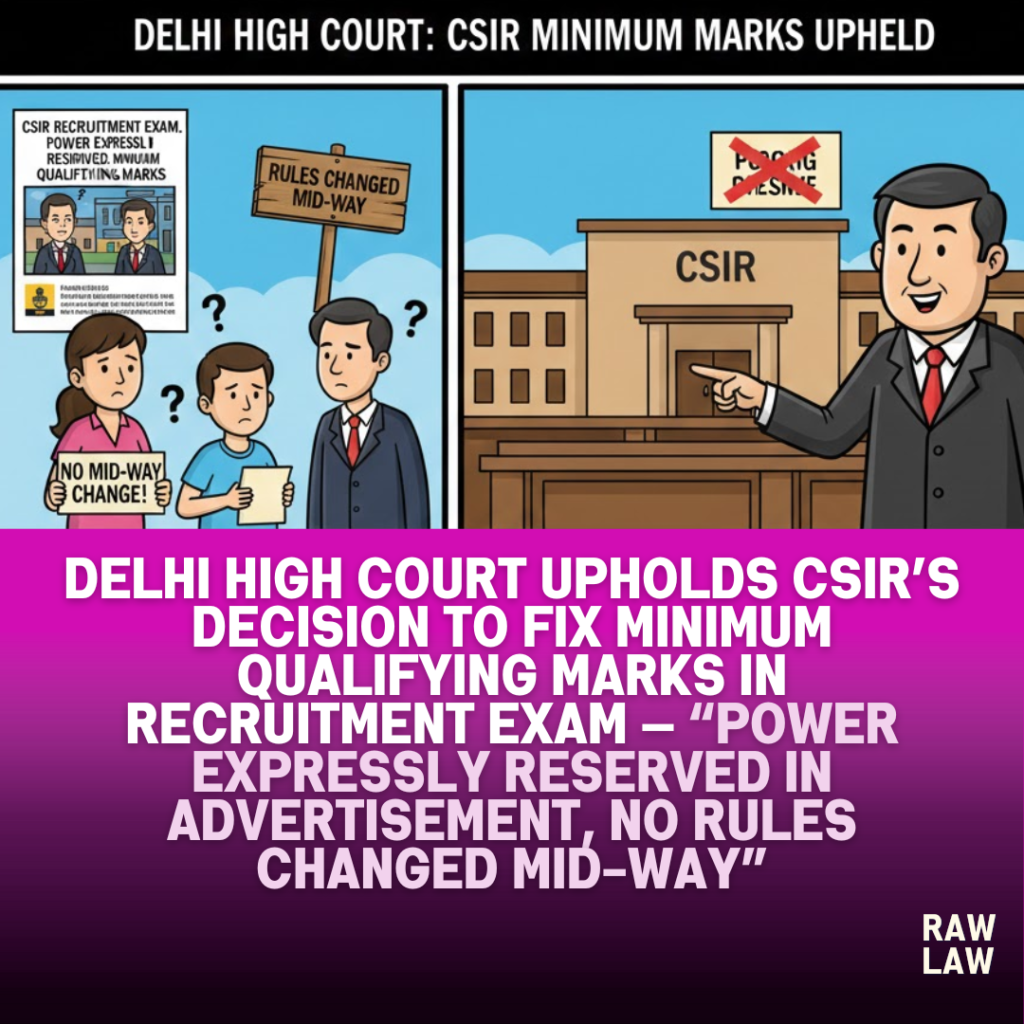
Court’s decision
The Delhi High Court dismissed a batch of writ petitions challenging the prescription of minimum qualifying marks in Paper-III of the Combined Administrative Services Examination-2023 conducted by the Council of Scientific and Industrial Research. Upholding the Central Administrative Tribunal’s order, the Court ruled that the recruitment advertisement expressly empowered the competent authority to prescribe threshold marks and that such prescription, notified before the relevant stage of examination, did not amount to changing the rules of the game mid-way.
Facts
The petitioners were candidates for the Combined Administrative Services Examination-2023 conducted to fill 444 posts, including 76 Section Officer posts and 368 Assistant Section Officer posts.
The recruitment advertisement dated 8 December 2023 outlined a two-stage examination process. Stage-I comprised Paper-I and Paper-II, while Stage-II comprised Paper-III. For Section Officer posts, the process also included an interview stage. Importantly, the advertisement stipulated that “Minimum threshold marks, wherever prescribed/required, shall be decided by the Competent Authority” and clarified that the process described was “suggestive only.”
Stage-I examinations were conducted in February 2024. Results were declared in June 2024, and candidates were shortlisted for Stage-II. On 28 June 2024, prior to the conduct of Paper-III scheduled on 7 July 2024, CSIR issued a notice prescribing minimum qualifying marks for Paper-III.
The petitioners appeared in Paper-III but failed to secure the prescribed threshold marks. They were consequently not shortlisted for interview. The final result was declared in January 2025, after which the petitioners approached the Tribunal, challenging the prescription of minimum marks. The Tribunal dismissed their applications, leading to the present writ petitions.
Issues
The principal issue before the High Court was whether CSIR had the authority under the recruitment advertisement to prescribe minimum qualifying marks for Stage-II (Paper-III).
A connected issue was whether prescribing such threshold marks after commencement of the recruitment process amounted to altering the rules of the game mid-way, thereby rendering the process arbitrary or illegal.
The Court also considered whether candidates who participated in the examination without objection could later challenge the selection criteria.
Petitioners’ arguments
The petitioners contended that the prescription of minimum qualifying marks after Stage-I had concluded amounted to changing the rules mid-way through the recruitment process.
They argued that the advertisement did not specify concrete minimum marks at the outset and that the subsequent fixation of benchmarks led to their exclusion from consideration. Reliance was placed on Supreme Court decisions including Tej Prakash Pathak v. Rajasthan High Court and Salam Samarjeet Singh v. High Court of Manipur to argue that selection criteria cannot be altered once the process has begun.
They maintained that such action was arbitrary and contrary to settled principles governing public employment.
Respondent’s arguments
CSIR contended that the recruitment advertisement explicitly reserved discretion to prescribe minimum threshold marks at appropriate stages. Clause 5-A clearly provided that such marks would be decided by the competent authority.
It was further argued that the minimum marks for Paper-III were notified on 28 June 2024, before the conduct of Stage-II on 7 July 2024. Thus, there was no element of surprise or post-evaluation alteration.
CSIR also raised a preliminary objection of non-joinder of selected candidates, contending that any challenge to the recruitment process would directly affect their rights.
Analysis of the law
The High Court reiterated that a recruitment advertisement constitutes the governing charter of a selection process. Rights of candidates and discretion of the recruiting authority must be assessed primarily with reference to its express terms.
The Court noted that the advertisement expressly reserved power to prescribe minimum threshold marks wherever required. Therefore, the contention that CSIR altered the rules mid-way was untenable.
Relying on the Five-Judge Bench decision in Tej Prakash Pathak, the Court observed that in the absence of statutory prohibition, a recruiting authority may prescribe qualifying benchmarks, provided they are notified before the relevant stage of examination and do not take candidates by surprise.
The Court distinguished Salam Samarjeet Singh, noting that in that case the criteria were altered after conclusion of the written examination, whereas in the present case the threshold was notified before Paper-III was conducted.
Precedent analysis
In Tej Prakash Pathak, the Supreme Court clarified that prescription of minimum qualifying marks prior to the conduct of the relevant stage is permissible and does not constitute alteration of rules mid-way.
The High Court applied this principle to hold that the fixation of threshold marks for Paper-III fell within the permissible domain.
The reliance on Salam Samarjeet Singh was rejected as misplaced, since that case involved post-examination modification of criteria.
The Court emphasized that what is impermissible is post-evaluation change in standards, not advance prescription of qualifying marks.
Court’s reasoning
The Court found that the advertisement unambiguously empowered CSIR to prescribe minimum threshold marks. The qualifying marks for Paper-III were notified on 28 June 2024, well before the conduct of the examination on 7 July 2024.
There was no evidence that the benchmarks were fixed after evaluation or tailored to exclude specific candidates. The prescription applied uniformly to all candidates and was justified on the basis of functional requirements of the posts.
The Court also observed that the petitioners had participated in the examination without protest and could not challenge the process after being unsuccessful.
Finding no arbitrariness or illegality, the Court upheld the Tribunal’s order.
Conclusion
The Delhi High Court dismissed the writ petitions and upheld the Tribunal’s decision. It held that CSIR acted within its authority under the recruitment advertisement and that the prescription of minimum qualifying marks did not vitiate the recruitment process.
Implications
This judgment reinforces the principle that recruitment authorities may prescribe minimum qualifying benchmarks if such power is reserved in the advertisement and exercised before the relevant stage.
It clarifies the distinction between impermissible post-evaluation changes and permissible advance prescription of standards.
For public recruitment bodies, the ruling underscores the importance of clear enabling clauses in advertisements. For candidates, it reiterates that participation without objection may preclude later challenges.
Case law references
- Tej Prakash Pathak v. Rajasthan High Court (2024 INSC 847) — Recruitment authorities may prescribe minimum benchmarks before relevant stage if advertisement permits.
- Salam Samarjeet Singh v. High Court of Manipur (2024) 14 SCC 179 — Alteration of criteria after conclusion of examination impermissible.
FAQs
1. Can recruiting bodies fix minimum qualifying marks after issuing advertisement?
Yes, if the advertisement expressly reserves such power and the marks are notified before the relevant stage of examination.
2. Does prescribing minimum marks amount to changing rules mid-way?
Not if the authority had reserved discretion in the advertisement and notified the benchmarks before conducting the concerned paper.
3. Can candidates challenge recruitment criteria after participating in the exam?
Generally, candidates who participate without protest and take a chance cannot later challenge the criteria after being unsuccessful.