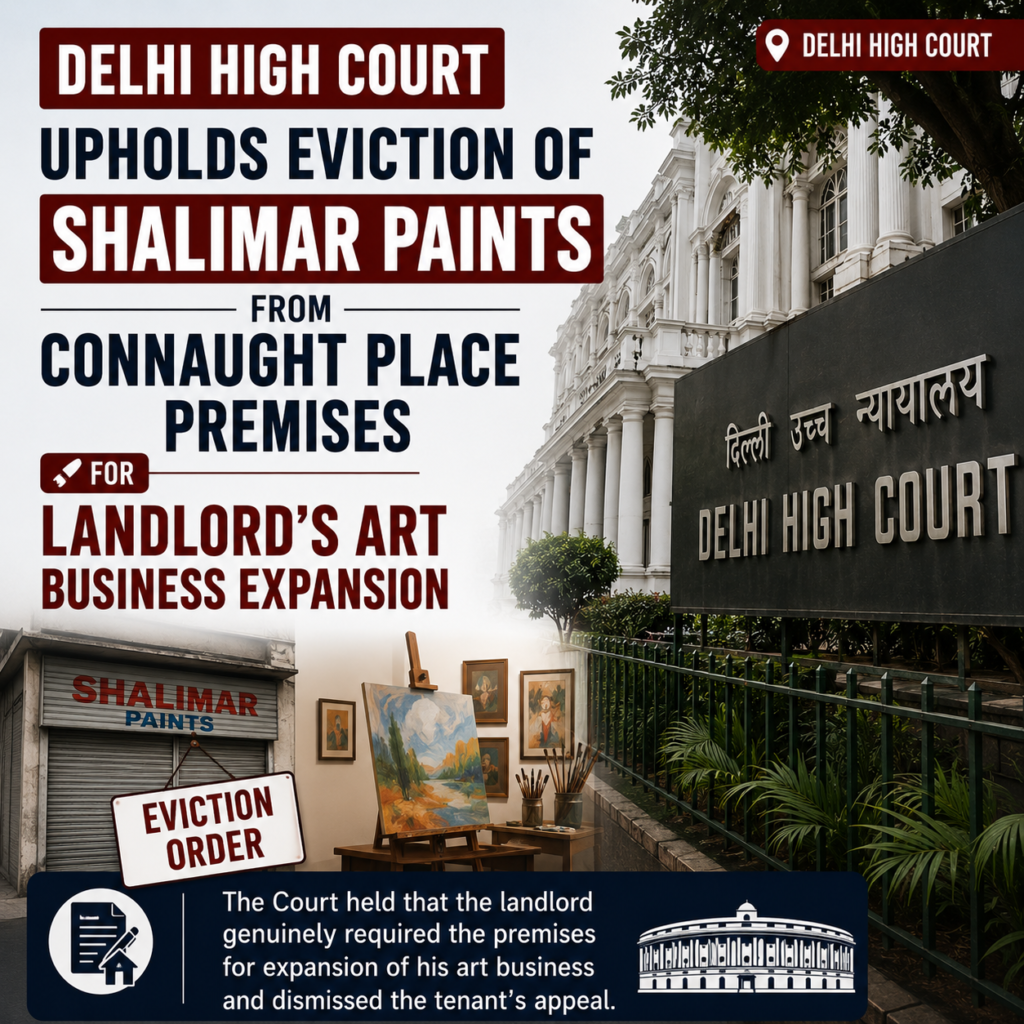
Delhi High Court Upholds Eviction of Tenant from Connaught Place Premises, Says Landlord Can Choose Suitable Space for Expanding Existing Business
Facts
The petitioners, Shalimar Paints Ltd. and another, filed a revision petition under Section 25B(8) of the Delhi Rent Control Act, 1958, challenging the order dated 6 November 2025 passed by the learned Rent Controller.
By the impugned order, the learned Rent Controller had dismissed the petitioners’ application for leave to defend and passed an eviction order in favour of the respondent-landlord, M/s Phelps and Company Pvt. Ltd., in respect of property No. 9-A, First Floor, Inner Circle, Connaught Place, New Delhi.
The respondent-landlord had sought eviction under Section 14(1)(e) of the Delhi Rent Control Act on the ground of bona fide requirement. It stated that it was a family-run private company and required the tenanted premises for expansion of its art business wing operating under the trademark “The Biv”. The business involved curating, managing and running art galleries, exhibitions, paintings, artifacts, decorative arts and allied activities.
The respondent claimed that the first-floor tenanted premises, accessible from Connaught Place’s Inner Circle, was better suited for display, storage, meetings with buyers and artists, and expansion of the art business. It also stated that one director already had a single-room office adjacent to the tenanted premises and that the respondent intended to remove the shared wall to create a larger display and office area.
Issues
- Whether the petitioners had raised triable issues requiring grant of leave to defend.
- Whether the respondent-landlord’s requirement for expanding its art business wing was bona fide.
- Whether availability of space on the third floor and terrace of the same building defeated the landlord’s claim of bona fide requirement.
- Whether alleged inconsistencies in challans/invoices relating to art items created a triable issue.
- Whether a company could maintain an eviction petition under Section 14(1)(e) of the Delhi Rent Control Act or whether it was confined to Section 22.
- Whether the High Court could interfere with the Rent Controller’s order in revision under Section 25B(8).
Petitioner’s Arguments
The petitioners argued that the learned Rent Controller failed to appreciate that substantial triable issues had been raised in the leave to defend application.
They contended that the respondent already had approximately 7,500 sq. ft. of commercial space on the third floor and terrace of the same building. According to the petitioners, the respondent’s own website for “The Biv” showed that it had a reception area, library, workspace, cabin space, board room and terrace garden, which were sufficient for running the alleged art business.
The petitioners argued that the respondent had concealed material facts regarding available alternate accommodation and had filed the eviction petition only to evict the tenants and re-let the premises at a higher rent.
They further submitted that the respondent had taken inconsistent stands: in the eviction petition it stated that the tenanted premises were required for the art business wing, while in the reply to leave to defend it also stated that the premises were required for offices of other directors.
The petitioners also alleged that the challans filed by the respondent were forged and fabricated because their serial numbers and dates appeared inconsistent.
It was also argued that since the respondent was a company, the maintainability of the eviction petition under Section 14(1)(e), instead of Section 22 of the Delhi Rent Control Act, raised a triable issue.
Respondent’s Arguments
The respondent-landlord argued that the bona fide requirement was genuine, existing and not imaginary. It submitted that “The Biv” was already operating as an art business wing and that exhibitions had already been conducted.
The respondent submitted that the third floor and terrace were being used for a co-working business and were not suitable for the art business expansion. It stated that those areas were accessible from Connaught Place’s Middle Circle, whereas the tenanted premises had access from the Inner Circle, which offered better visibility, footfall and commercial suitability.
The respondent further argued that the tenant could not dictate how the landlord should use its property or insist that the landlord should shut down one business to accommodate another.
Regarding the challans, the respondent submitted that they related to art items purchased around the same period and that minor differences in serial numbers or dates did not create any triable issue.
On maintainability, the respondent relied on the legal position that a company or body corporate is not barred from invoking Section 14(1)(e) where the requirement is otherwise bona fide.
Analysis of the Law
The Court considered the legal framework under Section 14(1)(e) of the Delhi Rent Control Act, which permits eviction where the landlord requires the premises bona fide and has no other reasonably suitable accommodation.
The Court also considered the scope of leave to defend under Section 25B, where a tenant must disclose facts which, if proved, would disentitle the landlord from obtaining eviction. However, the Court reiterated that leave to defend cannot be granted merely on vague, bald or moonshine pleas.
On the issue of alternate accommodation, the Court held that the relevant question is not merely whether some space exists with the landlord, but whether that space is reasonably suitable for the stated requirement.
The Court accepted that the tenanted premises were commercially more suitable because they were on the first floor and accessible from Connaught Place’s Inner Circle, whereas the third floor and terrace were being used for another business and had access from the Middle Circle.
The Court also held that a tenant cannot compel the landlord to close an existing co-working business and use that space for the art business, merely so that the tenant may continue occupying the tenanted premises.
Precedent Analysis
The petitioners relied on Santosh Devi Soni v. Chand Kiran, Charan Dass Duggal v. Brahma Nand, and Inderjeet Kaur v. Nirpal Singh to argue that leave to defend should be granted where triable issues arise and that the tenant’s burden at that stage is light.
They also relied on Khem Chand v. Arjun Jain to argue that where the landlord seeks additional accommodation, the Court must examine the suitability of existing accommodation.
The Court distinguished these authorities on facts. It held that in the present case, the respondent’s requirement was not speculative or imaginary, because the art business was already running and documents had been filed to show exhibitions and business activity.
The Court relied on Anil Bajaj v. Vinod Ahuja for the principle that a tenant cannot dictate to the landlord how the landlord should use his property for business purposes.
The Court also relied on K.S. Bhandari v. International Security Printers Pvt. Ltd., where it was held that a company or body corporate may invoke Section 14(1)(e) and/or Section 22 of the Delhi Rent Control Act, depending on the facts.
On revisional jurisdiction, the Court relied on Sarla Ahuja v. United India Insurance Co. Ltd. and Abid-Ul-Islam v. Inder Sain Dua, holding that the High Court’s power under Section 25B(8) is limited and cannot be treated as a regular appellate jurisdiction.
Court’s Reasoning
The Court held that the respondent had fully disclosed the availability of space on the third floor and terrace and had explained why that space was not suitable for the bona fide requirement.
The Court noted that the respondent had placed material on record to show that it was running an art business wing under the trademark “The Biv” and had conducted exhibitions before filing the eviction petition.
The Court found that the third floor and terrace were being used for co-working operations and were structured as workstations and office spaces. Therefore, the petitioners’ argument that the same space should be used for art exhibitions was rejected.
The Court held that the first-floor premises accessible from the Inner Circle of Connaught Place offered greater visibility and footfall and was therefore suitable for the respondent’s art business expansion.
On the challans, the Court held that the serial number/date issue did not create a triable issue. The challans showed continuity of item numbers and related to purchases made around the same period. Even if the challans were ignored, other material showed that the respondent was running an art business wing.
On Section 22, the Court held that the argument had no merit because the Division Bench had already clarified that a company can invoke Section 14(1)(e) or Section 22, depending on the facts.
The Court finally held that the Rent Controller’s findings did not suffer from illegality, material irregularity or jurisdictional error, and therefore no interference was warranted under Section 25B(8).
Conclusion
The Delhi High Court dismissed the revision petition and upheld the eviction order passed by the learned Rent Controller.
The Court held that the respondent-landlord had established a bona fide requirement for the tenanted premises for expansion of its existing art business wing.
The petitioners-tenants were directed to vacate and hand over vacant, peaceful and physical possession of property No. 9-A, First Floor, Inner Circle, Connaught Place, New Delhi-110001 to the respondent-landlord forthwith, as the six-month period under Section 14(7) of the Delhi Rent Control Act had already expired.
Case Details
Case: Shalimar Paints Ltd. & Anr. v. M/s Phelps and Company Pvt. Ltd.
Court: Delhi High Court
Case Number: RC.REV. 76/2026 & CM APPL. 16941/2026
Judge: Justice Amit Sharma
Date: 6 July 2026
Result: Revision petition dismissed; eviction order upheld; tenants directed to vacate the premises forthwith.