


Headnote
Code of Civil Procedure, 1908 – Sections 44A, 13 – Execution of foreign decree – Reciprocating territory – United Arab Emirates – Simultaneous execution in cause country and forum country – Limitation – Maintainability – Abuse of process.
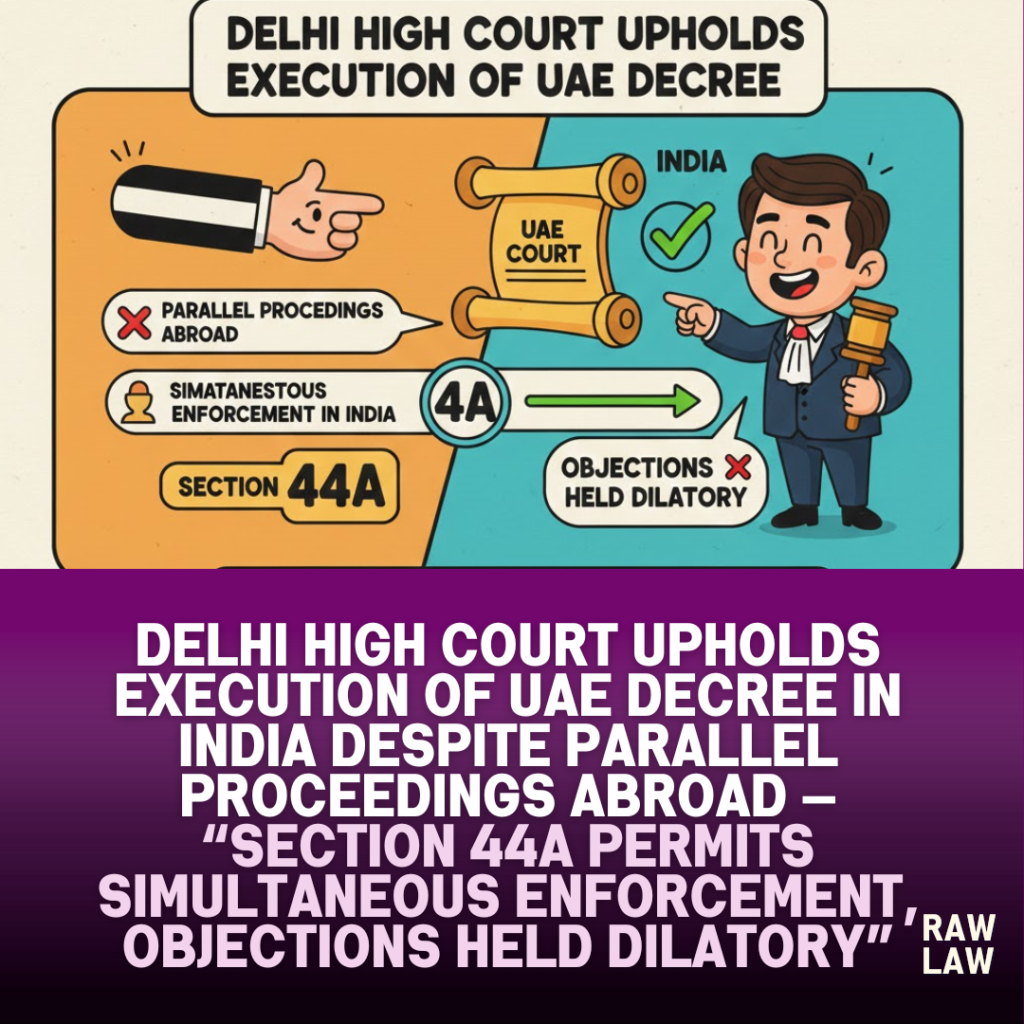
Held, a foreign decree passed by a superior court of a reciprocating territory is executable in India under Section 44A CPC even when execution proceedings are simultaneously pending in the country where the decree was passed. Section 44A does not mandate exhaustion of execution remedies in the cause country before approaching Indian courts, nor does the Supreme Court’s decision in Bank of Baroda v. Kotak Mahindra Bank prescribe a sequential bar on parallel execution; its observations are confined to limitation. The statutory fiction treating a foreign decree as a domestic decree permits concurrent execution, subject to safeguards against double recovery. Objections seeking to artificially bifurcate Section 44A inquiries or defer execution on the ground of pending foreign proceedings were held misconceived. Finding the UAE decree final, conclusive, and compliant with Section 13 CPC, and noting persistent dilatory conduct by judgment debtors, the Court dismissed the appeal and allowed execution to proceed.
Court’s decision
The Delhi High Court dismissed an Execution First Appeal challenging the maintainability of execution proceedings initiated in India for enforcement of a UAE decree. The Division Bench upheld the Single Judge’s ruling that a foreign decree from a reciprocating territory can be executed in India under Section 44A CPC even while execution is pending in the foreign jurisdiction. The Court affirmed that objections raised by the judgment debtors were without merit and that the execution petition was fully maintainable.
Facts
The dispute arose from substantial banking facilities extended by the decree holder, a foreign bank, to a corporate entity for financing crude oil and petroleum transactions. Upon default, proceedings were initiated before courts in Sharjah, United Arab Emirates. While the Sharjah Court of First Instance initially dismissed the claim, the Sharjah Court of Appeal reversed the decision and, by a decree dated October 10, 2023, directed multiple judgment debtors to jointly and severally pay over USD 118 million along with interest and costs.
The decree holder initiated execution proceedings in the UAE and, shortly thereafter, filed an execution petition before the Delhi High Court under Section 44A CPC, limiting execution in India to certain judgment debtors possessing assets within the Court’s territorial jurisdiction. A complex procedural history followed in the UAE involving attempted “corrections” to the decree, which were annulled by the UAE Court of Cassation, culminating in reaffirmation of the original decree’s validity.
The judgment debtors challenged the Indian execution proceedings, contending that execution in India was premature and barred due to pending proceedings in the UAE.
Issues
The principal issues before the Court were whether execution of a foreign decree in India is barred while execution proceedings are pending in the cause country, whether Section 44A CPC requires sequential execution, and whether the decree satisfied the tests of conclusiveness under Section 13 CPC. The Court also examined whether the judgment debtors had been denied an opportunity to raise objections on merits.
Appellants’ arguments
The judgment debtors argued that Section 44A CPC must be read in a staged manner, requiring satisfaction of sub-sections (1) and (2) as a threshold before any inquiry under sub-section (3) read with Section 13 CPC. Relying heavily on Bank of Baroda v. Kotak Mahindra Bank, they contended that execution in India could be initiated only after execution proceedings in the UAE had concluded and limitation had recommenced. It was further argued that the decree was not final due to ongoing proceedings abroad and that adverse observations on their conduct were unwarranted.
Respondents’ arguments
The decree holder countered that Section 44A CPC creates a legal fiction equating a foreign decree with a domestic decree for execution purposes, and that there is no statutory bar on simultaneous execution. It was argued that Bank of Baroda dealt only with limitation and did not prohibit parallel enforcement. The decree holder highlighted that certified copies of the decree and certificates of non-satisfaction had been duly filed, and that the judgment debtors had deliberately avoided raising substantive objections under Section 13 CPC while engaging in dilatory tactics.
Analysis of the law
The Court undertook a detailed examination of Section 44A CPC, holding that its sub-sections cannot be artificially segregated. An inquiry under Section 44A must be composite, encompassing procedural compliance and examination under Section 13 CPC. The statutory fiction “as if it had been passed by the District Court” was held to permit all procedural incidents applicable to domestic decrees, including simultaneous execution in multiple jurisdictions, subject to safeguards against double recovery.
The Court clarified that Bank of Baroda addresses limitation issues and does not impose a prohibition on parallel execution proceedings.
Precedent analysis
The Court relied on authoritative precedents including Prem Lata Agarwal v. Lakshman Prasad Gupta, Cholamandalam Investment v. CEC Ltd., and Union of India v. Atlanta Ltd., which recognise the permissibility of simultaneous execution of decrees. The decision in Bank of Baroda v. Kotak Mahindra Bank was distinguished as being confined to limitation and not maintainability.
Court’s reasoning
Applying settled principles, the Court found that the UAE decree had attained finality, that certificates of non-satisfaction complied with Section 44A(2), and that none of the exceptions under Section 13 CPC were pleaded or established. The Court also affirmed findings that the judgment debtors had engaged in obstructive conduct both in India and abroad. Emphasising principles of comity and the need to prevent frustration of decrees, the Court held that Indian execution proceedings could not be stalled.
Conclusion
The Division Bench dismissed the appeal, upheld the maintainability of the execution petition, and permitted execution to proceed in India. It reaffirmed that foreign decrees from reciprocating territories enjoy robust enforceability under Indian law.
Implications
This judgment significantly strengthens cross-border enforcement of foreign decrees in India. It clarifies that decree holders need not await the outcome of foreign execution proceedings before approaching Indian courts and that Section 44A CPC facilitates, rather than restricts, parallel enforcement. The ruling reinforces India’s commitment to comity of nations and commercial certainty.
Case-law references
- Bank of Baroda v. Kotak Mahindra Bank – Clarified to be confined to limitation, not a bar on parallel execution.
- Prem Lata Agarwal v. Lakshman Prasad Gupta – Simultaneous execution of decrees permissible.
- Cholamandalam Investment v. CEC Ltd. – No statutory bar on concurrent execution proceedings.
- Union of India v. Atlanta Ltd. – Execution against multiple judgment debtors simultaneously upheld.
FAQs
1. Can a UAE decree be executed in India while execution is pending in the UAE?
Yes. Section 44A CPC permits simultaneous execution unless expressly barred, which it is not.
2. Does Bank of Baroda v. Kotak Mahindra Bank require sequential execution?
No. The judgment addresses limitation and does not prohibit parallel execution proceedings.
3. What safeguards exist against double recovery?
Courts ensure that decretal amounts are not recovered more than once across jurisdictions.